
The Chief Technology Officer (CTO) role is no longer limited to technical infrastructure but has spread to leading strategic innovation. Traditionally, CTOs are being asked to lead digital transformation, guarantee solid application performance, and balance technology with ambitious business goals.
As the SaaS industry is set to reach $623 billion by 2025 (Statista), the need for scalable and high-performance solutions increases. To meet these demands, CTOs are increasingly adopting outsourcing as an integral strategy.
Well more than a tool for cost saving, outsourcing quicker access to highly skilled expertise that increases operational efficiency, and allows flexibility in dynamic industries. Whether working to fill knowledge gaps, accelerate development cycles, or manage integration complexities, well-planned outsourcing enables CTOs to tackle executive challenges confidently.
This blog highlights the challenges C-level executives face in the SaaS industry and how innovative CTO outsourcing strategies provide a model for lasting, effective leadership.
Who is a CTO & What are Their Major Responsibilities?

A Chief Technology Officer (CTO) is the backbone of any technology-oriented company, but not every CTO works the same. A CTO’s role varies depending on the company’s size, stage, and goals:
Traditional CTO vs. Innovation CTO vs. Fractional CTO
- Traditional CTO: This model tends to be concerned with keeping IT systems running, guaranteeing uptime, managing infrastructure, and keeping internal tech operations running. They are execution-oriented and usually found in organizations where stability is valued over innovation.
- Innovation CTO: This role emerged with the digital boom. Innovation CTOs are growth enablers, responsible for introducing emerging technologies, leading digital transformation, and innovating customer experiences through tech-driven solutions.
- Fractional CTO: Common among startups and SMEs, fractional CTOs offer high-level tech leadership on a part-time or contract basis. They help companies make critical decisions during early growth phases or transitions without the commitment of a full-time C-level hire.
- Digital CTO: A digital CTO is focused on using cloud platforms, big data, and AI to make customer-facing products and services more optimal. They blend tech strategy with business strategy and are usually seen in SaaS and Ecommerce firms.
- CTO as a Service (CaaS): Another developing trend is that CTOs provide consulting or advisory services in a package form, also known as CTO-as-a-Service. The Agile methodology benefits startups and non-tech founders by providing strategic planning, scaling the team, and MVP creation.
C-Level Challenges In Technology
Challenge 1: Bridging the Talent Gap
The talent deficiency in tech is a nagging problem for SaaS CTOs. According to a 2023 Korn Ferry report, the world will experience an 85 million-worker deficit of qualified workers by 2030, with software development jobs being among the most affected.
For CTOs, that translates to intense competition for engineers, skyrocketing pay rates, and extended hiring processes, problems that jeopardize product schedules and scalability.
Outsourcing Solution
Effective CTO outsourcing strategies, like offshore and nearshore development teams, access a larger talent base at competitive prices. Eastern Europe and Latin America, for example, provide qualified developers in time-zone alignment with North American businesses, while India remains a source of cost-efficient expertise. With outsourcing vendors, CTOs are able to easily call in experts and consider AI developers or DevOps engineers without the burden of direct hire.
Strategy
Set up specific roles for outsourced teams, bring them together with internal staff with tools such as Slack or Jira, and invest in cultural training to ensure cohesion.
🔎 Need to scale your dev team with vetted engineers? Explore our IT Staff Augmentation Handbook to see how flexible hiring models support your roadmap without long-term commitments.
Challenge 2: Keeping Up with Technological Developments
The SaaS environment is driven by innovations. AI, cloud, and low-code platforms are transforming customer expectations. CTOs have to embrace these technologies quickly, but internal teams don’t have the bandwidth or expertise to test at scale. According to a study by Exploding Topics, 77% of business leaders believe digital transformation is a driver for growth, but just 40% think they have the skills to implement it.
Outsourcing Solution
Expert vendors offer leading-edge capabilities. For instance, outsourcing AI development to a company with established machine learning expertise can speed feature deployment—such as predictive analytics for a CRM SaaS product. Likewise, cloud migration specialists can make transitions to AWS or Azure more efficient, minimizing downtime.
Strategy
Vet vendors for technical expertise and previous success in your space. Employ proof-of-concept (POC) stages to pilot capabilities prior to full engagement, so as to ensure alignment with your tech roadmap.
Challenge 3: Balancing Cost and Quality
SaaS companies operate on tight margins, with CTOs tasked to deliver high-quality solutions without breaking the bank. In-house development can lead to ballooning costs for salaries, benefits, and infrastructure, while delays erode profitability. However, low-cost outsourcing can compromise quality, risking customer churn.
Outsourcing Solution
Strategic outsourcing strikes a balance. For instance, according to a Clutch report of 2024, nearshore teams in Mexico offer 30-50% lower rates than U.S. developers.
Nearshore teams in Mexico, for instance, offer rates 30-50% lower than U.S. developers, per a 2024 Clutch report, with comparable quality due to proximity and cultural alignment. Onshore boutique firms, though pricier, provide premium expertise for niche needs like cybersecurity.
Strategy
Negotiate contracts with performance-based incentives, cap costs with fixed-price models, and monitor quality via regular code reviews and user acceptance testing (UAT).
Challenge 4: Ensuring Security and Compliance
Breaches of data cost SaaS companies an average of $4.45 million per breach, according to IBM’s 2023 report, while GDPR, CCPA, and SOC 2 compliance add complexity. CTOs need to protect customer data and satisfy regulatory requirements with minimal internal resources.
Outsourcing Solution
Security-minded outsourcing partners provide the expertise of encryption, penetration testing, and compliance audits. For instance, a vendor who is ISO 27001 certified will protect your SaaS platform against threats, and regulatory compliance is handled by legal experts.
Strategy
Prioritize vendors with good security practices—look for two-factor authentication and end-to-end encryption. Embed compliance checkpoints in project milestones to stay audit-ready.
Challenge 5: Scaling Operations with Agility
SaaS growth demands scalability—spiking user bases, new features, and global expansion. CTOs must architect systems that flex without fracturing, yet rapid scaling often strains in-house teams and budgets.
Outsourcing Solution
Flexible outsourcing models like staff augmentation or managed services, enable rapid scaling. A managed service can handle localization and support.
Strategy
Use modular outsourcing—short-term contracts for specific tasks—and integrate with cloud platforms like Kubernetes for elastic infrastructure. Test scalability with load simulations before launch.
Ethical Aspects of CTO Outsourcing
- Guarantee your outsourcing partner maintains fair labor practices and humane working environments.
- Select vendors dedicated to environmentally friendly operations and responsible resource usage.
- Confirm all data handling practices are in accordance with international privacy legislation such as GDPR, HIPAA, or CCPA.
- Prevent outsourcing partners involved in exploitative pricing, unpaid internship, or unethical subcontracting.
- Foster diversity and inclusion through collaboration with culturally sensitive, internationally respectful teams.
- Add transparency provisions to contracts to avoid hidden charges, third-party subcontracting, or IP abuse.
- Ensure outsourced AI/ML projects are not based on biased data sets, unethical surveillance, or user data abuse.
- Monitor for early warning signs of unethical behavior through periodic audits and third-party reviews.
Lessons from Failed Outsourcing Initiatives: What CTOs Can Learn?
Outsourcing is now a foundation of contemporary business practice, holding out the prospect of cost savings, access to expert talent, and efficiency in operations. For Chief Technology Officers (CTOs), outsourcing is an effective tool for speeding up development, ramping up operations, or dealing with complicated projects. But in its execution, it can also be a source of expensive delays, missed deadlines, and tainted reputations. By learning from recent case studies of failed outsourcing efforts, CTOs can extract important lessons to prevent mistakes and achieve the most success.
“For a deeper dive into outsourcing challenges, check out these 10 common mistakes businesses make while outsourcing software development.”
Below are four of the most recent examples from 2023 and 2024 with actionable takeaways.
1. Hertz vs. Accenture
Hertz selected Accenture in 2016 to develop a scalable custom platform for redesigning its website together with mobile apps for its customers. The conflict between Hertz and Accenture reached a peak of $32 million after the service provider was sued for developing a substandard product that showed poor scalability and delayed delivery without geographic adaptability.
What Went Wrong?
Misaligned expectations and communication issues damaged the project. Accenture purportedly overlooked Hertz’s scalability requirements, and there was no defined road map to meet global standards of deliverables.
Lesson for CTOs
Define precise requirements and establish robust communication channels upfront. Use detailed contracts that outline scalability, performance metrics, and milestones. Regular progress reviews can prevent scope creep and ensure alignment with business goals.
⚠️ Want to avoid critical vendor mistakes like this? Read our guide to outsourcing software development mistakes and learn how to protect your timeline, budget, and delivery success.
2. Queensland Health Payroll System (IBM)
Queensland Health Department’s IBM outsourcing of its payroll system, begun in 2007, is among the most notorious failures. It was originally funded for $6 million with a delivery in 2008, but technical problems ran costs up to $1.2 billion by project completion. The system failed to operate properly at all, with far-reaching check errors. Queensland excluded IBM from further government work in 2023, highlighting the long-lasting effect of this fiasco.
What Went Wrong?
What Went Wrong: Unrealistic timelines, poor risk assessment, and excessive reliance on IBM’s brand name instead of its tested capability resulted in catastrophe.
Lesson for CTOs
Vet vendors beyond reputation assess their technical expertise and past performance on similar projects. Build contingency plans and realistic timelines that account for testing and iteration. Secure contracts with clear accountability clauses to safeguard against vendor underperformance.
3. PatientDox’s Offshore Overreach
PatientDox, a healthcare technology startup, sought to standardize patient communication by outsourcing development to Indian, Israeli, and Chinese teams. By early 2024, the startup dissolved under the pressure of expediting growth and managing its offshore teams poorly. Its CEO confessed that decentralized management and cultural incompatibility led to slippage and a product that didn’t address market requirements.
What Went Wrong?
Excessive outsourcing in several geographies created coordination mayhem.
Lesson for CTOs
Scale outsourcing gradually and maintain strong oversight. Invest in cultural training and time-zone-compatible workflows to unify distributed teams. A single point of accountability can prevent fragmentation and keep projects on track.
4. Texas Data Center Consolidation (IBM)
In 2006, Texas contracted IBM for $863 million to consolidate 27 state agency data centers into two. By 2010, only 12% of the project was complete, causing backlogs and cost overruns. IBM repaid part of the funds, and the state switched vendors. In 2023, analysts revisited this failure, noting its relevance as hybrid cloud strategies make data consolidation projects increasingly common.
What Went Wrong?
IBM underestimated the project’s complexity, and Texas failed to monitor progress effectively. The contract lacked flexibility to adapt to emerging challenges.
Lesson for CTOs
Break complex projects into manageable phases with clear deliverables. Monitor progress with data-driven metrics and retain the flexibility to pivot vendors or strategies if needed. Understand the technical nuances of your initiative to avoid underestimating its scope.
How AI is Changing CTO Outsourcing Strategies

For CTOs, AI-powered outsourcing solutions are not just a labor solution, but a strategic, tech-first partnership. Outsourcing is no longer limited to manual coding, data entry, or testing. AI has enabled partners to offer intelligent, data-driven services such as:
- Predictive analytics
- AI-powered customer support (e.g., chatbots, virtual assistants)
- Automated QA and test scripts
- Natural Language Processing (NLP) for content automation
- AI model development and deployment
What’s Changing?
1. Automation: From Routine to Intelligent
Traditional automation handled repetitive workflows (e.g., CI/CD, infrastructure provisioning). But with intelligent automation, vendors now use machine learning and bots to:
- Detect anomalies in real time.
- Automatically scale cloud resources based on usage.
- Generate reports, track bugs, and suggest fixes.
- Reduce human error across systems and processes.
2. New Opportunities in Low-Code/No-Code Outsourcing
Thanks to platforms like Bubble, OutSystems, and Mendix, even non-technical teams can build apps. Vendors offering low-code/no-code development now enable:
- Rapid MVP creation
- Faster prototyping and iteration
- Cost-effective digital solutions without deep engineering teams
3. AI-Enhanced Communication & Project Management
AI is also improving how outsourcing relationships work. Smart tools now assist in:
- Auto-generating meeting notes and action items
- Predicting project delays based on historical patterns
- Recommending optimal team structures or timelines
- Real-time language translation for global teams
4. Balancing AI Adoption with Ethical Responsibility
With great power comes great responsibility. Outsourcing AI-related tasks means CTOs must ensure:
- Ethical data use (no unauthorized scraping or biased model training)
- Transparency in algorithm decision-making
- Compliance with AI governance frameworks (e.g., EU AI Act)
How CTOs Must Evolve Outsourcing Strategies in the Era of AI
- Select AI-first vendors: Seek out vendors who provide AI-driven services, not manual intervention.
- Reskill internal teams: Encourage collaboration between AI-savvy outsourced teams and internal staff to enable knowledge transfer.
- Create hybrid task flows: Use automation for repetitive tasks and human intelligence for strategy and innovation.
- Demand visibility: Ensure vendors use AI transparently—know what’s automated, how it’s working, and where human oversight is needed.
Rapid Checklist for Finding the Right IT Outsourcing Vendor
- Clearly outline your business goals, technical needs, and scalability requirements.
- Prioritize domain expertise, innovation, and subject matter knowledge over low-cost bids.
- Evaluate communication style, cultural compatibility, and collaboration processes early on.
- Verify security protocols, compliance certifications, and IP protection measures.
- Begin with a small pilot project to assess delivery quality and team alignment.
- Set up SLAs, KPIs, and governance frameworks to track accountability.
- Develop long-term partnerships by engaging vendors in strategic planning and ongoing improvement.
Future of Outsourcing: What CTOs Must Get Ready For
Outsourcing is no longer a back-end choice, it’s a front-end strategy at the center of innovation and scale. As the tech landscape continues to shift, so will the nature of outsourcing. For CTOs, being ahead requires not only knowledge of today’s outsourcing trends but anticipation of what’s next.
1. From Vendor Relationships to Co-Innovation Partnerships
The future of outsourcing isn’t about assigning tasks—it’s about co-creating value. Vendors will be required to play the role of strategic partners who bring ideas, enhance architecture, and influence product roadmaps.
CTO Insight: Build relationships where your partner thinks with you, not just for you. Choose collaborators who challenge assumptions and offer alternative solutions.
2. AI-First and Automation-Led Engagement Models
We’re moving toward outsourcing models where AI and automation aren’t just features as they’re built into the service delivery process itself.
Expect to see:
- Smart bots managing QA workflows
- AI-driven backlog prioritization
- Predictive maintenance in DevOps
- Real-time analytics dashboards managed by outsourced teams
Future Preparation:
- Look for vendors who are AI-native, not just AI-aware.
- Ensure your outsourcing strategy includes AI governance frameworks.
3. Decentralized Talent and Global Team Fluidity
The rise of remote-first work has enabled a borderless talent economy. In the future, outsourcing won’t be about one firm in one country—it will involve distributed micro-teams across continents, brought together through platforms and agile coordination.
CTO Strategy:
- Adopt global collaboration tools with time zone intelligence.
- Embrace asynchronous development methodologies.
- Be ready to manage talent fluidity—freelancers, gig workers, and hybrid teams.
4. Sustainability-Driven Outsourcing Decisions
Environmental, Social, and Governance (ESG) considerations are becoming key criteria in vendor selection. CTOs will be expected to work with partners who not only deliver results—but do so responsibly.
Future-Ready CTOs Will:
- Choose partners who follow sustainable cloud practices.
- Demand transparency on carbon footprint, e-waste, and green policies.
- Integrate ESG goals into vendor evaluations.
5. Cyber-Resilience and Zero Trust Outsourcing
With cyber threats becoming more sophisticated, outsourcing will increasingly rely on Zero Trust security models, where no one—internal or external—is automatically trusted.
Key trends:
- Decentralized identity management
- Continuous authentication for external teams
- Enhanced auditing and real-time threat monitoring
CTO Preparation:
- Work with vendors who integrate seamlessly with your Zero Trust architecture.
- Ensure outsourced access is monitored, limited, and revocable in real-time.
6. Verticalized Outsourcing and Specialized Expertise
Generic outsourcing firms will fade. The future lies in vertical-specific vendors and partners who deeply understand your industry, its regulations, and its end-users.
For example:
- Fintech firms will favor outsourcing partners with blockchain or RegTech knowledge.
- Healthtech companies will require HIPAA-compliant, AI-enabled solutions.
- Edtech vendors will seek experience in adaptive learning technologies.
Action Step:
CTOs should prioritize domain expertise as much as tech stack alignment when choosing future partners.
7. Outcome-Based Pricing Models
Outsourcing will shift from hourly rates to value-based pricing, where vendors are paid based on deliverables, user outcomes, or growth impact.
What Does This Mean for CTOs?
- Budget forecasting becomes more precise
- Accountability increases
- Success is measured in results, not effort
Partner with BrainX Technologies to Turn Challenges into Scalable Solutions

BrainX redefines CTO outsourcing strategies as your strategic tech partner, not just another vendor. We craft custom SaaS solutions powered by AI, secure cloud tech, and scalable applications, helping enterprise leaders and startup CTOs hit their goals.
Whether it’s accelerating product development or managing growth, our experts deliver innovation, speed, and reliability. We collaborate closely, offering professional support to tackle C-level challenges and turn your vision into measurable success with open communication every step of the way.
Recruiting the best software developers is now a daunting task for most businesses. The need for talented software engineers outnumbers the supply, and this has created stiff competition for talent. In fact, by 2030, the global deficit of tech skills will stand at more than 85 million, jeopardizing billions in foregone business revenue.
SaaS companies and software firms frequently experience lengthy hiring processes, hefty salary expectations, and talent deficiencies in their staff. These hiring hurdles can delay product roadmaps and impede growth. Amidst these challenges, staff augmentation has emerged as a strategic solution. It allows organizations to quickly bring in qualified software developers and IT professionals from external providers to extend their in-house team.
Instead of struggling for months to hire full-time employees or overburdening existing staff, companies can augment their development team with specialized talent on-demand. This blog will help you explore the role of IT staff augmentation in software development and how it helps build scalable, flexible software development teams.
What is IT Staff Augmentation in Software Development?
IT staff augmentation is an engagement model where you temporarily hire external IT specialists to extend your in-house team. Think of it as adding contract software developers, engineers, or designers from an outside provider to work under your direction on your projects – without the long-term commitment of a permanent hire. This approach gives your company immediate access to talent for a specific project or period when you need it most.How is staff augmentation different from outsourcing or freelancing?
Unlike outsourcing, where an external agency takes over an entire project and manages it independently, staff augmentation lets you retain control. The augmented specialists integrate directly into your team’s workflow and follow your processes and schedules. You access outside expertise without sacrificing control of the work. Automatically, although engaging a freelancer provides you with a stand-alone contractor for an assignment, augmented staff generally pass through an agency that screens and allocates experts committed full-time to your endeavor.
They are integrated into your staff and report to your management, being held responsible for meeting your standards and objectives. Essentially, IT staff augmentation provides the best of both worlds– the advantages of outsourcing paired with the close control of hiring in-house –and is an effective means to rapidly scale your technical capabilities.
📘 Want a deeper dive into benefits, challenges, types, and implementation? Read our full IT Staff Augmentation Handbook to build smarter, scalable dev teams.
Benefits of IT Staff Augmentation
Adopting IT staff augmentation offers several clear advantages that solve common team scaling challenges:
-
Access to Specialized Skills
You can tap into niche expertise on demand. If a project requires skills your team doesn’t have. For example, a machine learning engineer or a UX designer, staff augmentation lets you bring in that specialist quickly. You don’t have to be held back anymore by your internal talent, and even small firms can take advantage of new technology without the long process of recruiting or training.
-
Cost-Effectiveness
Staff augmentation is usually cheaper than conventional hiring or big outsourcing contracts. You only pay for the skills of the expert for as long as you require them. There’s no long-term salary commitment and no expenses for benefits, recruitment, or additional office space. In short, you get high-quality talent without the full-time price tag.
-
Scalability and Flexibility
You can scale your team up or down as needed. Bring on extra developers during a peak workload or critical deadline, then scale back when things normalize, without the hassles of hiring or layoffs. This flexibility allows you to always have the correct team size for immediate needs. It’s a perfect fit for variable workloads, allowing you to adjust in real-time when you’re ramping up to a big release or switching over to a new project.
-
Faster Hiring & Time-to-Market
IT staff augmentation significantly shortens the hiring timeline. Providers have talent ready to start, so you might onboard a skilled developer in days instead of months. By getting talent in place quickly, you can begin development sooner and deliver your product to market faster. Hitting critical deadlines and reducing time-to-market gives you a valuable competitive edge.
-
Project Control & Seamless Integration
With augmented staff, you maintain direct control over your projects. External team members work under your leadership and follow your processes, ensuring your standards are upheld. They also integrate into your existing workflows (joining stand-ups, using your tools) so that collaboration feels natural. Essentially, you gain extra team members without losing oversight or team cohesion.
When Should You Use IT Staff Augmentation?
Nearly any company can use on-demand talent, but there are certain circumstances where staff augmentation really excels. Consider applying IT staff augmentation in the following situations:
-
Tight Deadlines or Urgent Projects
When a project has a tight deadline, taking months to bring on full-time employees isn’t feasible. Augmentation allows you to bring on seasoned developers or designers quickly to fill the timeline. The extra hands help you deliver on schedule without overworking your core team.
-
Niche Expertise Needed
Occasionally, a project requires an expert skill set that your team lacks , such as a data scientist to do an AI feature or a DevOps specialist for a cloud deployment. Staff augmentation enables you to hire in the specialized skill for the project alone.
-
Scaling for Growth or Peak Demand
While undergoing spiky or fast growth during times of busy season or demand peaks, you may need to quickly ramp up development capacity. Rather than hire a permanent set of dozens, you can augment your onboarding with additional developers or testers to respond to the influx.
-
Fast-Tracking Startups
Startups often ask How does IT staff augmentation help startups? The answer: it gives new ventures immediate access to seasoned talent without the delays and costs of traditional hiring. If you need to build a product or MVP quickly, augmenting your small team with experienced developers can be a game-changer. You accelerate development while avoiding hefty long-term payroll commitments. In short, staff augmentation lets startups move faster and compete with larger companies by leveraging top talent on a flexible basis.
🚀 For startups also navigating strategic tech leadership gaps, CTO outsourcing strategies offer expert guidance without the cost of a full-time executive.
IT Staff Augmentation vs Outsourcing
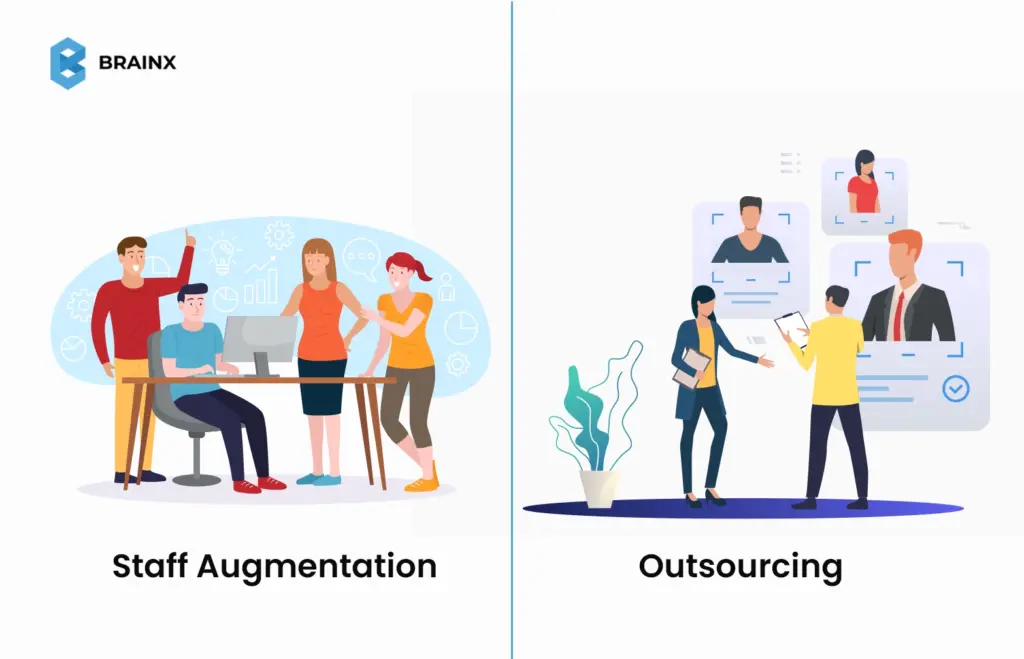
Business leaders often ask whether they should augment their team or outsource a project entirely. Both models involve bringing in external help, but there are clear differences in how work gets done. Here’s a direct comparison of IT staff augmentation vs. outsourcing:
IT staff augmentation involves augmented staff working alongside your in-house team, allowing for greater integration and collaboration. You maintain direct control over the augmented team members and their work, providing more day-to-day oversight. This model is highly flexible, enabling you to scale the team up or down quickly as needs evolve. Additionally, you only pay for the talent and hours you require, avoiding long-term salary commitments or benefits. In contrast, outsourcing involves assigning the project to an external team that operates independently from your staff. The vendor’s managers oversee the project, meaning you have less direct control. Outsourcing is generally less flexible due to contractual constraints, and any changes often require renegotiation. Costs are typically based on a fixed project fee, which includes vendor overhead and profit margins.
IT Staff Augmentation vs Full-Time Hiring
When considering staff augmentation versus hiring full-time staff, keep an eye on the kind of needs you have:
- Staff Augmentation is ideal for short-term projects or varied workloads. It provides speed and agility so you can bring talent in and release them when the project finishes. You won’t be carrying extra payroll once the work is completed.
The trade-off is that augmented staff are temporary; they might not accumulate the deep product knowledge or loyalty of a permanent team member (though you can often extend contracts or even hire top performers full-time later if they’re a great fit). - Full-Time Employees are ideal for long-term needs and core roles. A permanent team member becomes part of your company culture, gains extensive knowledge of your products, and can grow with your business. This is valuable for ongoing development and maintenance.
However, recruiting full-time staff takes time and is a significant fixed cost – you pay their salary (and benefits) even during slow periods. This investment only pays off if you have a sustained, ongoing need for their expertise.
🔍 Still evaluating both options? Check out our staff augmentation vs outsourcing comparison for a clear breakdown of pros, cons, and ideal use cases.
How to Implement IT Staff Augmentation Successfully?
Adopting staff augmentation is not just about finding talent – you also need the right processes to make it work smoothly. Here are some best practices for success:
1. Choosing the Right Staff Augmentation Partner
Start by selecting a reputable staff augmentation provider. Look for a partner with experience in projects like yours and a robust vetting process for their talent. Check client reviews or case studies, and ask to interview the proposed team members if possible.
A good provider will understand your industry and send candidates who fit both the technical requirements and your company culture. Choosing the right partner ensures you get competent professionals who can hit the ground running.
2. Onboarding and Integration
Treat augmented team members as an extension of your own team from day one. Give them access to code repositories, project documents, and communication channels, as you would for a new employee.
Get them familiar with the in-house team and define roles, responsibilities, and project objectives. Invite them to all pertinent team meetings and rituals (daily stand-ups, planning sessions, etc.). By getting them plugged into your processes and company culture, you enable them to work effectively and rapidly.
3. Managing Remote Developers Effectively
Most augmented staff are remote workers, so proactive management is essential. Have open communication channels and frequent check-ins to ensure everyone is on the same page. Utilize project management tools (e.g. Jira, Trello) and version control so work progress is open.
If there are time zone differences involved, establish some overlapping working hours or schedule a time for real-time discussions. Take advantage of video calls and chat tools for regular sync-ups. By keeping an open line of communication and outlining tasks and due dates, you can handle remote developers as well as on-site employees.
4. Ensuring Security and Compliance
When bringing in external developers on your projects, keeping sensitive data and IP safe is of top priority. Make contractors sign NDAs and spell out intellectual property ownership in your contracts.
These measures will reduce risks and keep your company’s data secure during the engagement.
- Give augmented staff access only to the systems and information necessary for their work.
- Use secure development environments and enforce your company’s security protocols (for example, requiring VPN or 2FA access where appropriate).
- If industry regulations apply (like GDPR or HIPAA), brief the augmented team on compliance requirements.
- When a contractor’s term ends, promptly revoke their access to systems and repositories.
Challenges and How to Overcome Them

Even with all its advantages, IT Staff Augmentation in software development comes with some challenges. Many discussions mention these risks, but few explain how to tackle them.
Here are common hurdles and ways to overcome them:
Integration & Cultural Fit
External team members might initially struggle to mesh with your company’s culture or work style.
To overcome this:
- Treat augmented staff like part of your team. Include them in team meetings and communications
- Consider assigning an in-house mentor to help them get oriented.
- By welcoming them and sharing your work norms early, you’ll help the external staff to blend in and work smoothly with your core team.
Communication Gaps
If your augmented developers work remotely or in different time zones, communication issues can arise.
Solve this by:
- Setting clear communication channels and regular check-ins.
- Use collaboration tools (chat apps, video calls) to keep everyone connected daily.
- If there’s a time zone difference, establish overlapping hours or a schedule for critical meetings.
- Consistent, structured communication will keep your distributed team on the same page.
Quality Control & Knowledge Transfer
Temporary team members might produce work that doesn’t initially meet your standards, and there’s a risk that knowledge leaves when they do.
Mitigate this by:
- Applying the same QA processes to augmented staff as you do internally through code reviews, testing, and feedback.
- Ensure they document their work and share knowledge with your in-house developers throughout the project.
- Before a contract ends, hold a handover session to capture any remaining know-how.
Dependency and Data Security
Relying on external people for critical work can feel risky, and you may worry about protecting sensitive data. The key is to plan and protect.
Avoid single points of failure by:
- Spreading critical tasks among multiple team members (so you’re not wholly dependent on one contractor).
- Secure your data by signing NDAs and give them access only to the systems and information necessary for their role.
- Plan for continuity and enforce strict data security measures to confidently leverage external talent without compromising your project or information.
⚠️ New to outsourcing? Here’s a breakdown of common outsourcing software development mistakes and how to avoid costly missteps during staff augmentation.
Real-World Case Studies
Here are a few examples of how companies have successfully used IT Staff Augmentation in software development:
Google’s Use of Staff Augmentation at Scale
Even tech giants rely on staff augmentation. Google hires so many freelancers that over the past several years they’ve sometimes outnumbered its full-time staff. Hiring external experts on a contract basis as needed, Google can rapidly expand groups for new ventures without the lags of normal hiring. This allows Google to accelerate development and innovate rapidly.
PayPal: Rapid Team Expansion for New Projects
PayPal has used IT staff augmentation to meet aggressive development goals. When PayPal needed to roll out new features (like updated mobile payment capabilities), it augmented its internal development team with experienced contract developers rather than trying to hire many full-timers immediately. These augmented programmers worked under PayPal’s managers and followed the company’s processes, providing a surge of productivity exactly when needed. As a result, PayPal was able to launch new products faster and handle growth spurts without overburdening its core team.
Scale Your Tech Team with BrainX Technologies

BrainX Technologies provides flexible IT Staff Augmentation in software development to help businesses overcome tech hiring challenges. We supply top-tier software developers to extend your in-house team and fill skill gaps quickly. Whether you need to build an MVP fast or require niche expertise for a critical project, BrainX delivers talent without the long recruitment process.
Our augmented staff integrates with your workflow, so you retain full control over projects. This approach helps you scale up development, meet tight deadlines, and avoid the costs of long-term hires.
Contact BrainX Technologies today to learn how our staff augmentation solutions can power your next software venture.
Outsourcing has become an integral part of businesses and leading companies are doing it to get professional services at a budgeted cost. Outsourcing software development is a convenient way to lessen the workload off of your client’s shoulders and start growing your small business. However, the success of an outsourced project lies in the client’s active participation and clear communication with the vendor. A dedicated project manager should be able to handle requirements, priorities, and tasks with real-time communication in place.
This is a cost-effective benefit, as it offers on-demand scalability and access to special skills with the development of advanced in-house systems. However, companies must be picky about outsourcing partners for more benefits and to avoid pitfalls. Are you looking forward to outsourcing software development?
Read this blog to save yourself from the common mistakes that most business owners make during the process.
Pros & Cons of Outsourcing Software Development

Outsourcing presents a set of advantages and challenges that might have a colossal sway on the running of an organization. On the positive side, outsourcing will offer your business cost savings, access to skilled manpower, and the capability to channel effort to core business activities. Outsourcing will increase efficiency and fuel innovations through the exploitation of external skill pools.
However, the potential drawbacks to outsourcing include issues related to quality, communication, and loss of direct oversight. Complex demands of businesses in this era of innovation necessitate considering the pros and cons of outsourcing before making a final decision. The table given below will help you understand these factors to make an informed decision that aligns with organizational goals.
Outsourcing offers several advantages and disadvantages that organizations must carefully evaluate. On the positive side, it provides economical labor costs and enhanced efficiency, along with flexible capacity to scale operations as needed. Companies can focus on strategic initiatives and core competencies while gaining access to specialized skills and global expertise. Outsourcing also offers faster time to market, adaptability to evolving business conditions, and reduced investment in internal infrastructure. Moreover, it allows for easy access to intellectual property and the potential for cash infusions through asset transfers to providers. However, there are notable drawbacks, including delayed project completion and insufficient domain expertise. Communication and cultural challenges, time zone discrepancies, and limited oversight can hinder collaboration. Additionally, businesses may face unavailability of key employees, which can disrupt operations and affect project delivery.
10 Mistakes Businesses Make While Outsourcing Software Development
Understanding common mistakes businesses make in outsourcing software development is crucial. It aids in achieving successful outcomes. From communication breakdowns to inadequate project planning, navigating these challenges can lead to more informed decision-making and ultimately, more effective partnerships.
Mistake #1: Setting Ambiguous Goals
Businesses outsourcing software development without clear goals often land in hot waters. Defining your expectations from the software is crucial, but learning the correct ways of doing it is more important. Not making your goals clear can result in delays and unsatisfactory performance.
Poorly defined goals and requirements would make it very difficult for any development team to understand what is expected from their end, hence leading to misaligned expectations, scope creep, and time overruns. Realistic and clear expectations, coupled with a comprehensive project scope, hold the potential to ensure the timely completion of the project and render it successful. This clarity helps to have a smooth working relationship with your outsourcing team.
Solution
This approach ensures a well-defined outsourced relationship and sets the stage for a successful project launch.
- Define your project goals using SMART criteria to guide the outsourced team toward delivering the desired results
- Evaluate your business objectives to discover outsourcing companies that coordinate your needs
- Clearly define project goals, requirements, and success metrics upfront to ensure mutual understanding and effective supervision
- Consider factors like starting from scratch or enhancing existing solutions, integration needs, target audience (internal or customer-facing), hardware utilization, existing source code, regulatory compliance, and ongoing maintenance requirements.
Mistake #2: An Improper Research
Outsourcing solves the challenge of limited local talent by accessing top global software engineers. However, firms often need more due diligence when selecting providers, needing more insight into whom to hire, expectations, and project oversight. While impressive profiles attract attention, deeper research is crucial.
You don’t need to be a software expert but understanding key markers of software quality is vital for project assessment. Reputable outsourced firms provide case studies relevant to your industry, showcasing their ability to align with your goals. Coding skills are essential, but translating vision into functional solutions requires broader business acumen, which is lacking in developers.
Not sure what to look for in a dev partner? Here’s how to choose the right software development company that aligns with your project goals and tech stack.
Solution
Follow these steps for a streamlined outsourcing process, where thorough evaluation of portfolios and client feedback guides informed decisions for successful partnerships and project launches.
- When outsourcing software development, reviewing the company’s portfolio and customer reviews provides insights into its capabilities.
- Opt for partners with a flexible model to initiate projects promptly.
- Align your search with predefined criteria—prioritize quality and time zone compatibility for effective collaboration.
Mistake #3: Undefined Roles & Responsibilities
One common mistake in outsourcing software development is neglecting to assign clear roles. While setting goals and discussing methodologies is crucial, appointing a project overseer ensures the outcome aligns with your vision.
“In many SaaS organizations, assigning or outsourcing CTO-level leadership becomes essential to ensure strategic alignment. Learn more about effective CTO outsourcing strategies that help overcome C-level tech challenges.”
Effective collaboration between you and the outsourcing team demands defined processes and delineated roles and obligations. This synchronization between customer expectations and technical execution hinges on structured communication and coordinated efforts throughout the project lifecycle.
Solution
- When outsourcing software development, it’s crucial to establish clear roles and responsibilities Establishing these roles facilitates efficient teamwork and operational excellence, providing a strategic advantage for your company in outsourced projects
- Assign a CTO, software engineer, or project manager to oversee project progress and provide timely feedback, fostering a collaborative relationship
- Business analysts from the customer and offshore development teams (ODT) must collaborate closely to manage requirements effectively
- Software and hardware engineers from the customer must work alongside the ODT to ensure product alignment
- Procurement manages product stream activities, coordinating with the ODT’s account manager to mitigate delivery risks and optimize outsourcing costs
- The outsourcing development team’s account manager should negotiate contracts and maintain client relationships, while the development team and quality assurance engineers ensure product adherence to specifications
Mistake #4: “Us vs. Them” Mindset
The most common pitfall in software outsourcing that has been identified is the “us and them” mentality. Clients view the working relationship as a hierarchical power dynamic rather than a collaborative partnership. This approach, driven by the desire for cost savings, tends to result in “thrown-over-the-wall” implementation and cost overruns.
Clients who are all about their interests and expect that outsourcing should be a cost-saving venture are inclined to have this adversarial “us against them” mindset with their service providers. It turns them into mortal enemies, diminishing the success and potentiality of a long-lasting outsourcing relationship.
Solutions
- Software engineers from both sides must work closely and feel a shared sense of ownership over the project
- Adopt a collaborative approach to work with the outsourcing partners rather than alone
- Develop a long-term partnership with mutual benefits besides transactions and costs to avoid disconnectedness
- Bargain with your program outsourcing supplier like a accomplice and not a subordinate
Mistake #5: Ineffective Communication
Slack is considered a trusted tool for communication with clients by 11% of people in 2024. Effective communication is like the glue that holds Agile projects together. Communication falters—whether due to time zone challenges or other factors—can create confusion, unclear goals, delays in project timelines, and even results that fall short of expectations. To prevent these issues, it’s crucial for both the client and the outsourced team to stay in sync through regular, open conversations.
Transparency plays a critical role here. By being transparent throughout the development journey, we can avoid misunderstandings and ensure everyone, including the product owner, understands the project’s direction. Setting up clear communication channels and staying updated with each other are fundamental steps toward achieving successful outcomes in outsourcing.
Solutions
- Use communication tools like mail and instant messaging to facilitate remote staffing
- Address teams that struggle with maintaining continuous communication
- Schedule weekly iteration calls to review completed work and plan future tasks
- Ensure transparency with clients by recording and updating every task
- Keep clients informed about project progress and be open to providing feedback at any time
Mistake #6: Uncertain Commitments
Most business owners neglect to provide a strong commitment during outsourcing software development which costs them heavily in the future. Outsourcing contracts hinge on mutual commitments. Supplier agrees to deliver specified products and services at required quality levels.
Insufficient commitment can lead to longer development times, higher defect rates, and slower release cycles. Changing an engineering team mid-project exacerbates these issues, increasing costs and delays. Businesses must maintain ongoing commitment throughout the development process to ensure successful outcomes and accommodate evolution and continuous improvement for foreseeable changes.
Solutions
- Define clear objectives, deliverables, and quality standards to ensure mutual understanding and agreement
- Authorize a CTO or project manager to administer outsourcing strategies
- Document all details and share them with the stakeholders to maintain transparency
- Include clauses in the contract for continuous improvement and adaptation to foreseeable changes
Mistake #7: Undetermined Financial Plans
Many firms underestimate the importance of budgeting for outsourced software development, assuming it will be quick and cheap. This misinterpretation regularly leads to insufficient money-related planning. While outsourcing can be cost-effective it’s not always inexpensive. Without a clear budget, businesses risk choosing low-cost teams that may lack technical expertise or effective processes.
In the long run, this can result in higher costs due to fixing mistakes and poor quality. Effective budgeting is crucial to avoid overspending and ensure the selection of a competent team, ultimately safeguarding against expensive corrections and ensuring project success.
Solutions
- Align goals according to budget and deliverables
- Evaluate vendors based on their capabilities, technical expertise, past performance, and proposals considering both cost and quality
- Discuss budget constraints or changes promptly with the outsourced company to avoid misunderstandings
Mistake #8: Neglecting Quality Testing
Neglecting early testing can lead to significant issues and inefficiencies. Many companies still make the critical mistake of involving Software Quality Assurance (SQA) teams only halfway through or at the end of a project. Waiting until the project is nearly complete to test for defects is a flawed approach that jeopardizes success, client satisfaction, and third-party collaboration.
Quality testing should start early and be integrated throughout the development process. While you don’t need to be a software expert, having a basic understanding of key quality markers is essential to ensure that the project meets standards and avoids costly fixes later on.
Solutions
- When selecting outsourcing providers, consider those who:
- Implement Agile methodologies
- Conduct pair programming and peer reviews
- Utilize robust testing frameworks
- Establish clear quality metrics and benchmarks
- Prioritize regular progress reviews and feedback loops
- To ensure project success, involve an SQA team from the outset
Mistake #9: Poor Cybersecurity & Data Security Measures
With data breaches taking an average of 118 days to detect, robust data protection strategies have become more crucial than ever in outsourcing. Prioritizing cybersecurity is essential. It helps to prevent breaches that can compromise sensitive information and damage a business’s reputation
The rising ratio of cyber attack risks has made it vital to ensure that your outsourcing partner implements stringent security measures such as HIPAA and GDPR compliances to protect data. Verifying third-party providers adhere to these standards helps avoid penalties. It also safeguards your organization’s reputation
Solutions
- Enforce strict access controls and secure data exchanges with providers
- Restrict access based on job needs to minimize data risks
- Implement multi-factor or token-based verification for all framework access
- Utilize real-time instruments to distinguish suspicious client behavior
- Regularly train offshore staff on information security best practices
- Provide offshore employees with secured, pre-approved devices for management
Mistake #10: Skipping Post-Development Support
Outsourcing introduces significant organizational changes, necessitating thorough post-outsourcing support. Neglecting post-development support can lead to poor software performance, security risks, and user frustration.
It often results in unexpected costs for fixing issues that proper planning could have prevented. Without ongoing support and maintenance, outsourced processes or services may fail to operate effectively and meet customer expectations.
Solutions
- Organizations must prioritize post-outsourcing support with clear service level agreement
- Offer continuous training and support to keep outsourced services effective
- Organizations should regularly review and improve outsourced processes and services
Trust BrainX to Help You Avoid These Mistakes!
With a focus on full-stack development services and cutting-edge technologies, BrainX demonstrates a deep understanding of software development across various domains. Our expertise in web development, mobile development, and AI services ensures clients receive top-notch solutions. These solutions are tailored to their needs BrainX team uses the latest tools and technologies, making us strategic technology partners for innovative development services. So, if you’re looking for a reliable partner for outsourcing software development needs, BrainX Technologies can take care of your projects with their specialized expertise.
Software development life cycle refers to the method of developing and delivering software. The software development life cycle (SDLC) defines various tasks crucial for creating a software application. In this article, we will disclose all about software development life cycle stages and models as well as the importance of this process.
Most advancements in the tech industry have been brought about to save time, and effort and make tasks error-free. Software development automates repetitive tasks and saves time for task completion. It removes errors, enhances efficiency, and saves investments time and money for businesses. Based on the figures, there will be a value of $1039 million growth in the software development market by 2027.
What Is A Software Development Life Cycle?

The SDLC is a systematic method to design, develop, and test high-quality software efficiently, aiming for cost-effectiveness and on-time delivery. They prepare in advance so that the chances of things going wrong during and after production are lessened even, surpassing anything we thought possible or imaginable. The development life cycle involves planning, analysis, designing, construction, testing, deployment, and maintenance. It provides a structured way to track every task, ensuring that all the steps are clearly defined from the initial workflow using an application until completion.
This enables developers to log and history each task, thus avoiding any missed or unordered mandatory phases resulting in a bug-free end product. It speeds up development and reduces costs by providing an extensive blueprint with well-defined stages, each having its process and deliverables. Ultimately, this structured way of working assists organizations in efficiently delivering great software through a pipeline—from development to testing into production. Adherence to the SDLC enables software projects to be completed quickly and efficiently at minimal risk compared to other production methods. In summary, the SDLC is a model for creating successful software solutions, ensuring an organized process, and making it efficient and productive.
History of SDLC
The rapid advances in computer science during the 1950s and 1960s led to the development of a production framework that later transformed into the software development life cycle. Before the 1950s, computing’s simplicity didn’t require a detailed approach like this life cycle. However, as programming complexity increased, structured programming emerged, necessitating more tactical development models, leading to the SDLC. Initially called the “systems development life cycle” in the 1960s, it was developed by large corporations to manage complex business systems needing extensive data processing and analysis. Over time, this framework has been adapted for hardware, software, and other complex project development.
Why is SDLC important?
Steps, activities, and deliverables in the software development life cycle (SDLC) process help in planning, estimating, and scheduling all your projects, easing tracking, and controlling projects. The SDLC increases visibility at every stage of the life cycle so that all stakeholders are informed and participate in the development. This transparency is vital to remain customer-centric and fulfill client expectations, as it guarantees that both parties fully understand the goals they are aiming for from a software perspective.
This systematic approach decreases project risks and management expenses, leading to a lower overall cost of production. Different software development life cycle stages and models provide a framework for managing changing requirements, staying on top of new technology, and fostering cross-functional collaboration. These are common struggles for product teams and this life cycle lays out a roadmap of what to deliver at each stage and when. Through the SDLC, product teams can clarify all expectations at a fundamental level among stakeholders before embarking on software development.
This agreement, combined with a systematic plan to achieve these goals, enhances the project’s overall success. The SDLC offers product teams several advantages, such as enhanced visibility into the development process, more efficient estimation, planning, and scheduling, better risk management, and more precise cost estimation. Additionally, a systematic approach to delivering software that meets customer expectations leads to higher satisfaction rates.
Also Read : Benefits and Perspectives of AI in Software Development
Models of Software Development Life Cycle
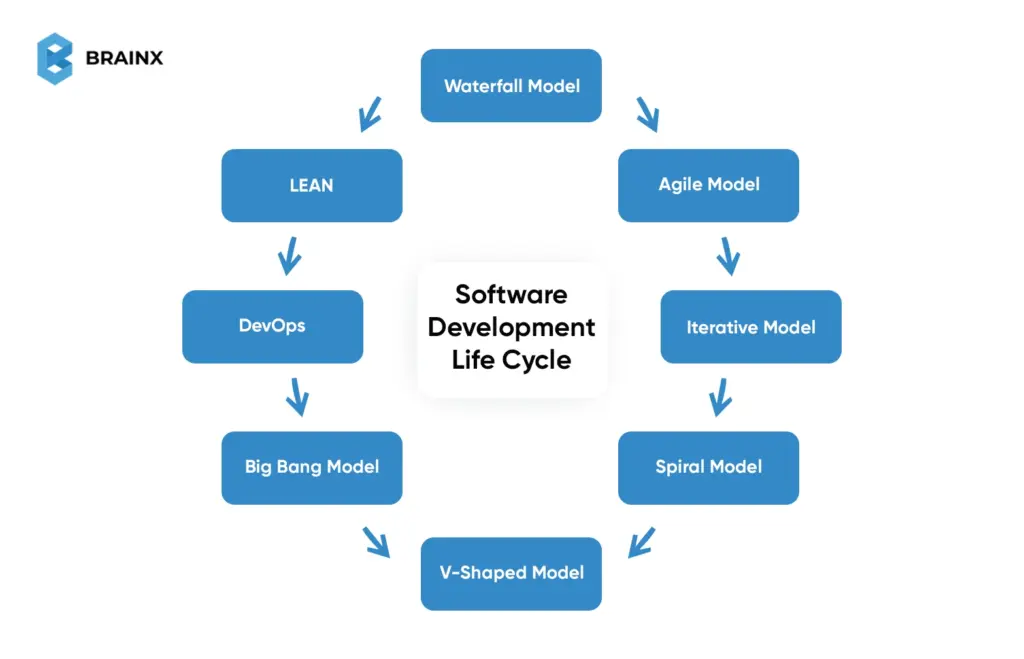
Currently, over 50 acknowledged software development life cycle models are being utilized, each with its advantages and drawbacks for different software development projects or teams. Here we have discussed 8 common software development life cycle models.
1. Waterfall Model
The Waterfall model is the oldest and most fundamental SDLC model. It is the first and basic model on which other SDLC models are based. Every phase must be executed in sequence, and it is not possible to move out of order or go back. It traces the path of a linear progression since each phase builds on data from the previous stage and follows its project plan, delivering something concrete at every step.
Its straightforward, user-friendly nature does come at the cost of it being unforgiving; meaning one early shortfall in time has ripple effects across the entire course. As there is a longer gap between stages, bugs identified after this stage will be recorded and not fixed until the end of the project.
It is inconvenient for dynamic/adaptive projects as well as long-term development. These are the constraints due to which the Waterfall model method is no longer used these days, yet found in multiple software development life cycle stages and models.
However, it remains a very good example of SDLC. Although some consider that the Waterfall model was never created with a mind to be used in a real project, it is still one of the cornerstones keeping memory about those structured SDLC methodologies. It is simple by design, but where there has been a shift in software development to more flexible models, it lacks the flexibility.
2. Agile Model
The SDLC can successfully adapt with less customization, and because the Agile model is proposed, its implementation will be much faster. Agile was born out in 2001 and is now quite literally the law for software development – it has even crept into non-tech projects. The Agile methodology resounds with the principle of fast implementations, focusing on working in short iterations at publishing small features continuously.
Every version is tested, and feedback from stakeholders is taken all the way down so that developers can find it before regression occurs. Agile is the name of various development processes with slight deviations from each other. Agile incorporates two well-known methodologies:
- Scrum
- Kanban
While Kanban is all about the visualization of dependencies and bottlenecks, the Scrum method organizes work into sprints (the most usual rhythm is 2-4 weeks) with two other events happening on a Scrum day: daily check-ins to make sure everything’s moving along fine! What is a Scrum Master doing – making sure that the team stays focused. On the other hand, Kanban takes a page from Japanese manufacturing techniques and focuses on using visual elements to show changes between your tasks.
Kanban utilizes a board where tasks progress through columns representing various stages of development, providing a real-time view that is invaluable for identifying bottlenecks. Unlike Scrum, Kanban’s pull-based task flow promotes a balanced, predictable work tempo, allowing teams to take on new tasks incrementally based on their capacity and deliver continuously. In sum, Agile being a flexible and iterative approach makes it easier to adapt quickly to the changing circumstances, leading you towards efficient project management.
3. Iterative Model
The Iterative model in software engineering can generate an almost developed, ready-to-deploy version with each cycle and progressively add new requirements to the solution until it becomes 100% finalized. Iterations work in a cycle: the project team runs multiple iterations to implement, test, and evaluate software requirements.
Every phase generates a new version, and the process ends when the complete system is developed. Early working prototypes, improved documentation, stronger control, and flexibility on changes are some of the pros of the iterative model. However subsequent cycles are very resource-intensive.
There are 4 development phases of the iterative model:
- Inception: The project concept is initiated.
- Elaboration: The project details are developed, and resources are evaluated.
- Construction: The software development takes place.
- Transition: The final product is deployed.
4. Spiral Model
Software Development Life Cycle employs the Spiral model, a technique that is undefeated in risk handling and adaptability. The Spiral is used to show a series of spirals, and each spiral means a phase in the design. It contains multi-spirals where they are based on the kind of project, so the count of spirals is very fluctuating as it is established on the project. It is, therefore, stimulated by the Iterative model; thus the Spiral employs the cycle through the subsequent four levels or phases continually: Setting, Risk Evaluation, Design, and Assessment.
This type lets the creation be used continually to be further perfected over and over till it is completed. The Spiral model is particularly well-suited for large-scale projects and is often preferred for its suitability. It allows crew members to design whatever they desire for the product the consumer desires very quickly. It is achieved by having users’ feedback throughout the method. Spiral models in risk handling, it is where the implementation will commence from the 1st period to obtain the products. Then at the start of the 1st phase of the spiral, the risk examination starts where they will accept the risks wherever they will start in the evaluation process.
5. V-Shaped Model
The V-shaped model in SDLC is a sequential process similar to the waterfall, but it tests at every stage. During each stage of this model, a specific testing phase is associated with the system which is nothing but Verification and Validation. The integration of development activities with quality assurance/testing for each phase can be done immediately after the completion of that. The phased approach means each phase moves to the next one only after completing its prior iteration, and it emphasizes verification & validation of integration throughout all steps in development.
V-Model Design
- Requirements Gathering & Analysis: This is the first phase where our business team discovers and analyzes customers’ requirements and vision for desired software, and finally defines the project scope.
- Design: During this phase, software architecture and design (both high-level and detailed designs) are created.
- Implementation: In this phase, the product is developed using design specifications.
- Testing: The software is thoroughly tested in this phase to ensure that it will work according to customer requirements and high-quality standards.
- Deployment: After being tested, the software is then deployed and run officially.
- Maintenance: It becomes necessary to maintain the software over its lifespan such that it remains in line with customer requirements and functions correctly.
6. Big Bang Model
The Big Bang model in SDLC is the informal and ad-hoc approach to software development where little planning or documentation accompanies coding, with no formal stages of design-based engineering. This means that we only start implementing what is needed at the point of time, and often without a strict roadmap.
Therefore, changes are expensive and likely require that a large part of the software be rewritten. Although not appropriate for bigger projects, the Big Bang model can be used for academic or practice projects as well as smaller projects involving one or two developers. This works especially well in scenarios where the requirements are not very clear and there is no defined release deadline.
7. DevOps
On the other hand, it is a modern concept involving SDLC influenced by Agile and Lean thinking which comes with its title to replace “Operations” representing collaborative dev (Development Team) operations across teams. DevOps is a merger of Developers and Operations more likely to be viewed as developers-as-operations or vice versa than traditional silos. It enables fast innovation, smaller and more frequent software update releases, with higher quality firmware.
Discipline, continual feedback loops, and success in configuration management have made DevOps a way of doing things that encompasses an unwavering focus on improvement stemming from automation and streamlining processes. Though selecting the right SDLC methodology is important, it should be noted that a proper procedure serves as only one part of an overall framework. There is no replacement for a great team of people working closely together to solve tough problems and deliver high-quality software.
8. LEAN
Derived from the ‘lean’ manufacturing efficacy method, Lean involves seven fundamental principles for improving software development: wastage elimination; facilitating continuous learning; delaying decisions until the last responsible moment (LRM); delivery in speed prioritization with teams being empowered autonomously and responsibly as a unit entity within integrity voids understanding of explicit wholes.
Lean teams center on those few critical tasks that will move the project forward, avoiding too much multitasking and constantly minimizing waste. This strategy includes reducing non-essential meetings and streamlining documentation activities across the software development life cycle (SDLC).
Like Lean, Agile is all about efficiency in the SDLC, but it’s a whole lot customer-centric. Agile values customer feedback over other types of inputs and deploys requirements through the process giving greater opportunities for adaptation. Lean, in contrast, is all about eliminating wasteful practices to improve the customer experience well-being and by extension increased delight.
Software Development Life Cycle Stages
1. Planning & Analysis
In the initial phase of software development, project planning sets the stage by gathering business requirements from clients or stakeholders. This step is crucial for evaluating whether the project is feasible and aligns with goals like revenue potential, production costs, and meeting end-user needs. To guide decisions on which features to prioritize and when a framework for feature prioritization proves invaluable.
This framework weighs the value of software features or updates against factors like development time, costs, and other relevant considerations. Once it’s clear the software project meets business and stakeholder objectives, is feasible to develop, and satisfies user requirements, it’s ready to advance to the next phase.
2. Define Requirements
This phase converts information from the planning and analysis stage into clear requirements for the development team. It begins with gathering and refining high-level requirements and defining key functions and processes. Essential documents, such as a software requirement specification (SRS), Use Case document, and Requirement Traceability Matrix, are created.
Requirements definition includes gathering and analyzing business, end-user, functionalities, and technical needs. It involves an “as is” assessment of current processes and a “to be” analysis for future improvements. The resulting gap analysis identifies necessary changes, impacting software, IT infrastructure, business processes, and roles, ensuring comprehensive system development.
3. Design
The design phase elaborates the initial plan and vision into a detailed software design document (SDD), which includes system design, programming languages, templates, platform choices, and security measures.
This phase often involves creating flowcharts to illustrate software responses to user actions. Typically, a prototype model is also developed during this stage. The prototype is a pre-production version, allowing the team to visualize the product and make necessary changes without extensive code rewrites.
4. Development
In the development phase, the team breaks the project into software modules and converts requirements into code. This phase can be time-consuming and requires specialized tools. Setting a timeline with milestones is essential to ensure developers understand expectations and that progress is tracked effectively.
At times, development overlaps with testing, enabling early detection of critical bugs. It’s important to choose development software that aligns with your project needs, as different tools offer various specialties.
5. Testing
The quality assurance team must conduct validation testing before releasing the software to the production environment. This step is necessary to ensure that all functions are working as intended.
This testing phase can also identify significant user experience and security issues. Software testing can sometimes be performed in a simulated environment, and simpler tests can be automated.
Types of Testing
- Performance testing assesses the speed and scalability of software under various conditions.
- Functional testing ensures that the software meets client/project requirements.
- Security testing aims to analyze and detect potential vulnerabilities within the software.
- Unit testing examines each unit and component of the software individually.
- Usability testing assesses the user interface and user experience of a software.
- Acceptance testing refers to end-user testing, beta testing, application testing, or field testing. It is the final testing stage that checks if the software delivers the intended outcomes.
6. Deployment
The deployment phase is among the most critical stages to manage in the software development life cycle (SDLC). A robust deployment process is crucial as it can have a significant impact on your business operations.
During the deployment phase, the final product is delivered to the intended user, with the option to automate and schedule this process based on its type.
Also Read: Outsourcing Software Development – 10 Critical Mistakes Businesses Should Avoid
Deployment Strategies
- Basic Deployment
Basic deployment is a fast and cost-effective strategy for updating all target environments simultaneously. However, it can be vulnerable and risky due to being completed in a non-controlled environment.
- Rolling Deployment
A rolling deployment is a slow, gradual update of your applications. It adds flexibility as it first scales up a new version and then scales down the old one which means no downtime.
- Blue/Green Deployment
Blue/Green Deployment is a technique where two application versions, blue (current/active) and green (new/upgraded) run simultaneously. Traffic initially flows to the blue (current) version, then switches to green (new) after testing. It minimizes downtime but involves higher costs due to resource duplication.
- Canary Deployment
Canary deployment gradually releases updates to a small user group before expanding to all users, minimizing risks by testing changes incrementally rather than deploying to everyone simultaneously.
- A/B Testing
Unlike canary deployment, A/B testing works by sending traffic and running the software’s functionality tests in a small sector of users. It helps recognize the most efficient approach for increased conversation and the one that can help in further development or improvement.
- Shadow Deployment
In a shadow deployment, two software versions run in parallel, with incoming requests routed to both. This tests the new version under production load to ensure performance requirements are met.
7. Maintenance
In the traditional waterfall software development process, the maintenance phase marks the concluding stage of the SDLC. However, the industry is increasingly adopting agile software development approaches, where maintenance serves as a stage for ongoing enhancement.
Fixing these bugs is essential for enhancing user experience and retention. In certain instances, addressing them may require revisiting the initial stages of the software development life cycle.
How BrainX Can Optimize Your Software Development Process?
BrainX emphasizes a collaborative approach, working closely with clients to ideate, develop, and deploy tailored solutions that address specific industry challenges. Our dedication to quality and innovation is demonstrated by our thorough software development life cycle.
- We start with collaborative ideation leveraging diverse expertise to innovate.
- Through strategic insights and market research, we ensure a unique value proposition.
- Our planning phase includes risk evaluation and timeline setting, aligning with your approval.
- Our UI/UX designers craft engaging prototypes, emphasizing aesthetics and usability.
- Agile-based development ensures transparency and alignment with objectives.
- Rigorous testing guarantees quality, minimizing issues post-launch.
- We continue refining post-launch with customer feedback and updates, ensuring your product remains competitive and relevant.
Software development, also referred to as the SLDC (Software Development Life Cycle), is the procedure of developing computer programs. It has multiple stages for creating products that meet technical specifications and user requirements. The statistics by Radix reveal that the global population of software developers will expectedly grow by 28.7 million by the end of 2024, marking a substantial increase of 3.2 million over four years. More than 4.3 million software developers are working in the US alone, astonishing Isn’t it?
The growing trend of outsourcing software development services is increasing the difficulty of choosing the right SaaS partner amidst multiple options available in the IT sector. Finding the ideal fit that effectively aligns with your business objectives needs careful consideration through concrete evaluation.
Let us walk you through the tips on how to choose a software development company and the do’s and don’ts to consider.

What is Software Development?
The software development process includes multiple stages to create products for different industries. The entire process helps develop products that meet technical requirements and client needs.
Software companies use an SDLC certification to demonstrate adherence to international standards when developing their computer programs. Software development teams also abide by this constitution for designing, constituting, and nourishing software quality standards.
Let’s Take A Look At The Software Development Process

The Software Development Process entails a systematic approach to creating software for a system or project, often referred to as the Software Development Life Cycle (SDLC). While there are multiple approaches to building software, here is the breakdown of this process for those who follow the Agile method:
Phase #1 Brainstorming
Robust software development starts with a brainstorming session among team members. It involves the discussion of ideas based on the diverse experiences of each team member. The brainstorming phase helps focus on the pressing customer needs and find solutions to resolve them effectively.
Phase #2 Strategic Insights
The next step after ideation is to conceptualize the discussed ideas to proceed with the research phase. This step progresses with gathering insights from competitor analysis, market trends, and the scope of creating a unique value proposition for your product. Customer feedback also helps significantly in determining whether your idea aligns with the customer’s expectations or not.
Phase #3 Planning & Risk Evaluation
Have you cleared the first 2 steps effectively? If yes, let’s move to the third step. The planning and risk evaluation phase involves formulating strategies to develop your product and evaluate the potential risks. This process includes outlining the product specifications, identifying the resources, and developing documentation and timelines.
Phase #4 Prototyping & Designing
Prototyping has multiple benefits for businesses because it helps to build everlasting impressions. You must focus on creating user-centric UI/UX designs to make your software engaging and unique. This phase is crucial to be followed by all software development companies to ensure delivering a remarkable product with aesthetic and interactive elements.
Phase #5 Software Development
This stage requires you to get familiar with the methodologies that your software development partner adopts for the final development. Similarly, every company must determine that it’s crucial to establish a process that allows for regular progress reviews and assessments. This ensures ongoing alignment with your objectives through transparent communication.
Phase #6 Testing & Quality Assurance
When selecting a professional software development company, it’s crucial to grasp their testing and quality assurance approach. Emphasizing the creation of high-quality products from the start is essential to mitigate future challenges.
Phase #7 Market Launch & Upgradations
This phase entails ongoing analysis of customer feedback and market trends to implement necessary adjustments and ensure your product remains current and competitive. The market launch of a product marks the conclusion of the software development journey. However, even at this stage, your software development partner must remain committed to continuous updates and refinements.
What Are The Different Types of Software?
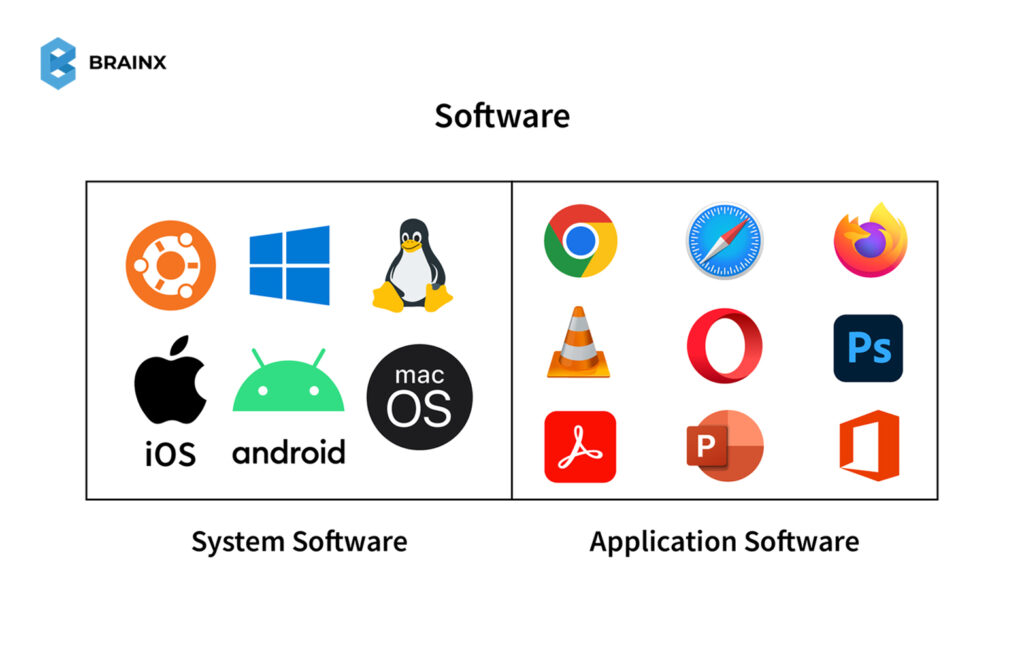
System Software
A system software, or an operating system, acts like a translator and converts instructions into a computer-friendly language. It also controls all hardware parts inside your machine to keep everything working efficiently. Popular operating systems include Windows, used on Microsoft computers, and macOS, found on Apple MacBooks.
Application Software
Application software allows the execution of multiple tasks on different devices. Internet browsers, word-processing apps, media players, etc., are popular examples of such software. Some other everyday use examples include photo editing tools, antivirus, and SaaS (software-as-service) products.
Why Should You Choose A Software Development Company?
Custom software development has a significant role in streamlining internal operations and user-friendly app development for businesses of all sizes. Considering the following, we have discussed below some reasons behind choosing the right software development company for your project’s success:
Expertise and Efficiency
Software companies have potent technical expertise and efficiency. Their team of developers is well-versed in navigating challenges with hands-on experience in using advanced technologies. SDCs have seasoned resources to work with libraries and frameworks following different methodologies to ace complex tasks.
Cost-Effectiveness
Even after the initial investment, the overall partnership with a software development company can be an intelligent long-term investment. It allows you to avoid the overhead of hiring and managing your in-house developer team. That includes expenses like recruiting, employee benefits, training, and providing dedicated workspace and equipment.
Custom Software Solutions
Multiple businesses opt for an off-the-shelf solution for their uniqueness because a one-size-fits-all approach cannot bring them potent outcomes. It is important to understand that each business is different and needs a unique solution. Custom software development services save businesses from turmoil by ensuring that every need is addressed systematically according to preferences.
Immediate Risk Mitigation
Experienced software development companies can help you effectively avoid costly delays and setbacks. They can promptly identify pitfalls and suggest solutions to mitigate risks often associated with complex development projects.
Faster Product Launches
SDCs can bring products and services to market comparatively faster to help you stay ahead of the competition. Working with these companies, you get a team of experts to focus on your project, streamline the development process, and complete deadlines effectively. That results in faster deployment, quick launches, and prompt value realization with an uncompromised quality.
Focus on Your Core Business
Hiring the right software development company allows you to seize maximum opportunities by positioning your organization as a market leader and translating to business agility. Your internal team gets more time to focus on their core competencies with an outsourced software development partner. They allow you to maintain business continuity while driving innovation through your software project.
Scalability and Flexibility
A good SDC can adapt to your project’s evolving needs. They can scale their resources up or down depending on the project phase, ensuring efficient resource allocation.
How to Search for The Best Software Development Company?
- Consider app type, starting point (scratch or extension), existing roles and tech stack, and budget.
- Utilize platforms like Clutch, Techreviewer, and Google for client reviews.
- Maintain a neutral perspective by analyzing both good and bad reviews.
- Ensure the company comprehends your business needs and project context.
- Explore the company’s portfolio and website to gauge capabilities.
- Assess expertise in relevant technologies.
- Examine project organization methods and tools used by the company.
- Authenticate the possessions of codes and transfer of the IP rights.
- Confirm security measures for protecting intellectual property and user data.
- Observe professionalism, commitment, and mutual understanding from the company.
Things to Avoid While Researching a Software Development Partner
- Partnering with companies significantly larger than yours.
- Opting for the cheapest options available.
- Hiring self-proclaimed experts claiming mastery of excessive and unnecessary technologies.
- Choosing companies with poorly designed or low-quality websites.
- Relying on generic or vague testimonials for decision-making.
- Considering companies with vague or unimpressive portfolios showcasing a lack of specific expertise or successful projects.
Onshoring, Offshoring, Nearshoring, Or Hybrid? Which Outsourcing Option Is Best For You?
As your business expands, you face an ever-growing to-do list and numerous business processes awaiting attention. Outsourcing becomes a viable consideration to meet the increasing demand for your products and services.
Outsourcing has multiple modes, but they work best for businesses that adopt them according to their core values. If you’re confused, these four outsourcing options will help you make an informed decision.
Onshoring
Domestic outsourcing, also known as onshoring removes all language barriers by allowing businesses to collaborate with native developers. Onshoring software development is mostly less expensive than offshoring but can pose challenges like exposing your business to regional disruptions.
Offshoring
Offshore outsourcing might sound similar to nearshoring but involves hiring remote teams from another continent that do not necessarily have to be near you. The key benefit of this is cost-effectiveness because the hourly costs of offshore developers are less than the nearshore and onshore ones.
Nearshoring
Nearshore software development is slightly similar to onshore and offshore options but involves working with countries with the same time zones. It empowers efficient communication, keeping track of developmental progress,
Hybrid
Hybrid software development outsourcing integrates onsite management within your region and offshore development. It merges the benefits of local oversight with the cost-effectiveness of offshore development.
12 Tips on How to Choose A Software Development Company
1. Define Project Objectives & Timeline
Having a clear road map of your project is essential to save time. While detailed planning is optional, creating a basic requirements list and assessing necessary technical skills helps prevent misunderstandings and ensures accurate budget and timeline estimates.
2. Compile A List of Software Development Companies
After outlining the project goals and timeline, the second step is to enlist potential software development companies. You can use the following resources for identifying these companies;
- Utilize Google to search for the best companies. Paid and organic results offer valuable insights. Explore individual company websites to gather information on their services, industries served, past clients, and work methodologies.
- Explore review and ranking websites for software development services, such as Clutch, renowned for its comprehensive listings. Filter search results by location, project size, hourly rate, industry focus, and other criteria to find suitable options.
3. Assess Portfolios
Now, compare software development companies on your list using their portfolios and customer reviews. Assess if they have relevant experience, gauge their expertise, and determine their ability to handle your project. Assure they understand your niche and business processes. Be cautious of firms unable to share project details due to confidentiality agreements.
4. Ensure Compatibility with Your Goals
The best software development company is a true partner by deeply understanding your business needs and aligning with your end goals. They should involve business analysts in developing requirements to ensure success. Consider looking elsewhere if a potential partner takes excessive time to understand your needs during the sales process. Pay attention to how many questions they ask; the more, the better.
5. Determine Their Specialization In Your Requirements
Prioritize those companies that keep up with the latest technological advancements and innovations. Look for firms whose software developers demonstrate strong technical knowledge and competency, particularly in the areas relevant to your project. Moreover, starting with a small project can help you assess scalability and operations better than a large commitment.
6. Observe Communication Styles
Effective communication is essential throughout software development from defining requirements to gathering feedback. Clear communication of goals and expectations can build better connections and streamline operations between the stakeholders and the development team. Pay attention to communication styles during initial interactions, whether via email or calls.
7. Analyze Development Methodology
A well-documented and well-executed project development process enhances efficiency and enables the team to address challenges effectively. The methodology should prioritize adaptive planning, early delivery, frequent updates, and modern communication tools to keep you informed throughout the project.
8. Check Their Security Practices
Partnering with a software development company involves transferring sensitive information, so it’s crucial to understand their handling procedures and security measures to safeguard your ideas, products, and confidential materials. Assess the development team’s security practices and determine the necessary security level for your solution. Ask detailed questions to ensure alignment with your security requirements.
The following documents are required to be signed by you and your outsourced development partner to avoid repercussions:
- Sign an NDA (Non-Disclosure Agreement) to maintain confidentiality while protecting trade secrets.
- Get API access for connecting to the software’s ready-made features.
- Limit access to your data through server access.
- The outsourced company needs to have SSL certificates to authenticate its developers.
9. Understand The Team Structure
Understanding a company’s business structure and development team dynamics is crucial. Avoid companies without formal team structures to ensure efficient working dynamics and minimize unnecessary overhead.
10. Seek Clarity on Testing Policies
Before signing a contract with a software development company, ensure clarity on their testing policy and the inclusion of backup services, support, and maintenance. Confirm the duration of these services to avoid surprises or additional costs post-commitment.
11. Learn About The Communication Policy
Choose a software development company with stable communication tools like Jira, Slack, and a secure internet connection. Since language is a barrier, you must find a company that can efficiently communicate in English. In most cases, Visa-free status is also a significant factor for convenient visits.
12. See How Their Pricing Works?
Fixed Price Model
Most people prefer the fixed-price model because it offers clarity and cuts down expenses. Companies opting for this model have to agree upon business decisions, product specifications, scope of work, and other aspects of the project before the commencement of the project. A fixed-price model approach is typically associated with the Waterfall method for project management.
Example:
You agree to pay a fixed price of $50,000 to a software development company for building your e-commerce website. The agreement will contain clauses about the project scope, timeline, and cost and any changes requested by you will be charged. The deployment and launch of a project will be done according to the agreed cost and deadline.
Material Model
The material model, often used with the Agile method for project development, calculates the costs according to the time spent on the project, typically at an hourly or person-day rate. The scope of work’s adaptability makes it flexible in situations like testing and iterations to determine the best solutions for users’ needs.
Example:
You have outsourced a software development company that develops projects on a time and materials basis. Being a client, you will be billed based on hours worked by the development team and any material used with the flexibility for changes during the project.
12 Key Questions to Ask Before Hiring A Software Development Company

- How long have you been supporting development projects?
- What are your specializations in industries, territories, and software types?
- What are the skill sets and tech stacks within your organization?
- Which businesses have you partnered with in the past?
- What is your development methodology?
- What technologies are your software developers familiar with?
- What methodologies do you use for handling project management and communicating with clients?
- What is your quality assurance process?
- Please describe the measures you will take to secure my data.
- What is your pricing model?
- How do you tackle projects that exceed budget or timelines?
- Do you take up the responsibility to offer ongoing support and post-launch maintenance?
Fundamental Do’s And Don’ts Aiding in Decision Making!
While working with outsourced tech partners is a significant investment, it requires high consideration before jumping to conclusions! Below are some dos and don’ts you must ponder before hiring a software development company.
Don’ts
- Do not make hasty decisions without proper evaluation.
- Remember to review resources that can provide valuable insights into the company’s competencies and the quality of its work.
- Do not restrict your research to only one resource of information.
- Don’t hold back from asking questions when communicating with software development companies.
Do’s
- Have patience and take time to research suitable software service providers thoroughly.
- Get valuable insights about the company’s competencies & expertise by reviewing their tech portfolios and case studies.
- Broaden your research by exploring enlisted software development companies’ websites, reviews, and social media presence.
- Inquire about their approach to development, the technologies they would employ, and any other concerns you may have.
Red Flags That You Must Not Neglect…
Despite considering various factors when evaluating a potential software development partner, there may still be signs or “red flags” indicating that they are not a suitable fit for your needs. These red flags could signal potential issues or shortcomings in the partnership, prompting you to reconsider or explore other options.
- Absence of ballpark estimates
- Insufficient reliable references
- Poorly performing website and low content quality
- Reluctance to provide source code ownership
- Cliché recommendations
- Negative reviews
- Lack of clarity regarding portfolio
- Overpromising on project delivery
- Vague pricing models
- Rigidity in altering project requirements
- Unclear contractual agreements
Trusted Platforms for Finding Reliable Software Development Companies

We have enlisted some trusted platforms that can help you find reliable software development companies that have been acknowledged for their solutions.
Clutch
Clutch is an independent platform where businesses can find and connect with software development service providers and IT professionals. It helps businesses make informed decisions by providing detailed profiles and reviews of these service providers. Clutch has simplified the process of finding reliable software developers for numerous businesses.
GoodFirms
Only some software companies you connect with are trustworthy to close a deal with, but GoodFirms has made it easier. This platform is renowned for providing a list of widely trusted companies with their reviews, ratings, and detailed profiles that help in making better decisions.GoodFirms aims to simplify the process of finding reliable and reputable companies by offering a comprehensive directory and vetted information.
Upwork
Upwork connects businesses with skilled freelancers, including top-tier developers. The platform verifies talent, offers portfolio reviews, and allows project postings or Talent Scout assistance for faster hires. With collaboration-focused tools and optional Upwork Plus for enhanced access, it’s ideal for managing freelance developers and fostering team integration.
LinkedIn is a professional platform for businesses, professionals, and software development companies to build valuable connections. It helps business owners find potential service providers that align with their business goals.
Why Choose Brainx Technologies As Your Software Development Partner?
As a custom software development company with 9+ years of experience, we offer:
- Extensive multi-industry expertise that has delivered 250+ projects to 130+ satisfied clients.
- Professional custom software development services for your startup, SMB, or enterprise-level company in healthcare, education, social networking, real estate, e-commerce, and lifestyle industries.
- Bespoke flexible cycle development for your diverse project development needs.
- A pool of talent comprised of specialists to build MVP and update the product upon collected feedback from the first users.
- Time-tested software development technologies for web, and mobile solutions.
- Top-quality results that have been acknowledged and awarded with Clutch Global Awards and Payoneer Award.
- A hallmark of completed innovative projects like MOHE, iinputs, and CORE, etc as a testimonial of our expertise.
You are undertaking a significant project, but don’t have sufficient skilled developers to address the workload or meet deadlines. The global demand for flexible hiring models is growing fast. According to industry research, the IT outsourcing market surpassed $92 billion in 2019 and is projected to reach $145 billion by 2027, growing at 4.6% annually. Even more striking, app outsourcing alone is expected to hit $121.60 billion by 2024. These numbers reflect the increasing shift toward models like IT staff augmentation, which offer speed, flexibility, and cost-efficiency at scale.
The situation is critical, and hiring full-time employees isn’t feasible right now. Many businesses are experiencing this same reality. IT staff augmentation becomes a savior for businesses in such situations.
Outsourcing without structure can create more chaos than progress. That’s why having a Detailed IT Staff Augmentation Handbook is critical for companies scaling technical teams. This resource provides a clear framework for engaging external developers while maintaining control over quality, security, and communication.
Whether you’re offshoring to reduce costs or augmenting onshore for flexibility, the handbook outlines essential steps—from talent selection to onboarding processes and compliance checklists. It also helps define roles between in-house teams and augmented staff, ensuring smooth collaboration.
More importantly, in today’s regulatory landscape, the handbook should also address legal responsibilities like IP protection and data privacy—especially when operating under frameworks like GDPR.
Learn more about official GDPR compliance guidelines to understand data privacy requirements for outsourcing and team augmentation.
A Detailed IT Staff Augmentation Handbook doesn’t just guide operations; it builds confidence for stakeholders, speeds up hiring decisions, and reduces the risks often tied to rapid growth.
It’s like that expert being available for your organization at just the right time without all the hassle of the recruitment process or having to permanently hire. It is a quick fix but also a flexible solution to achieve the top talent you need, to catch up on your projects, and also not burden your current team.
Read this guide on all about IT staff augmentation, how it works, and how it can give your business an edge.
What is IT staff augmentation?
IT staff augmentation is a flexible hiring approach where businesses bring in people from outside their organizations to supplement their in-house teams for a short period of time.
These are seasoned experts who come on a short-term contract to cater to the requirements of a project without the cost of hiring process or long-term employee benefit liabilities.
This is an ideal solution for businesses that may suddenly face a rise in workload or require specialized skills for a particular project. Efficient scaling of your workforce can avoid the delays and costs associated with permanent hiring.
For example, if you have three FinTech software development company developers but need to get five for your project. Then instead of putting further workload on your existing team, you could hire two seasoned professionals on a contractual basis This ensures that your deadline will be met without inconvenience.
IT staff augmentation allows you to adapt to the market while keeping the cost and risks down. In fact, this ensures you get the right talent at the right time for delivering high-quality results without long-term commitment.
Benefits of Staff Augmentation
IT staff augmentation is a smart solution for businesses wanting to scale effectively, cut costs, and keep up with the ever-changing demands of projects. This flexible approach brings plenty of benefits, making it an essential tool for success. Let’s dive into what makes IT staff augmentation so valuable.
1. Access to a Global Talent Pool
Businesses can bridge the gap between themselves and the best talent in the world through staff augmentation. Staff augmentation services open up opportunities for companies to utilize a large pool of specialized professionals with unique skills. Use this model to find the specific developers, engineers, or even consultants who will do your specific job right across town or around the globe. According to Statista, the global developer population exceeded 28 million in 2024, highlighting the scale of accessible talent worldwide.
2. Cost-Efficient Without Trade-Off
Full-time employees bring many overhead expenses to a company in the form of salaries, benefits, health insurance, and retirement plans. Staff augmentation using IT avoids these overhead costs since clients pay only for services delivered. It helps minimize overhead while availing talent.
3. Greater Flexibility
Staff augmentation process enables you to scale your team dynamically, ensuring alignment with the specific demands of your project. No long-term commitments or full-time hires—just the right people, in the right numbers, exactly when you need them.
4. Faster Time-to-Market
With pre-vetted, highly skilled professionals at your service, resource augmentation accelerates timelines. No time-consuming hiring process and onboarding is needed because the organization gets to deliver well within deadlines, reduces time to market; hence, stays competitive in product/service delivery.
5. Mitigated Project Risks
Every project comes with its own unique challenges and risks. The staff augmentation services that bring experienced professionals into an organization not only fill skill gaps but also analyze potential risks and implement effective solutions. This approach is proactive and ensures that projects are delivered successfully, on time, and within budget.
6. Trial Before Commitment
One of the most important advantages of staff augmentation is the chance to test professionals before making the final hiring decisions. This minimizes the chance of hiring some individual with inadequate skills, a bad work ethic, or just an unsuitable cultural fit with your team over time.
7. Keep Project Control
Unlike traditional outsourcing, IT staff augmentation allows businesses to retain full control over projects. With external professionals integrated directly into your team, decision-making and project visibility remain in-house, fostering seamless collaboration and accountability.
8. Increased Efficiency
Augmented teams are often highly specialized and focused on delivering results. This focus leads to improved efficiency, ensuring that projects are completed with precision and quality while optimizing resources.
9. Minimized Internal Disruptions
Introducing permanent hires with specialized skills can sometimes create tension among existing employees. Staff augmentation minimizes these concerns by offering a temporary yet effective solution, which allows internal teams to stay at higher morale and focus more on their core responsibilities.
10. Strategic Cost Savings
From saving recruitment costs to diminishing administrative overheads, staff augmentation is an effective cost-saving method for companies looking to maximize their expenses. This model ensures that resources are being transferred to where they are needed the most and not wasted on unnecessary costs.
💡 Not sure whether to build in-house or outsource? Read our in-depth staff augmentation vs outsourcing comparison to make a confident, cost-effective decision.
Different Types of IT Staff Augmentation
1. Onshore (In-Country) Staff Augmentation
This model involves hiring IT professionals within Pakistan, ensuring alignment in language, culture, and time zones. It facilitates seamless communication and integration into existing teams.
Example:
A New York-based SaaS company supplements its development team with local IT consultants from San Francisco to expedite a new feature rollout, ensuring real-time collaboration during standard business hours.
2. Nearshore Staff Augmentation
In this approach, companies hire IT experts from neighboring countries with similar time zones and cultural backgrounds. While it offers cost advantages, it may require adjustments in communication strategies.
Example:
A U.S.-based SaaS firm collaborates with developers from Mexico to enhance its platform, coordinating tasks across similar time zones for efficient project completion.
3. Offshore Staff Augmentation
It’s a model that entails hiring professionals from distant countries, often with significant time zone differences. It provides access to a broader talent pool and can be cost-effective.
Example:
A SaaS company in Seattle hires developers from India for a complex project. The developers utilize their specific skills while managing the time difference by working flexible hours.
4. Project-Based Augmentation
This model is most suitable for projects with timelines wherein companies can hire experts temporarily to achieve project goals without long-term commitments.
Example:
A Chicago-based SaaS startup hires a dedicated cybersecurity team for the security audit of a new product launch, ensuring that all vulnerabilities are addressed before it goes live.
5. Skill-Based Augmentation
This emphasizes hiring professionals for specific tasks or projects with unique skill sets for particular tasks, and specialized needs are well catered to.
Example:
An Austin-based E-commerce SaaS company hires a data scientist trained in machine learning to develop a recommendation engine on their platform.
6. Time-Based Augmentation
Ideal for addressing temporary needs, this model involves hiring professionals for a set period, such as during peak seasons or to cover for employees on leave.
Example:
A SaaS provider in Boston augments its IT support team during the holiday season to handle increased user activity and ensure system stability.
7. Hybrid Augmentation
Hybrid augmentation combines elements of different augmentation models to tailor solutions to specific business needs, making it balanced between cost, expertise, and flexibility.
Example:
A multinational SaaS corporation with its headquarters in the U.S. relies on a combination of local project managers based in California. They hire offshore developers from Eastern Europe to manage costs while ensuring effective oversight of projects.
8. Commodity-Based Staff Augmentation
This model involves hiring personnel for non-specialized, repetitive tasks that don’t require specific expertise. It’s a cost-effective solution to increase capacity for basic, temporary tasks.
Example:
A SaaS company in Atlanta hires temporary data entry clerks to manage a large volume of information during a system upgrade. They also ensure that routine tasks are handled efficiently without burdening the core team.
Business Challenges Associated with Staff Augmentation
Although it offers a lot of advantages, there are several challenges when integrating augmented staff into existing teams.
1. Integration and Team Dynamics
Introducing external professionals into an already-built team can disrupt the existing workflows as well as interpersonal relationships. Ultimately, the success of staff augmentation depends on how well these external members gel with the in-house team. Different work cultures, communication skills, and different levels of familiarity with the company-specific process may lead to frustration or conflicts, which in turn may not enhance productivity.
2. Knowledge Transfer and Training
The benefit of filling gaps in skills will be partially counterbalanced by a learning curve about the specific systems, tools, and processes of the company. Staff augmentation requires time and resources for training and knowledge transfer to enable effective contributions by the augmented staff. This will temporarily offset any efficiency gains envisioned.
3. Quality Assurance
Adding other team members externally can be problematic in maintaining constant quality in deliverables. Augmented staff may possess different standards or approaches, hence leading to potential differences in quality of work delivered. Quality assurance robust processes and clearly defined guidelines would be necessary for maintaining the organization’s standards.
4. Communication Barriers
Effective communication is the key to team success. When augmented staff are remote or from different cultural backgrounds, language barriers and time zone differences can hinder smooth communication. These challenges may lead to misunderstandings, delays, and reduced team cohesion.
5. Security and Confidentiality Risks
Granting access to sensitive company information by external personnel can create potential security risks. It is, therefore, very important that augmented staff are able to adhere to the company’s data protection policies and maintain confidentiality. This calls for full security measures and probably further training of the external team members.
6. Dependency Concerns
Augmented staff reliance on critical functions can lead to dependency issues. If the external professionals leave the company unexpectedly, it may leave the company vulnerable with unmet project needs and a lack of necessary skills internally to continue the work seamlessly.
7. Cost Management
Resource augmentation is cost-effective but the cost can sometimes balloon out of proportion if not managed properly. Hourly wage rates for the highly specialized expertise will be high, and extending contracts beyond the scope of the initial engagement can be straining on budgets. Controlling costs is indispensable to make staff augmentation financially viable.
8. Legal and Compliance Issues
Engaging augmented staff requires addressing many legal and compliance considerations, such as employment laws, tax regulations, and contractual obligations. Non-compliance in these areas may result in legal issues and financial losses. Companies should ensure that all engagements comply with relevant laws and regulations.
9. Alignment with Company Culture
The augmented staff needs to be aligned culturally with the rest of the team in order to have a unified working environment. Disparities in work ethics, values, and corporate culture cause friction and a lower morale within the team. Assessing cultural fit at the time of selection would be ideal for bringing harmony to the team.
10. Performance Monitoring
It is hard to evaluate the augmented staff’s performances, especially as they are distant. Therefore, it is important to clarify performance metrics with regular assessment protocol to ensure outside team members meet your expectations and actually contribute to helping the project reach a goal.
Staff Augmentation vs Traditional Hiring: What’s the Difference?
When resolving the dispute between staff augmentation vs traditional hiring, understanding the following differences can save businesses from making a wrong decision.
Staff Augmentation:
- Involves hiring external professionals for short-term purposes to supplement the core workforce for particular projects or durations.
- Highly flexible; an organization can ramp up or ramp down the number of employees required on a project without long-term contracts.
- Potentially more cost-effective for short-term needs; reduces costs of benefits, training, and long-term salaries.
- Fast onboarding; the external staff can be easily absorbed to meet immediate project requirements.
- Augmented staff work under the organization’s direction, ensuring that they are working toward company objectives.
- Access to specialized skills and expertise that might not be in-house, so it can rapidly adapt to the needs of a project.
- External employees are likely less committed to the organization and therefore may influence group cohesion and longer-term project integrity.
- Reduces administrative responsibilities; external providers handle HR functions like payroll and benefits for augmented staff.
Traditional Hiring:
- Is about hiring core employees who are permanent additions to the organization.
- Not as flexible; a change in staff levels will have to await long recruitment or severance procedures that make it less responsive to changes in needs.
- Higher long-term costs including salaries, benefits, training, and other employee-related costs.
- It may take considerable time to find and train suitable candidates.
- Direct oversight and management of permanent staff, creating a deeper integration with company culture.
- Limited to the current set of skills for the employees on board; adding new skills involves training or hiring a new full-time employee, which takes time.
- The permanent employee will be more committed to the organization’s long-term goals and provide a stable cohesive work environment.
- Increases administrative workload; the organization is responsible for all HR functions related to employee management.
- Involves observance of labor laws and regulations; the company has procedures for dealing with legal and compliance issues about permanent employees.
- Empowers easier cultural incorporation; permanent employees will easily assimilate into the company culture, which promotes teamwork and communication.
How to Choose the Right Partner
One must choose an ideal IT staff augmentation partner, as their success completely relies on those augmentations to ensure the objectives for your business.
Looking beyond staff augmentation? Here’s how to choose the right software development company for full-service projects and long-term tech partnerships.
A fitting choice will facilitate the experience and the flexibilities required with augmentations based on business goals. Follow these steps while selecting:
1. Assess Experience & Expertise
Ensure the partner has a proven track record in your industry and the specific technologies relevant to your projects. Experience in similar projects indicates their capability to meet your requirements.
2. Evaluate Communication Skills
Effective communication is vital. The partner should be responsive, transparent, and proficient in your preferred communication channels to ensure seamless collaboration.
3. Checking for Cultural Alignment
Cultural similarity eases augmentees’ smoother absorption into a work team precursor to boosting productivity and working towards team unison.
4. Check the Testimonials of Clients and References
The experience of previous clients will give insight into the dependability, hard work, and quality of the partner.
5. Evaluate Flexibility and Scalability
Your partner must be able to scale up or down resources to meet your business’s requirements.
6. Know How They Recruit
A tough recruitment process guarantees that the professionals provided by your partner are competent and meet your standards.
7. Take Time Zone and Location into Account
Proximity has a big influence on communication and collaboration. Onshore, nearshore, or offshore is also up to your discretion depending on operational needs.
⚠️ Don’t let small mistakes cost you big. Learn what to avoid in our guide to outsourcing software development mistakes before signing your next contract.
Questions to Ask Before Staff Augmentation Partners Before Signing the Deal
- What is their experience in the industry?
- Can they provide case studies or references?
- How do they ensure the quality of your staff?
- What is their communication protocol?
- How do they handle confidentiality and data security?
- What are their pricing models?
- How do they manage time zone differences?
What Sets Great Augmentation Partners Apart?
- Consistent success in delivering quality projects on time and within budget.
- Access to a diverse range of skilled professionals to meet various project needs.
- Ability to quickly adjust to changing project requirements and scale resources accordingly.
- Clear and open communication regarding project status, challenges, and timelines.
- Strict adherence to data protection and confidentiality agreements.
- Shared values and work ethics that facilitate seamless integration with your team.
- Focus on understanding and meeting the specific needs and goals of your business.
How Does the Staff Augmentation Process Work?
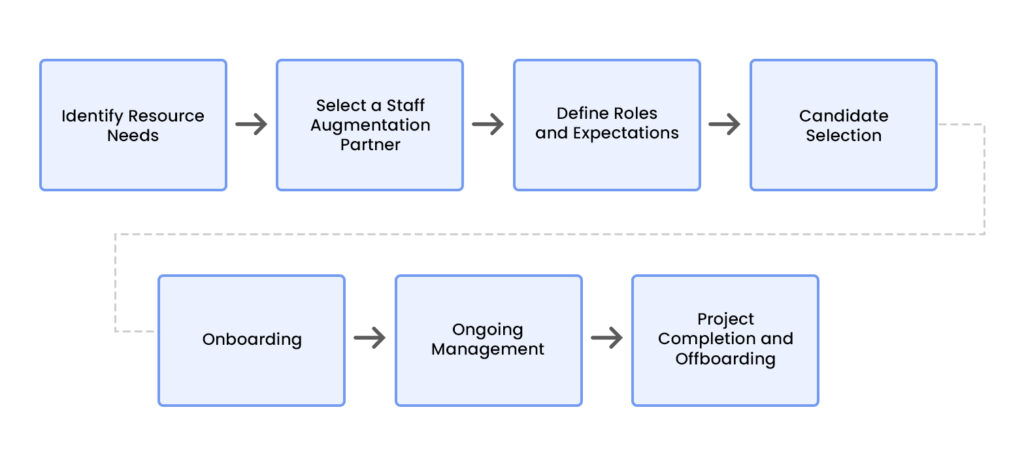
When to Choose IT Staff Augmentation?
IT staff augmentation is a strategic approach that will help organizations to augment their in-house teams for temporary periods of time with professionally skilled people and allows flexibility without long-term commitments in traditional hiring.
Short-Term Projects
This is ideal for initiatives requiring specialized skills for a limited duration, allowing efficient project completion without permanent hires.
For a deeper look at how outsourcing can support these fast-moving projects, check out our article on the Benefits of Outsourcing App Development.
Skill Gaps
When your team lacks specific expertise, staff augmentation provides access to professionals with the necessary skills to bridge the gap.
Scalability Requirements
It is easy to scale up your labour force quickly and according to project requirements, avoiding the time wasted in traditional hiring processes.
Cost Control
Reduces the full-time employment-related costs, which include benefits and long-term salary payments.
Fast Time-to-Market
This integration of seasoned professionals accelerates the project time cycle and introduces products or services into the market faster.
Access to Experienced Professionals
Identifies risks and minimizes the chance of failure to make the project successful.
Resource Flexibility
Allows a dynamic size change and adjustment in the team as per the requirement of the project, hence ensuring operational efficiency.
Curious how this model works in real teams? See how IT staff augmentation accelerates software development for startups and scaling tech companies.
Scope of IT Staff Augmentation for Businesses
IT staff augmentation provides businesses with an opportunity to add temporary in-house teams with the help of special talent, making it flexible and full of expertise without the traditional long-term commitment of hiring. This is the best way by which most organizations can adapt to the dynamic market needs and technological advancements.
- Businesses can easily introduce professionals who are experts in cloud computing, data security or analytics. This ensures projects are executed with precision and creativity.
- Companies can easily adjust team sizes based on project needs, allowing them to adapt swiftly to market changes without the delays tied to traditional hiring processes.
- Through staff augmentation, companies can save on these overhead costs of full-time employment, including the provision of benefits and long-term salaries, which makes it cost-effective for short-term or specialized project needs.
- The use of experienced professionals will allow for faster project delivery, and through this, businesses can reach the market with products or services ahead of others.
- Augmented staff bring diverse experiences from various projects and companies, hence avoiding common pitfalls and adapting to changing project requirements.
Strategize Your Staff Augmentation with BrainX
BrainX Technologies is a top-end software development company that focuses on creating innovative digital solutions for all businesses.
“In addition to scaling dev teams, BrainX also supports CTO outsourcing strategies to help SaaS companies address executive-level tech challenges with flexibility and speed.”
We offer:
- Web Development: We are a team of web developers who create safe, scalable, and user-friendly web applications according to the needs of your business.
- Mobile App Development: We have expertise in developing high-performance mobile apps both on iOS and Android, guaranteeing exceptional functionality and user satisfaction.
- Artificial Intelligence Development: We use AI to innovate smart solutions driving business efficiency.
- Ecommerce web development: Customized online shops that will separate you from other competitors in this competitive market and are designed by our experts.
- Blockchain development: We present blockchain solutions through decentralized applications, and smart contracts for businesses to develop this emerging field.
- DevOps Services: Our DevOps experts streamline the software development process by maximizing the potential of DevOps technology.