
 February 10, 2025 -
  16 minutes read

Knowing how to choose a software development company can prevent costly delays, security gaps, rework, and mismatched expectations. Software development follows the Software Development Life Cycle (SDLC), a structured process for planning, designing, building, testing, deploying, and maintaining software. SlashData estimated 48.4 million developers worldwide in Q3 2025, illustrating both the scale of the market and the challenge of distinguishing capable delivery partners from convincing sales presentations.
The growing use of outsourced software development gives businesses access to specialized talent and flexible delivery models, but it also increases the number of vendors to compare. Choosing the right software development partner requires evidence-based evaluation of relevant experience, team composition, security, delivery processes, pricing, contract terms, and long-term support.
This guide explains how to choose the right software development company using a practical checklist, a weighted vendor scorecard, due-diligence questions, and 2026 considerations such as AI-assisted development policies.

Key Takeaways
- Define your project goals, scope, budget, technical requirements, security needs, and expected outcomes before comparing software development companies.
- Evaluate every shortlisted company using the same checklist and weighted scorecard rather than relying only on pricing, reputation, or sales presentations.
- Verify relevant industry experience, technical capabilities, the proposed team, development methodology, quality assurance process, and communication practices.
- Review security and AI-assisted development policies, including data access, code reviews, vulnerability testing, AI tool usage, and protection of proprietary information.
- Compare the total cost of ownership, not just the initial development quote. Include infrastructure, licences, maintenance, support, scaling, security, and future rework.
- Carefully review client references, source-code ownership, contract and exit terms, and consider a paid discovery phase or pilot before committing to a complex or long-term project.
Quick Answer
To choose a software development company, first define the outcomes, scope, budget range, technical constraints, compliance needs, and support expectations for your project. Then compare every shortlisted company using the same evidence-based criteria: relevant experience, the proposed team, architecture, security, development and QA processes, communication, pricing, contract terms, client references, and post-launch support. For a complex or high-risk engagement, validate the preferred vendor through a paid discovery phase or pilot before committing to full development.
Checklist for Choosing the Right Software Development Company
Use this software development company checklist to compare potential partners consistently instead of making a decision based only on pricing, brand recognition, or sales presentations.
| Evaluation Area | Evidence to Request | Warning Sign |
|---|---|---|
| Relevant experience | Comparable case studies, outcomes, and client references | Only generic portfolio samples |
| Technical expertise | Proposed architecture, technical lead, and named specialists | The sales team cannot answer technical questions |
| Industry knowledge | Projects in your sector and understanding of workflows or compliance | No awareness of domain-specific risks |
| Security | Secure SDLC, access controls, testing, remediation, and incident response | Security is discussed only before launch |
| Development and QA | Sprint process, test strategy, acceptance criteria, and change management | Vague methodology or testing only at the end |
| Communication | Meeting cadence, reporting tools, decision logs, and escalation path | No direct access to delivery leads |
| Pricing and total cost | Detailed estimate, assumptions, exclusions, and ongoing costs | Extremely low or vague quotation |
| IP and contract terms | Clear ownership of code, designs, documentation, and accounts | The vendor retains essential components |
| Team continuity | Named team, employment status, substitution, and knowledge-transfer plan | Unclear subcontracting or frequent team changes |
| Post-launch support | Warranty, maintenance scope, response targets, and SLA terms | Support is excluded or undefined |
Use a Weighted Vendor Evaluation Scorecard
A checklist confirms whether a vendor meets a requirement, but a weighted scorecard helps when several companies have different strengths. Score each shortlisted company from 1 to 5 for every criterion, multiply the score by the weight as a decimal, and add the results. For example, a rating of 4 for a criterion weighted at 20% contributes 0.80 points. Set non-negotiable thresholds for security, compliance, and IP ownership so a high total score cannot hide a critical risk.
| Criterion | Suggested Weight |
|---|---|
| Relevant technical experience | 20% |
| Industry and domain knowledge | 15% |
| Security and compliance | 15% |
| Development and QA process | 15% |
| Communication and transparency | 10% |
| Team composition and continuity | 10% |
| Pricing and total cost | 10% |
| Post-launch support | 5% |
What is Software Development?

The software development process includes multiple stages to create products for different industries. The entire process helps develop products that meet technical requirements and client needs.
Software companies can demonstrate mature delivery practices through recognized standards, security frameworks, quality certifications, and documented SDLC controls. These may include ISO 9001 for quality management, ISO/IEC 27001 for information security, NIST’s Secure Software Development Framework, OWASP SAMM, or clearly documented Agile and DevSecOps practices. A certificate alone is not enough; ask how the company applies its process to planning, code review, testing, release management, and maintenance.
Let’s Take A Look At The Software Development Process

The Software Development Process entails a systematic approach to creating software for a system or project, often referred to as the Software Development Life Cycle (SDLC). While there are multiple approaches to building software, here is the breakdown of this process for those who follow the Agile method:
Phase #1 Brainstorming
Robust software development starts with a brainstorming session among team members. It involves the discussion of ideas based on the diverse experiences of each team member. The brainstorming phase helps focus on the pressing customer needs and find solutions to resolve them effectively.
Phase #2 Strategic Insights
The next step after ideation is to conceptualize the discussed ideas to proceed with the research phase. This step progresses with gathering insights from competitor analysis, market trends, and the scope of creating a unique value proposition for your product. Customer feedback also helps significantly in determining whether your idea aligns with the customer's expectations or not.
Phase #3 Planning & Risk Evaluation
Have you cleared the first 2 steps effectively? If yes, let's move to the third step. The planning and risk evaluation phase involves formulating strategies to develop your product and evaluate the potential risks. This process includes outlining the product specifications, identifying the resources, and developing documentation and timelines.
Phase #4 Prototyping & Designing
Prototyping has multiple benefits for businesses because it helps to build everlasting impressions. You must focus on creating user-centric UI/UX designs to make your software engaging and unique. This phase is crucial to be followed by all software development companies to ensure delivering a remarkable product with aesthetic and interactive elements.
Phase #5 Software Development
This stage requires you to get familiar with the methodologies that your software development partner adopts for the final development. Similarly, every company must determine that it's crucial to establish a process that allows for regular progress reviews and assessments. This ensures ongoing alignment with your objectives through transparent communication.
Phase #6 Testing & Quality Assurance
When selecting a professional software development company, it's crucial to grasp their testing and quality assurance approach. Emphasizing the creation of high-quality products from the start is essential to mitigate future challenges.
Phase #7 Market Launch & Upgradations
This phase entails ongoing analysis of customer feedback and market trends to implement necessary adjustments and ensure your product remains current and competitive. The market launch of a product marks the conclusion of the software development journey. However, even at this stage, your software development partner must remain committed to continuous updates and refinements.
What Are The Different Types of Software?
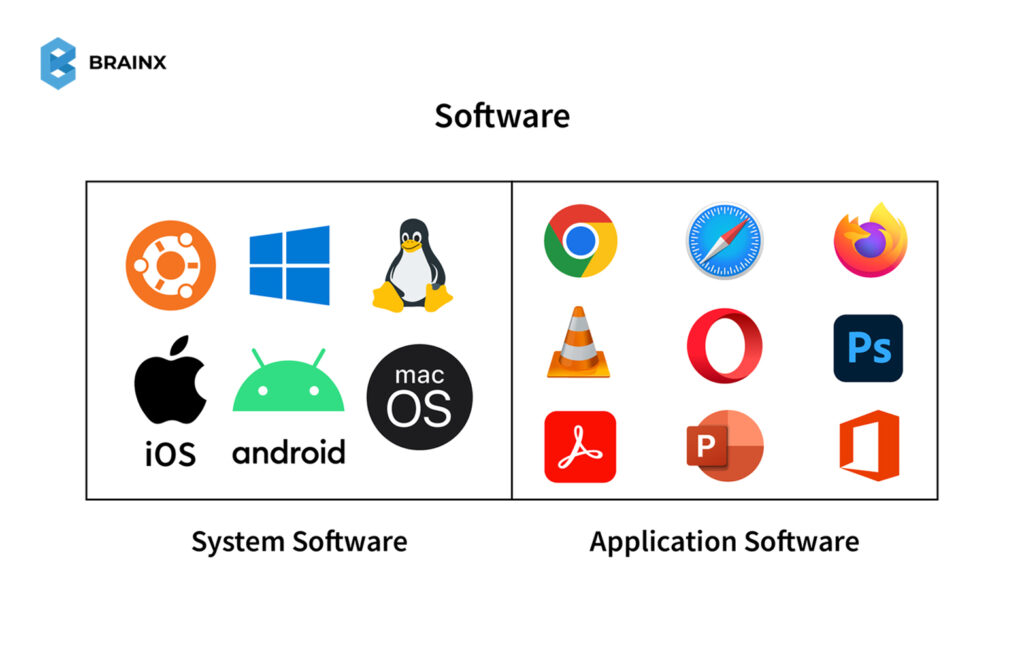
System Software
A system software, or an operating system, acts like a translator and converts instructions into a computer-friendly language. It also controls all hardware parts inside your machine to keep everything working efficiently. Popular operating systems include Windows, used on Microsoft computers, and macOS, found on Apple MacBooks.
Application Software
Application software allows the execution of multiple tasks on different devices. Internet browsers, word-processing apps, media players, etc., are popular examples of such software. Some other everyday use examples include photo editing tools, antivirus, and SaaS (software-as-service) products.
Why Should You Choose A Software Development Company?
Custom software development has a significant role in streamlining internal operations and user-friendly app development for businesses of all sizes. Considering the following, we have discussed below some reasons behind choosing the right software development company for your project's success:
Expertise and Efficiency
Software companies have potent technical expertise and efficiency. Their team of developers is well-versed in navigating challenges with hands-on experience in using advanced technologies. SDCs have seasoned resources to work with libraries and frameworks following different methodologies to ace complex tasks.
Cost-Effectiveness
Even after the initial investment, the overall partnership with a software development company can be an intelligent long-term investment. It allows you to avoid the overhead of hiring and managing your in-house developer team. That includes expenses like recruiting, employee benefits, training, and providing dedicated workspace and equipment.
Custom Software Solutions
Multiple businesses opt for an off-the-shelf solution for their uniqueness because a one-size-fits-all approach cannot bring them potent outcomes. It is important to understand that each business is different and needs a unique solution. Custom software development services save businesses from turmoil by ensuring that every need is addressed systematically according to preferences.
Immediate Risk Mitigation
Experienced software development companies can help you effectively avoid costly delays and setbacks. They can promptly identify pitfalls and suggest solutions to mitigate risks often associated with complex development projects.
Faster Product Launches
SDCs can bring products and services to market comparatively faster to help you stay ahead of the competition. Working with these companies, you get a team of experts to focus on your project, streamline the development process, and complete deadlines effectively. That results in faster deployment, quick launches, and prompt value realization with an uncompromised quality.
Focus on Your Core Business
Hiring the right software development company allows you to seize maximum opportunities by positioning your organization as a market leader and translating to business agility. Your internal team gets more time to focus on their core competencies with an outsourced software development partner. They allow you to maintain business continuity while driving innovation through your software project.
Scalability and Flexibility
A good SDC can adapt to your project's evolving needs. They can scale their resources up or down depending on the project phase, ensuring efficient resource allocation.
How to Choose a Custom Software Development Company
Custom projects require more than general development capacity because the company must translate unique workflows, constraints, integrations, and growth plans into a maintainable product. Businesses evaluating how to choose a software development company for bespoke solutions should prioritize discovery capability, architecture experience, integration expertise, source-code ownership, and long-term maintainability.
Ask the company to explain how it will convert business requirements into user journeys, system requirements, architecture decisions, and measurable acceptance criteria. A strong partner should challenge unclear assumptions, identify operational risks, and explain the tradeoffs between building a custom component, integrating a third-party service, or adapting an existing platform.
- Review custom software case studies that are comparable in complexity, integrations, scale, or regulatory requirements.
- Evaluate the proposed architecture for scalability, reliability, data ownership, and future feature development.
- Confirm experience with APIs, legacy systems, cloud platforms, data migration, and third-party integrations relevant to your project.
- Clarify ownership of source code, designs, documentation, cloud accounts, data, and reusable components before development starts.
- Assess whether the company can provide maintenance, monitoring, security updates, performance optimization, and future team onboarding
How to Search for The Best Software Development Company?
- Consider app type, starting point (scratch or extension), existing roles and tech stack, and budget.
- Utilize platforms like Clutch, Techreviewer, and Google for client reviews.
- Maintain a neutral perspective by analyzing both good and bad reviews.
- Ensure the company comprehends your business needs and project context.
- Explore the company's portfolio and website to gauge capabilities.
- Assess expertise in relevant technologies.
- Examine project organization methods and tools used by the company.
- Authenticate the possessions of codes and transfer of the IP rights.
- Confirm security measures for protecting intellectual property and user data.
- Observe professionalism, commitment, and mutual understanding from the company.
Things to Avoid While Researching a Software Development Partner
- Partnering with companies significantly larger than yours.
- Opting for the cheapest options available.
- Hiring self-proclaimed experts claiming mastery of excessive and unnecessary technologies.
- Choosing companies with poorly designed or low-quality websites.
- Relying on generic or vague testimonials for decision-making.
- Considering companies with vague or unimpressive portfolios showcasing a lack of specific expertise or successful projects.
Onshoring, Offshoring, Nearshoring, Or Hybrid? Which Outsourcing Option Is Best For You?
As your business expands, you face an ever-growing to-do list and numerous business processes awaiting attention. Outsourcing becomes a viable consideration to meet the increasing demand for your products and services.
Outsourcing has multiple modes, but they work best for businesses that adopt them according to their core values. If you’re confused, these four outsourcing options will help you make an informed decision.
Onshoring
Domestic outsourcing, also known as onshoring, means hiring a provider in your own country. It can simplify legal alignment, travel, language, and time-zone coordination, but rates are often higher than nearshore or offshore alternatives and local talent availability may be limited. Compare cost against communication needs, delivery risk, and required expertise rather than assuming one model is always cheaper.
Offshoring
Offshore outsourcing involves working with a team in a distant country, often with a larger time-zone difference. It can broaden the talent pool and reduce hourly rates, but it requires disciplined communication, documentation, security controls, and delivery governance to manage coordination risks.
Nearshoring
Nearshore software development means working with a provider in a nearby country or region, usually with overlapping working hours and closer cultural or business alignment. The countries do not need to share the exact same time zone. Nearshoring can provide a balance between easier collaboration and more competitive rates.
Hybrid
Hybrid software development outsourcing integrates onsite management within your region and offshore development. It merges the benefits of local oversight with the cost-effectiveness of offshore development.
12 Tips on How to Choose A Software Development Company
1. Define Project Objectives & Timeline
Having a clear road map of your project is essential to save time. While detailed planning is optional, creating a basic requirements list and assessing necessary technical skills helps prevent misunderstandings and ensures accurate budget and timeline estimates.
2. Compile A List of Software Development Companies
After outlining the project goals and timeline, the second step is to enlist potential software development companies. You can use the following resources for identifying these companies;
- Utilize Google to search for the best companies. Paid and organic results offer valuable insights. Explore individual company websites to gather information on their services, industries served, past clients, and work methodologies.
- Explore review and ranking websites for software development services, such as Clutch, renowned for its comprehensive listings. Filter search results by location, project size, hourly rate, industry focus, and other criteria to find suitable options.
3. Assess Portfolios
Now, compare software development companies on your list using their portfolios and customer reviews. Assess if they have relevant experience, gauge their expertise, and determine their ability to handle your project. Assure they understand your niche and business processes. Be cautious of firms unable to share project details due to confidentiality agreements.
Speak With Previous Clients
Portfolio pages show what a company wants prospects to see. A reference call helps you understand how the vendor behaved when the project faced delays, scope changes, technical uncertainty, or post-launch issues. Ask for references from projects similar in size, delivery model, or complexity.
- Did the project remain within the expected budget and timeline?
- How did the company communicate delays, risks, or unexpected technical issues?
- How were scope changes documented, estimated, approved, and priced?
- Did the delivered software require significant rework after acceptance?
- Was the same core team retained throughout the engagement?
- How responsive was the company after launch?
- Would you hire the company again for a larger or more complex project?
4. Ensure Compatibility with Your Goals
The best software development company is a true partner by deeply understanding your business needs and aligning with your end goals. They should involve business analysts in developing requirements to ensure success. Consider looking elsewhere if a potential partner takes excessive time to understand your needs during the sales process. Pay attention to how many questions they ask; the more, the better.
5. Determine Their Specialization In Your Requirements
Prioritize those companies that keep up with the latest technological advancements and innovations. Look for firms whose software developers demonstrate strong technical knowledge and competency, particularly in the areas relevant to your project. Moreover, starting with a small project can help you assess scalability and operations better than a large commitment.
Evaluate Their AI-Assisted Development Policies
AI coding assistants can accelerate documentation, testing, refactoring, and routine implementation, but they also create security, privacy, licensing, and quality risks when used without governance. NIST’s Generative AI Profile emphasizes structured governance, risk measurement, and ongoing management. In 2026, a mature development company should be able to explain its approved tools, human-review requirements, data controls, and monitoring practices.
- Which AI coding, testing, documentation, or design tools may developers use?
- Can proprietary code, credentials, customer data, or internal documents be submitted to external AI systems?
- Do the selected AI providers use customer inputs or outputs for model training, and what contractual controls apply?
- Is AI-generated code reviewed, tested, scanned, and approved by qualified humans before release?
- How are copyright, open-source licensing, and code-provenance risks assessed?
- Does the company maintain an approved AI tools policy and usage logs where appropriate?
- How are AI-enabled product features evaluated for accuracy, security, misuse, and post-deployment performance?
- How is sensitive customer data protected when building or operating AI systems?
Start With a Paid Discovery Phase or Pilot
For a large, technically uncertain, or business-critical project, a paid discovery phase or limited pilot provides stronger evidence than a sales proposal. Discovery may produce validated requirements, user journeys, architecture options, a prioritized backlog, a risk register, delivery estimates, and a prototype. A pilot can additionally test code quality, integration capability, or a high-risk feature before the full engagement.
- Understanding of the business problem and user requirements
- Communication quality and responsiveness
- Technical decision-making and ability to explain tradeoffs
- Quality of documentation, architecture, or prototype outputs
- Code quality and test coverage when the pilot includes development
- Ability to work through ambiguity and changing information
- Accuracy and transparency of estimates
- Responsiveness to review comments and stakeholder feedback
Define the paid phase as a separate engagement with clear deliverables, ownership terms, acceptance criteria, and no obligation to continue. The outputs should remain useful even if you select another company for full development.
6. Observe Communication Styles
Effective communication is essential throughout software development from defining requirements to gathering feedback. Clear communication of goals and expectations can build better connections and streamline operations between the stakeholders and the development team. Pay attention to communication styles during initial interactions, whether via email or calls.
7. Analyze Development Methodology
A well-documented and well-executed project development process enhances efficiency and enables the team to address challenges effectively. The methodology should prioritize adaptive planning, early delivery, frequent updates, and modern communication tools to keep you informed throughout the project.
8. How to Choose a Secure Software Development Company
Partnering with a software development company involves transferring sensitive information, so it's crucial to understand their handling procedures and security measures to safeguard your ideas, products, and confidential materials. Assess the development team's security practices and determine the necessary security level for your solution. Ask detailed questions to ensure alignment with your security requirements.
The following documents are required to be signed by you and your outsourced development partner to avoid repercussions:
- Sign an NDA (Non-Disclosure Agreement) to maintain confidentiality while protecting trade secrets.
- Get API access for connecting to the software’s ready-made features.
- Limit access to your data through server access.
- Require TLS certificates and secure configurations to protect data in transit and validate the identity of servers or services. TLS certificates do not authenticate individual software developers; developer access should be controlled through verified accounts, multi-factor authentication, and role-based permissions.
To choose a secure software development company, examine how it protects data, manages access, reviews code, tests vulnerabilities, and responds to incidents throughout the complete development lifecycle. Security should be built into planning, implementation, verification, release, and maintenance rather than treated as a final pre-launch check.
NIST’s Secure Software Development Framework (SSDF) recommends integrating secure development practices into each SDLC implementation. Request practical evidence of the following controls rather than accepting a general promise that the software will be secure:
- A documented secure software development lifecycle with defined security responsibilities
- Role-based access controls, least-privilege permissions, and multi-factor authentication
- Peer code reviews, protected branches, and controlled production releases
- Static application security testing, dynamic testing, and penetration testing when appropriate
- Open-source dependency, licence, and vulnerability scanning
- Secrets and credential management that keeps keys out of source code
- Encryption for sensitive data in transit and at rest
- Vulnerability triage, remediation timelines, and verification of fixes
- Incident response, notification, recovery, and evidence-preservation procedures
- Data residency, retention, deletion, and regulatory requirements
- Controls for employee, contractor, and subcontractor access
- Defined security monitoring and patching responsibilities after launch
9. Understand The Team Structure
Understanding a company's business structure and development team dynamics is crucial. Avoid companies without formal team structures to ensure efficient working dynamics and minimize unnecessary overhead.
10. Seek Clarity on Testing Policies
Before signing a contract with a software development company, ensure clarity on their testing policy and the inclusion of backup services, support, and maintenance. Confirm the duration of these services to avoid surprises or additional costs post-commitment.
11. Learn About The Communication Policy
Choose a software development company with reliable communication and project-management tools such as Jira, Slack, Microsoft Teams, or equivalent platforms. Confirm that the delivery team can communicate clearly in the agreed working language and that meetings, reports, decisions, risks, and escalations are documented. If in-person workshops or visits are expected, assess travel practicality separately rather than treating visa-free access as a primary selection criterion.
12. Compare Pricing and Total Cost of Ownership
Fixed Price Model
A fixed-price model offers budget predictability when requirements, deliverables, assumptions, and acceptance criteria are stable. The client and development company agree on the scope, timeline, and cost before work begins. Changes outside the approved scope normally require a formal change request and additional pricing. This model is often associated with Waterfall or tightly scoped delivery.
Example:
You agree to pay a fixed price of $50,000 to a software development company for building your e-commerce website. The agreement will contain clauses about the project scope, timeline, and cost and any changes requested by you will be charged. The deployment and launch of a project will be done according to the agreed cost and deadline.
Time and Materials Model
The time and materials model, often used with Agile delivery, calculates cost according to the time spent by the project team, typically at an hourly, daily, or monthly rate. Its flexible scope is useful when requirements will evolve through research, testing, feedback, and iteration.
Example:
You have outsourced a software development company that develops projects on a time and materials basis. Being a client, you will be billed based on hours worked by the development team and any material used with the flexibility for changes during the project.
Dedicated Team Model
A dedicated team model provides a stable group of developers, designers, QA specialists, and delivery leads for an extended period. It suits evolving products that need continuity, predictable capacity, and deeper domain knowledge. Confirm whether the team is genuinely dedicated, how capacity is measured, and how substitutions are handled.
Staff Augmentation
Staff augmentation adds selected specialists to your internal team while your organization retains day-to-day management and product ownership. It works well when you already have strong technical leadership and need to fill defined skill or capacity gaps.
Milestone-Based Pricing
Milestone-based pricing links payments to agreed phases or deliverables, such as discovery, design approval, MVP completion, integration, or launch. Each milestone should have clear deliverables, review periods, acceptance criteria, and rules for rejected or incomplete work.
Managed Development Team
A managed development team gives the vendor responsibility for team coordination, delivery management, engineering practices, and agreed outcomes. This model can reduce the client’s management burden, but it requires transparent reporting, measurable service expectations, and access to technical decision-makers.
Costs Beyond the Initial Development Quote
The lowest proposal is not necessarily the lowest-cost option. Compare the total cost of ownership over the expected life of the software, including costs that may sit outside the initial development estimate.
- Cloud hosting, storage, monitoring, backups, and data transfer
- Third-party APIs, software licences, plugins, and commercial components
- Data migration, cleansing, validation, and cutover support
- Security testing, monitoring, certifications, and vulnerability remediation
- Maintenance, operating-system updates, dependency upgrades, and browser or device compatibility
- Scaling infrastructure and performance optimization
- Documentation, administrator training, user training, and knowledge transfer
- Warranty coverage, support retainers, and service-level agreements
- Future developer onboarding and access to repositories or cloud accounts
- Technical debt, rework, and replacement of poorly selected components
Review the Contract, IP, Exit, and Support Terms
A strong proposal does not compensate for an unclear contract. Review the commercial and legal terms with qualified counsel where appropriate, and make sure the agreement reflects how the project will actually be delivered. Ownership, access, change management, support, and exit planning should be explicit rather than assumed.
| Contract Area | What to Confirm |
|---|---|
| Project scope | Deliverables, exclusions, dependencies, assumptions, and acceptance criteria |
| Payments | Rates, milestones, invoicing, taxes, expenses, and payment conditions |
| Change requests | How changes are documented, estimated, approved, scheduled, and billed |
| Source-code ownership | When ownership transfers and whether any essential code is excluded |
| Design and documentation | Ownership of design files, architecture, test assets, manuals, and specifications |
| Third-party components | Licences, restrictions, recurring costs, and replacement risks |
| Reusable vendor components | What remains vendor-owned and whether your product can operate without the vendor |
| Repositories and cloud accounts | Client access, administrator rights, backups, and credential control |
| Data return and deletion | Export format, return timeline, verified deletion, and retention exceptions |
| Termination | Notice periods, outstanding payments, unfinished work, and termination rights |
| Knowledge transfer | Documentation, handover sessions, environment setup, and successor support |
| Warranty | Defect coverage, duration, exclusions, and remediation timelines |
| Maintenance and SLAs | Support hours, severity levels, response targets, monitoring, and patching |
| Transition assistance | Support when moving the product to an internal team or another vendor |
12 Key Questions to Ask Before Hiring A Software Development Company

- How long have you been supporting development projects?
- What are your specializations in industries, territories, and software types?
- What are the skill sets and tech stacks within your organization?
- Which businesses have you partnered with in the past?
- What is your development methodology?
- What technologies are your software developers familiar with?
- What methodologies do you use for handling project management and communicating with clients?
- What is your quality assurance process?
- Please describe the measures you will take to secure my data.
- What is your pricing model?
- How do you tackle projects that exceed budget or timelines?
- Do you take up the responsibility to offer ongoing support and post-launch maintenance?
Questions to Ask: Strong Answers and Red Flags
The value of a vendor interview depends on the quality of the answer. Look for specific processes, named responsibilities, evidence, and examples. Generic assurances should not be treated as proof.
| Question | Strong Answer | Red Flag |
|---|---|---|
| How do you handle scope changes? | A documented approval, impact analysis, re-estimation, and scheduling process | “We will handle changes as we go” |
| Who will work on the project? | Named team members with clear roles, seniority, and availability | Only salespeople are available |
| What is your security process? | Specific access controls, reviews, testing, remediation, and incident procedures | A generic claim that security is guaranteed |
| What happens when a sprint is delayed? | A clear escalation, root-cause, recovery, and communication process | No defined recovery approach |
| Who owns the code and project assets? | Ownership and access transfer clearly under the contract | The vendor retains essential code or accounts |
| How do you handle team changes? | Advance notice, equivalent replacement, documentation, and knowledge transfer | No continuity plan |
| How do you test the software? | Risk-based test strategy, automated and manual testing, acceptance criteria, and defect tracking | Testing only occurs immediately before launch |
| What support is available after launch? | Defined warranty, maintenance scope, severity levels, response targets, and pricing | Support will be discussed after delivery |
Fundamental Do’s And Don’ts Aiding in Decision Making!
While working with outsourced tech partners is a significant investment, it requires high consideration before jumping to conclusions! Below are some dos and don’ts you must ponder before hiring a software development company.
Don'ts
- Do not make hasty decisions without proper evaluation.
- Remember to review resources that can provide valuable insights into the company's competencies and the quality of its work.
- Do not restrict your research to only one resource of information.
- Don't hold back from asking questions when communicating with software development companies.
Do's
- Have patience and take time to research suitable software service providers thoroughly.
- Get valuable insights about the company’s competencies & expertise by reviewing their tech portfolios and case studies.
- Broaden your research by exploring enlisted software development companies' websites, reviews, and social media presence.
- Inquire about their approach to development, the technologies they would employ, and any other concerns you may have.
Red Flags That You Must Not Neglect…
Despite considering various factors when evaluating a potential software development partner, there may still be signs or "red flags" indicating that they are not a suitable fit for your needs. These red flags could signal potential issues or shortcomings in the partnership, prompting you to reconsider or explore other options.
- Absence of ballpark estimates
- Insufficient reliable references
- Poorly performing website and low content quality
- Reluctance to provide source code ownership
- Cliché recommendations
- Negative reviews
- Lack of clarity regarding portfolio
- Overpromising on project delivery
- Vague pricing models
- Rigidity in altering project requirements
- Unclear contractual agreements
Trusted Platforms for Finding Reliable Software Development Companies

We have enlisted some trusted platforms that can help you find reliable software development companies that have been acknowledged for their solutions.
Clutch
Clutch is an independent platform where businesses can find and connect with software development service providers and IT professionals. It helps businesses make informed decisions by providing detailed profiles and reviews of these service providers. Clutch has simplified the process of finding reliable software developers for numerous businesses.
GoodFirms
Only some software companies you connect with are trustworthy to close a deal with, but GoodFirms has made it easier. This platform is renowned for providing a list of widely trusted companies with their reviews, ratings, and detailed profiles that help in making better decisions.GoodFirms aims to simplify the process of finding reliable and reputable companies by offering a comprehensive directory and vetted information.
Upwork
Upwork connects businesses with skilled freelancers, including top-tier developers. The platform verifies talent, offers portfolio reviews, and allows project postings or Talent Scout assistance for faster hires. With collaboration-focused tools and optional Upwork Plus for enhanced access, it’s ideal for managing freelance developers and fostering team integration.
LinkedIn is a professional platform for businesses, professionals, and software development companies to build valuable connections. It helps business owners find potential service providers that align with their business goals.
How to Choose the Right Software Development Company: Final Takeaway
Learning how to choose a software development company involves more than comparing hourly rates or selecting the most impressive portfolio. Define what success means for your project, compare vendors using consistent evidence, verify the assigned team, examine security and AI-assisted development controls, calculate total cost, and review contract and exit terms before making a commitment.
The strongest partner is not necessarily the largest or cheapest company. It is the one that can demonstrate relevant experience, explain technical decisions clearly, surface risks early, protect your data and intellectual property, deliver through a transparent process, and support the software after launch. Use the checklist and weighted scorecard in this guide to document your decision and reduce reliance on intuition.
Why Choose Brainx Technologies As Your Software Development Partner?
As a custom software development company with 9+ years of experience, a 120+ engineer team, 250+ delivered projects, and 130+ satisfied clients, BrainX offers:
- Extensive multi-industry expertise that has delivered 250+ projects to 130+ satisfied clients.
- Professional custom software development services for your startup, SMB, or enterprise-level company in healthcare, education, social networking, real estate, e-commerce, and lifestyle industries.
- Flexible, full-cycle development tailored to diverse project requirements.
- A pool of talent comprised of specialists to build MVP and update the product upon collected feedback from the first users.
- Time-tested software development technologies for web and mobile solutions.
- Top-quality results that have been acknowledged and awarded with Clutch Global Awards and Payoneer Award.
- A portfolio of innovative projects such as MOHE, iinputs, and CORE that demonstrates our delivery experience.
Frequently Asked Questions
How do I choose the best software development company?
Define your project outcomes, constraints, budget range, security needs, and support expectations first. Shortlist companies with relevant experience, then compare their proposed teams, technical approach, QA process, communication, pricing, contract terms, references, and post-launch support. Use a consistent checklist and weighted scorecard instead of selecting a company based only on its rate or sales presentation.
What should I look for in a software development company?
Look for comparable case studies, a qualified named team, clear architecture and delivery methods, secure development practices, structured testing, transparent reporting, realistic estimates, clear intellectual-property terms, and dependable maintenance. The company should understand your business context and explain tradeoffs rather than simply agree with every request.
What questions should I ask a software development company?
Ask who will work on the project, how the company handles requirements and scope changes, what development and testing processes it follows, how it protects data, how delays are managed, who owns the code, what costs are excluded, how team changes are handled, and what support is available after launch. Strong answers should include specific procedures and evidence.
How can I evaluate a software development company’s security?
Request evidence of a secure SDLC, access controls, code review, dependency scanning, application security testing, encryption, credential management, vulnerability remediation, incident response, and post-launch patching. Confirm who can access your data and environments, including employees and subcontractors, and verify any industry-specific compliance or data-residency requirements.
How much does it cost to hire a software development company?
Cost depends on scope, complexity, architecture, integrations, security requirements, team composition, location, delivery model, and support needs. Compare fixed-price, time and materials, dedicated team, staff augmentation, milestone-based, and managed-team options. Include hosting, licences, maintenance, security, migration, training, support, scaling, and future rework when calculating total cost.
Should I start with a pilot before hiring a development company?
A paid discovery phase or pilot is valuable for complex, high-risk, or long-term projects. It lets you assess requirements understanding, communication, technical judgment, documentation, estimates, code quality, and response to feedback before committing to full development. Define separate deliverables, ownership, acceptance criteria, and no obligation to continue.