 August 3, 2026 -
  45 minutes read

Key Takeaways
- Serverless computing architecture works best for event-driven APIs, integrations, scheduled jobs, file processing, and variable workloads with clear service boundaries.
- It also has gateways, queues, data stores, workflow engines, IAM, observability, and infrastructure as code, in addition to functions.
- Business benefits materialize when teams shorten the synchronous path, externalize state, design idempotent handlers, and automate deployment and governance.
- The largest cost is often outside function execution. API gateways, logs, data operations, egress, warm capacity, and third-party calls can dominate the bill.
- For high utilization, long running compute, special networking, heavy in-memory state or deep runtime control, you are better off using containers or Kubernetes.
- A safe adoption path starts with one bounded workflow, measures latency and unit economics, then expands only where the model remains simpler and cheaper to operate.
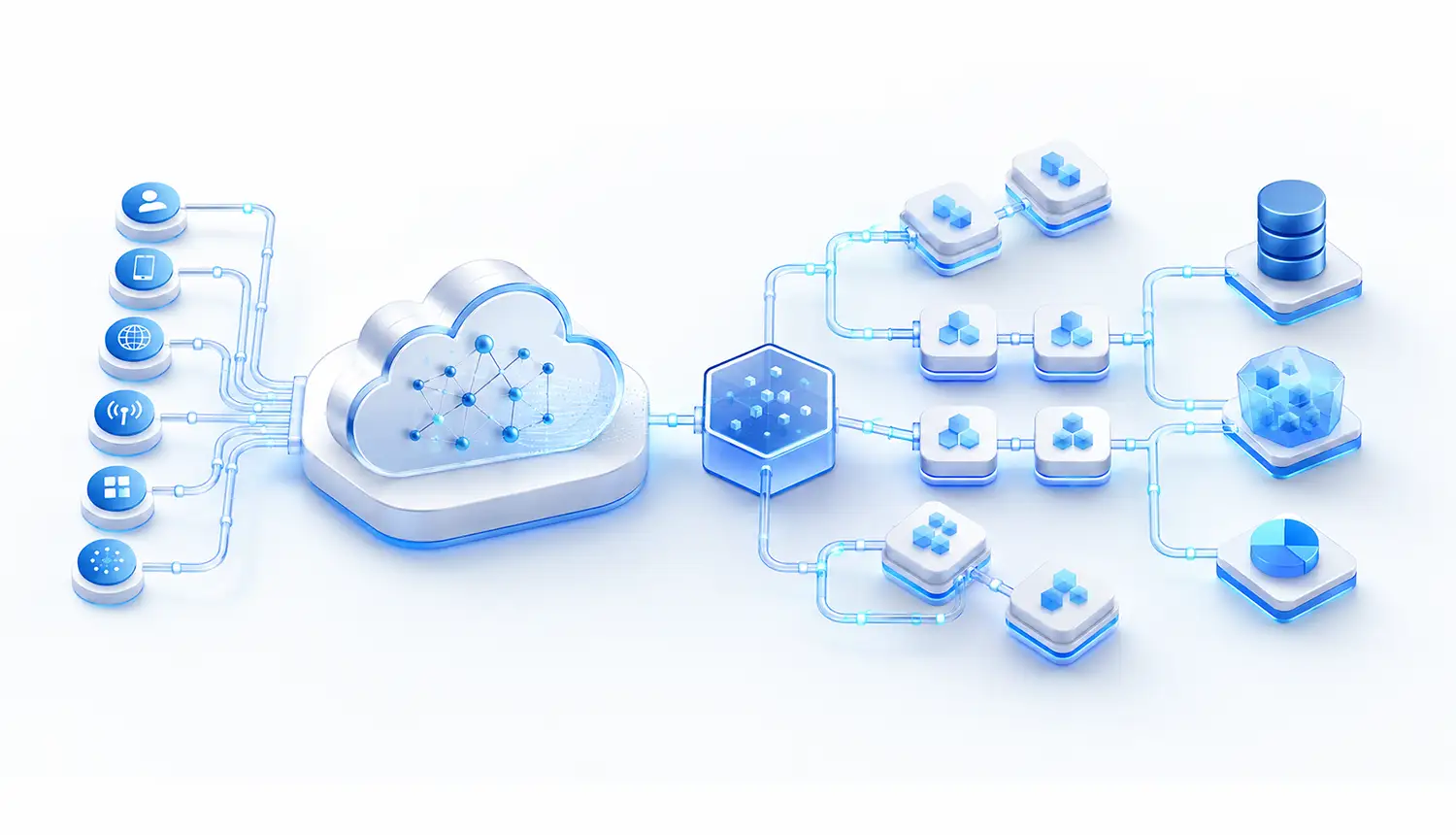
A serverless computing architecture is a cloud operating model where your team deploys application code and event logic while the provider manages provisioning, scaling, patching, and much of the runtime. The servers still exist, but they are abstracted behind managed services. You pay for requests, execution, and connected services instead of reserving idle capacity for every workload.
That model is now part of mainstream cloud architecture. Datadog’s State of Serverless report found that over 70% of its AWS customers, 60% of its Google Cloud customers, and 49% of its Azure customers had at least one serverless solution. Synergy Research Group also reported that global enterprise spending on cloud infrastructure services reached $419 billion in 2025, with fourth-quarter spending growing by approximately 30% year over year after adjusting for currency fluctuations.
For architecture teams in 2026, the question is no longer whether managed cloud services can scale or not. The question is whether a specific workload benefits from their operating model, constraints, and economics.
This guide explains the building blocks, end-to-end request flow, common patterns, data and security decisions, platform tradeoffs, and practical implementation steps. It also specifies when using containers or Kubernetes is the right approach, since serverless is meant to address a workload problem instead of becoming an ideology.
What Is a Serverless Computing Architecture (and What “Serverless” Actually Means)?
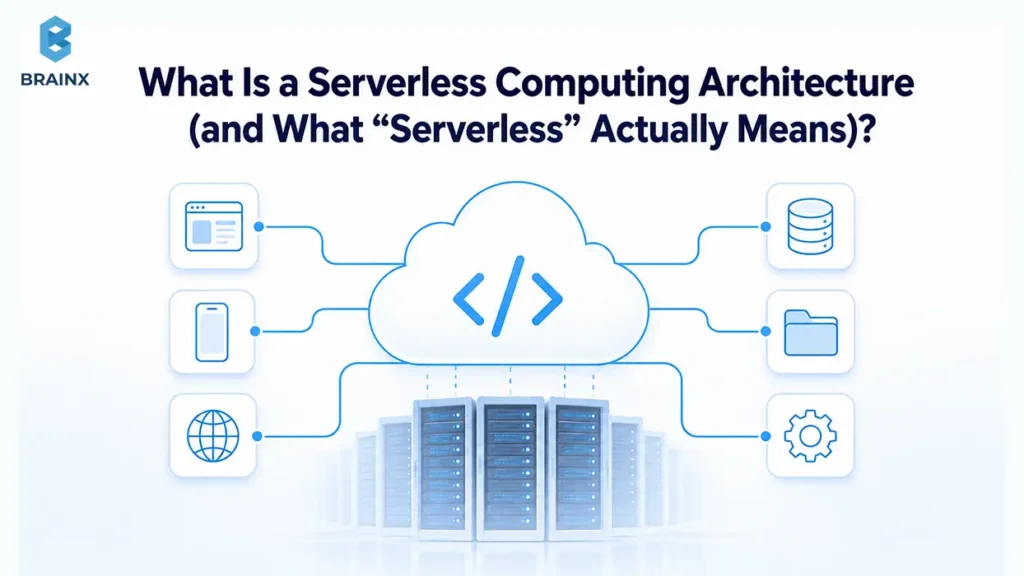
Serverless architecture is a cloud computing model in which developers build and run applications without provisioning, maintaining, or scaling the underlying servers. The physical servers still exist, but the cloud provider abstracts infrastructure management behind managed services and usage-based operating models.
A serverless system commonly combines two categories of cloud capabilities:
Function as a Service
Function as a Service, or FaaS, allows developers to deploy small units of event-driven code that run in response to HTTP requests, file uploads, messages, schedules, database changes, or other triggers.
Examples include:
- AWS Lambda
- Azure Functions
- Cloud Run functions
Google renamed Cloud Functions to Cloud Run functions as it brought function deployments into the broader Cloud Run platform. A function is now deployed as a managed Cloud Run service from source code while retaining a function-oriented development model.
Backend as a Service
Backend as a Service, or BaaS, provides managed capabilities that applications would otherwise have to build and operate themselves. These can include authentication, databases, object storage, messaging, API management, secrets, and workflow execution.
Examples include:
- Amazon DynamoDB and Amazon S3
- Firebase and Cloud Firestore
- Auth0
- Amazon SQS and Azure Service Bus
- AWS Step Functions and Azure Durable Functions
FaaS is therefore only one part of the architecture. A production serverless application may combine functions, serverless containers, managed databases, event brokers, object storage, API gateways, workflow engines, and edge runtimes. AWS similarly describes serverless applications as compositions of managed services rather than functions operating in isolation.
The practical change is a shift in responsibility. Your team still owns application behavior, data design, identity, resilience, observability, testing, and cost controls. The provider owns more of the physical infrastructure, host operating system, runtime fleet, patching, and capacity management.
This reduces undifferentiated infrastructure work, but it does not remove architecture work. Teams still need to decide how events are validated, how state is stored, how duplicate execution is handled, how failures are recovered, and how an end-to-end business transaction is monitored.
Fundamental Serverless Architecture Terms
Serverless platforms use several terms that influence how applications are designed and operated.
| Term | What It Means |
| Event | A record that something happened, such as an order being submitted, a file being uploaded, or a customer record being updated. |
| Trigger | The service or condition that starts a function, container, or workflow. Examples include an HTTP request, queue message, schedule, or object-storage event. |
| Invocation | A single request to execute a function or handler. One business transaction may create several invocations across different services. |
| FaaS | A serverless compute model in which small units of code run in response to events without the team managing the underlying runtime fleet. |
| BaaS | A managed backend capability, such as identity, storage, databases, messaging, or authentication, consumed through an API or service interface. |
| Stateless Execution | A model in which correctness does not depend on data remaining in the local memory or file system between executions. Durable state is stored externally. |
| Cold Start | The additional initialization work required when the platform creates a new execution environment before processing a request. |
| Warm Execution | An invocation that reuses an already initialized execution environment. Temporary connections or cached configuration may still be available. |
| Concurrency | The number of requests or events that can be processed at the same time, either by one instance or across multiple instances. |
| Idempotency | The ability to process the same request or event more than once without creating an unintended duplicate business outcome. |
| Orchestration | Central coordination of a multi-step workflow, including sequence, retries, waiting periods, branching, and compensation. |
| Choreography | A decentralized model in which services respond independently to events without one component controlling the full workflow. |
These terms describe different parts of the execution model. For example, a queue message may trigger an invocation, the platform may create a cold execution environment, and the handler may need to be idempotent because managed event sources can redeliver a message. AWS explicitly advises developers to expect duplicate processing with some Lambda event sources and to make handlers idempotent.
Serverless Computing Architecture Overview: Core Components
A useful serverless computing architecture overview begins with the components that carry business traffic, state, security, and failure handling. The function or container is only one component in the path.
| Building Block | Purpose | Typical Services | Primary Design Question |
|---|---|---|---|
| Ingress | Accepts HTTP requests, webhooks, files, schedules, or events. | API gateways, load balancers, object storage events, schedulers. | How will the system authenticate, validate, throttle, and reject traffic? |
| Compute | Runs stateless business logic or containerized services. | AWS Lambda, Azure Functions, Cloud Run, Cloudflare Workers. | What runtime, latency, duration, memory, and concurrency limits apply? |
| Messaging | Buffers work and decouples producers from consumers. | Queues, topics, event buses, streaming platforms. | What are the delivery, ordering, retry, and retention guarantees? |
| State and Data | Stores durable business state and large objects. | Managed SQL, document or key-value databases, object storage, caches. | Which consistency model and connection pattern does the workflow require? |
| Orchestration | Coordinates multi-step, long-running, or compensating workflows. | Step Functions, Durable Functions, Google Workflows. | Does the workflow need central visibility and deterministic recovery? |
| Identity and Secrets | Controls service access and protects credentials. | IAM roles, managed identities, secret managers, KMS. | Can each component receive only the permissions it needs? |
| Observability | Reconstructs a business transaction across distributed services. | Logs, metrics, traces, alerts, cost dashboards. | Can an operator follow one event across retries and downstream calls? |
| Delivery and Governance | Makes environments repeatable and changes reviewable. | Terraform, AWS CDK, Bicep, CI/CD policies. | Can the architecture be recreated, tested, and rolled back consistently? |
The most important omission in many diagrams is observability. A single customer action may cross a gateway, function, queue, workflow, database, and third-party API. Without correlation IDs, structured logs, traces, and meaningful business metrics, the system becomes difficult to debug precisely when it begins scaling.
Serverless Computing Architecture in Practice: A Minimal Reference Architecture You Can Copy
A strong minimum reference architecture for a SaaS capability contains seven parts:
- An Authenticated Ingress
- Request Validation
- Stateless Compute
- A Durable Data Store
- An Asynchronous Channel
- Telemetry
- Infrastructure as code
It is intentionally small enough to understand yet complete enough to operate.
Consider a lead-capture workflow. A browser or partner webhook sends a request to an API gateway. The gateway verifies the caller, applies rate limits, and invokes a function. The function validates the payload, writes a lead record, and publishes a lead-created event. A separate consumer enriches the lead through a CRM or AI service. Another consumer sends a notification after enrichment succeeds.
The synchronous path performs only the work required to acknowledge the request safely. Slower enrichment, notifications, and external integrations move behind a queue or event bus. This keeps response time predictable and gives the system a natural place to absorb traffic spikes, retry transient failures, and isolate unstable dependencies.
The durable state stays outside the handler. The function can reuse temporary connections or cached configuration while an execution environment remains warm, but correctness must never depend on local memory surviving the next invocation. That is what lets the platform add or remove instances without corrupting the workflow.
How Serverless Architecture Works: An End-to-End Request Flow
A serverless request flow is a chain of managed decisions, such as when to receive an event, which execution environment to use, when to start the runtime, run the handler, make calls to downstream services, emit a result and when to apply a retry or failure policy. Each step has an impact on latency, cost and reliability.
- An event source accepts the request or event. This may be an API gateway, object upload, queue, database change feed, scheduled trigger, or edge request.
- The platform authorizes the invocation and selects an existing execution environment or creates a new one.
- For a new AWS Lambda environment, the initialization phase starts extensions, the runtime, and static function code. This setup contributes to cold-start latency.
- The handler validates input, applies business rules, and reads or writes durable state. It should enforce timeouts for every downstream call.
- The handler returns a response or emits another event. In an asynchronous flow, the user may receive an acknowledgment before downstream work completes.
- The platform and messaging layer apply configured retry, backoff, visibility timeout, and dead-letter behavior after a failure.
- Logs, traces, metrics, and business events record what happened. A correlation ID connects the original trigger to all downstream processing.
A synchronous request should be deliberately short. Authentication, validation, a necessary state change, and an acknowledgment usually belong in the request path. Image conversion, report generation, email, data enrichment, and third-party synchronization usually belong behind a queue. This separation prevents one slow dependency from consuming the entire request timeout.
An asynchronous path changes the user experience as well as the architecture. Instead of waiting for a final result, the client receives an accepted response and a job identifier. It can poll a status endpoint, subscribe to updates, or receive a webhook when processing finishes. That contract must be designed explicitly rather than treated as an implementation detail.
What Gets Billed, and Where “Hidden Costs” Show Up in Real Systems
Function pricing is usually based on requests, execution duration, and configured memory or CPU. That simplicity can be misleading because the full workflow includes many separately billed services. A cost model should follow a business transaction from ingress to completion, not stop at the function line item.
| Cost Layer | What Drives It | Common Surprise | Control |
|---|---|---|---|
| Compute | Invocations, duration, memory or CPU, provisioned or always-ready capacity. | Functions wait on slow APIs or databases while the meter continues. | Use strict timeouts, smaller handlers, right-sized memory, and asynchronous work. |
| Ingress | API requests, edge requests, authentication, data transfer. | A low-cost function sits behind a relatively expensive gateway path. | Compare direct service URLs, gateway tiers, caching, and request aggregation. |
| Messaging and Workflow | Queue operations, event deliveries, workflow state transitions. | A chatty design creates several billable transitions per transaction. | Model transitions per business outcome and batch where latency permits. |
| Data | Reads, writes, storage, backups, replicas, connection proxies. | Autoscaling compute creates sudden database connection or operation growth. | Cap concurrency, use connection-aware services, cache carefully, and batch writes. |
| Observability | Log ingestion, retention, indexing, traces, custom metrics. | Verbose payload logging costs more than the compute it describes. | Sample traces, redact payloads, set retention, and log structured business facts. |
| Network | Egress, cross-region transfer, NAT gateways, private connectors. | A serverless workload repeatedly crosses regions or leaves the cloud. | Keep data paths local, cache results, compress payloads, and map egress early. |
| External APIs | Per-call pricing and retries. | Retries multiply third-party charges during an incident. | Use idempotency, rate limits, circuit breakers, and retry budgets. |
The right metric is usually cost per completed business transaction, such as cost per processed order, generated document, synchronized customer, or analyzed image. Track that metric beside latency, error rate, queue age, and retry volume. It exposes designs that appear inexpensive at the function layer but are costly end to end.
Why Are Teams Choosing Serverless in 2026 (What Changed vs. a Few Years Ago)?
Teams are choosing serverless more confidently in 2026 because the surrounding platform has matured. The choice is no longer limited to short functions. Managed containers, workflow engines, stronger local tooling, private networking, mature observability, and better startup controls support a wider range of production workloads.
Platform improvements are visible in current documentation. Azure now recommends Flex Consumption for new serverless function apps and offers optional always-ready instances. Cloud Run supports containerized services, jobs, automatic scaling, and GPU configurations. AWS Lambda SnapStart can reduce initialization latency for supported runtimes. Edge platforms such as Cloudflare Workers provide a different serverless model for globally distributed request handling.
The development model also improved. Infrastructure as code, deployment previews, local emulators, distributed tracing, policy-as-code, and managed identity are easier to integrate into standard delivery pipelines. Those capabilities make serverless less dependent on manual console configuration and reduce the gap between a prototype and an operable product.
AI and automation workloads add another reason. Many AI-enabled business flows are event-driven: a file arrives, text is extracted, a model is called, a result is validated, and a downstream record is updated. Serverless services are a strong fit for the orchestration and enrichment layers when model latency, GPU needs, and payload size are handled deliberately.
The model remains hybrid in most mature environments. A SaaS product may use serverless functions for webhooks and scheduled automation, serverless containers for APIs, managed workflows for long-running processes, and Kubernetes for steady, specialized services. The value comes from choosing the right operating model per workload, not from forcing every component into the same platform.
What Business Benefits Can Serverless Deliver (and When Do Those Benefits Actually Materialize)?
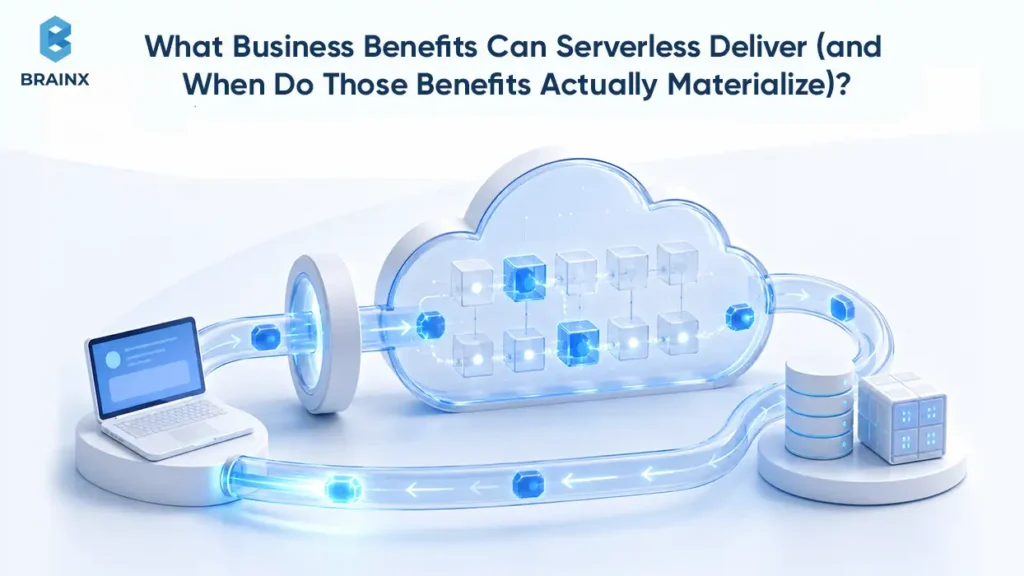
Serverless can reduce infrastructure work, accelerate delivery, and align operating cost more closely with demand. However, these benefits are conditional. They materialize when the workload, architecture, delivery process, and downstream systems support the serverless operating model.
| Potential Benefit | How It Creates Value | When It Materializes | What Can Prevent It |
| Reduced operational overhead | The provider manages provisioning, runtime capacity, host patching, and much of the scaling infrastructure. | Teams use managed services instead of rebuilding platform capabilities and retain clear production ownership. | Teams treat managed services as maintenance-free and neglect observability, governance, or recovery planning. |
| Elastic scalability | Compute instances can be added or removed as requests and events change. | Work can scale horizontally and downstream systems can absorb, buffer, or limit demand. | Unbounded concurrency overwhelms databases, third-party APIs, or shared services. |
| Lower idle cost | Scale-to-zero and usage-based billing reduce the need to reserve capacity between executions. | Workloads are intermittent, seasonal, scheduled, or highly variable. | The application requires permanent warm capacity or runs continuously at stable high utilization. |
| Faster development and release cycles | Managed gateways, queues, databases, identity services, and deployment tools reduce infrastructure setup. | Teams use reusable templates, infrastructure as code, automated testing, and small deployment boundaries. | Manual console changes, tightly coupled functions, or weak integration testing recreate delivery friction. |
| Granular deployment and scaling | Individual functions, services, and consumers can be updated and scaled separately. | Boundaries align with real business capabilities and have clear ownership. | Excessive fragmentation creates a distributed monolith with many dependencies and deployment relationships. |
| Event-driven flexibility | Producers and consumers can evolve independently through queues, topics, and event buses. | Event contracts are explicit, versioned, observable, and designed for duplicate delivery. | Uncontrolled choreography makes business flows difficult to trace and recover. |
| Faster experimentation | A bounded capability can be created, measured, modified, or retired without provisioning a permanent platform. | The pilot has defined success criteria, production controls, and a path to scale or retire. | Prototype shortcuts become permanent architecture without security, monitoring, or resilience work. |
| Improved fault isolation | Queues, retries, timeouts, dead-letter paths, and independently scaled consumers can contain failures. | Each component has bounded responsibility and failures do not remain in long synchronous chains. | Shared state and cascading downstream calls turn a local failure into a broader outage. |
The strongest business case is often reduced lead time for a bounded capability. A team can add a webhook consumer, document-processing step, notification workflow, or scheduled reconciliation without creating and maintaining a new server fleet.
This benefit can compound when the organization has reusable security, deployment, observability, and infrastructure-as-code standards. CyberArk, for example, created serverless architectural blueprints for common platform concerns and reported reducing the setup time for a new service from 18 weeks to approximately three hours. That result came from combining serverless services with automation and platform engineering, not from functions alone.
Granularity also requires restraint. Separating every small operation into a different function can increase network calls, deployment relationships, and operational complexity. Boundaries should follow independently owned business capabilities, scaling characteristics, or failure domains rather than arbitrary code size.
The cost case requires similar care. Serverless can lower total cost for low-volume, variable, or bursty workloads, but stable compute-heavy workloads may cost less on reserved containers or virtual machines. Compare total cost of ownership, including engineering time, platform services, logging, networking, security, and on-call work. A cheaper function line item does not automatically create a cheaper product.
Challenges of Serverless Architecture
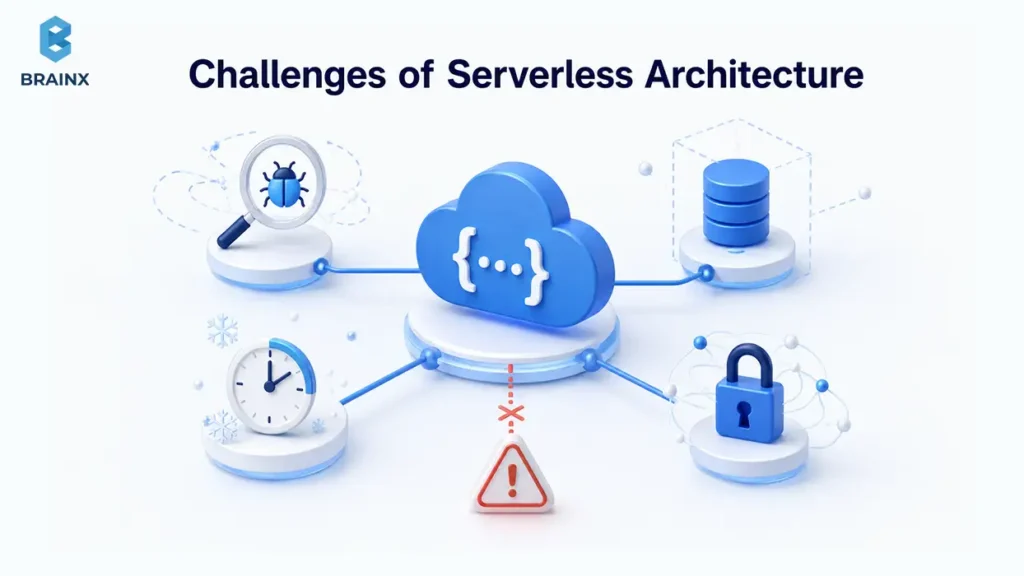
Serverless transfers more infrastructure responsibility to the provider, but it also introduces distributed-system and platform-specific challenges. These limitations do not make serverless unsuitable by default. They determine where the model needs additional controls or where another runtime is a better fit.
Cold Starts and Tail Latency
When no initialized execution environment is available, the platform may need to start a runtime, load application code, and initialize dependencies before processing the request. This can increase tail latency, particularly for latency-sensitive APIs, large packages, or runtimes with expensive startup logic.
Warm-capacity features can reduce this risk, but they introduce baseline cost. Azure Flex Consumption provides always-ready instances, while Cloud Run supports minimum instances. Google also notes that reducing cold starts through minimum instances has billing implications.
The decision should be based on measured percentile latency rather than average response time. Not every background worker needs startup optimization, while a user-facing authentication or checkout endpoint may require it.
Distributed Debugging
A single transaction may cross an API gateway, function, queue, event bus, workflow engine, database, and third-party API. Traditional application logs from one process are not enough to reconstruct that path.
Teams need correlation IDs, structured logs, distributed traces, service-level metrics, and business-outcome monitoring from the start. Azure’s current guidance emphasizes application-wide integration testing and monitoring through Application Insights and Azure Monitor, while OpenTelemetry provides a vendor-neutral framework for traces, metrics, and logs.
Platform Limits
Every managed service imposes boundaries around execution duration, payload size, concurrency, memory, networking, and regional availability. A design that works in a local environment can fail when a payload exceeds a gateway limit or when one concurrency setting allows more work than a database can support.
These limits are not only technical restrictions. They shape the application contract. Large files may need to move through object storage, long-running processes may need orchestration or job services, and heavy compute may require serverless containers or dedicated infrastructure.
Cost Variability
Usage-based billing reduces idle cost, but the final bill can become difficult to predict when one business transaction creates many function invocations, event deliveries, workflow transitions, database operations, logs, and external API calls.
Different providers, regions, memory allocations, and execution patterns can also produce materially different costs. A 2026 comparative FaaS pricing study found meaningful cost variation across both providers and regions, reinforcing the need to model the actual workload instead of relying on a generic per-request comparison.
Use cost per completed business transaction as the primary metric and test several demand scenarios before production.
State and Data Complexity
Functions are stateless by default, but business processes are not. Orders, approvals, customer records, workflow progress, and idempotency keys must live in durable external services.
This creates design questions around consistency, transactions, connection management, event ordering, and schema evolution. A rapidly scaling compute layer can also generate more database connections or write operations than the data tier can safely handle.
Duplicate Events and Retry Behavior
Managed event systems may retry failed work and can deliver the same event more than once. A handler that sends a payment, creates an order, or emails a customer without idempotency can repeat that side effect.
AWS recommends idempotent functions for event-source mappings because duplicate processing can occur. Its best-practice guidance also recommends bounded retries, timeouts, backoff, and partial-batch handling where supported.
Vendor and Operational Lock-In
Business logic can often be moved more easily than the surrounding operations. Identity policies, event formats, workflow definitions, database models, networking, observability, and deployment tooling can become closely tied to a provider.
Avoiding every provider-native service can remove much of the reason for adopting serverless. A more practical approach is to isolate domain logic, keep contracts explicit, use infrastructure as code, and document the cost of replacing each provider-specific capability.
Local Testing and Environment Parity
A handler may run correctly in a local unit test while failing in production because of IAM policies, event envelopes, networking, concurrency, or managed-service behavior.
Microsoft recommends continuously testing functions within the context of the complete application and including integration tests in build automation. AWS CDK applications containing Lambda functions can also be built and tested locally through the AWS SAM CLI, but cloud-based integration testing remains necessary for managed-service behavior.
The later production-gotchas section explains how to mitigate these risks in implementation. This section establishes when those risks should influence the original architecture decision.
Serverless Architecture Use Cases: Best Fits and Risky Workloads
The best serverless use cases are event-driven, horizontally scalable, short enough for the chosen platform, and able to keep durable state outside the compute process. Risk increases when the workload needs long execution, strong affinity to local memory, specialized networking, or stable high utilization.
| Use Case | Fit | Why |
|---|---|---|
| Webhooks and integration endpoints | Strong | Bursty traffic, small handlers, clear retries, and independent scaling. |
| Public and internal APIs | Strong to conditional | Good for variable demand when latency, database connections, and payload limits are controlled. |
| File and media processing | Strong | Object events naturally trigger parallel transformations and asynchronous workflows. |
| Scheduled automation and reconciliation | Strong | No need to keep a worker running between schedules. |
| Queue consumers and event pipelines | Strong | Messaging provides buffering, retries, and independent scaling. |
| AI enrichment and document intelligence | Conditional | Good for orchestration and model calls; heavy inference may need serverless GPU containers or dedicated compute. |
| Real-time streaming | Conditional | Works for event transforms and consumers, but throughput, ordering, and state require careful service selection. |
| Long-running CPU or GPU processing | Risky | Duration, startup, memory, and cost may favor jobs, containers, or dedicated infrastructure. |
| Low-latency trading or control systems | Risky | Tail latency and deterministic runtime control can outweigh managed simplicity. |
| Stateful legacy transaction cores | Risky | Shared state, long transactions, and tight database coupling resist horizontal event-driven execution. |
A two-minute fit check can prevent weeks of rework. Score each statement from 0 to 2, where 0 means false, 1 means partly true, and 2 means clearly true:
- Traffic is variable, seasonal, scheduled, or event-driven.
- The unit of work can be completed within the platform’s duration and payload limits.
- Durable state can live in a managed database, object store, cache, or workflow engine.
- Duplicate delivery can be handled through idempotency or deduplication.
- The team can implement infrastructure as code, tracing, alerts, and cost monitoring.
- Downstream systems can tolerate, buffer, or cap concurrency.
A score of 9 to 12 indicates a strong candidate for a pilot. A score of 5 to 8 indicates a conditional fit that needs a careful reference design. A score below 5 usually points toward containers, virtual machines, or a hybrid design.
When a Container-First or Kubernetes Approach Is the Better Call
Choose a container-first platform when you need more control without taking on a full cluster. Serverless containers are useful for custom runtimes, larger application frameworks, predictable concurrency, longer requests, and portability across environments. They preserve a managed scaling model while giving the team a normal container boundary.
Choose Kubernetes when the workload needs deep control over networking, scheduling, sidecars, service meshes, storage, specialized hardware, daemon processes, or coordinated multi-service operations. It is also appropriate when a platform team already operates clusters efficiently and the workload has stable utilization that justifies reserved capacity.
A hybrid architecture is often the best answer. Keep edge handlers, webhooks, scheduled jobs, and asynchronous integration steps serverless. Run steady APIs, specialized services, or long-lived workers in containers. Use Kubernetes only where its control and ecosystem solve a real requirement. This reduces the cluster surface while avoiding serverless constraints where they would become architectural debt.
Serverless Architecture Examples
A use case describes where serverless may fit. An architecture example shows how the services work together to complete a business outcome. The following examples illustrate different combinations of synchronous requests, asynchronous events, state, and observability.
Example 1: Serverless API With Asynchronous Order Processing
An ecommerce application receives a new order through an authenticated API.
Architecture flow:
Customer request → API gateway → order function → transactional data store → order-created event → queue → payment, inventory, and notification consumers
The API gateway authenticates the customer, validates the request size, and applies rate limits. The order function validates business rules and creates an order record with an idempotency key.
The synchronous path ends once the system has safely accepted the order. Payment confirmation, inventory updates, fraud checks, and notifications continue asynchronously through queues or an event bus.
Each consumer can scale and retry independently. The order status becomes the source of truth for the customer experience, while correlation IDs connect the original request to every downstream event.
This pattern works when the customer does not need every downstream activity to finish before receiving confirmation. It becomes risky when the business presents an order as complete before required payment or inventory guarantees are established.
Example 2: AI-Assisted Document Processing
A healthcare, insurance, or financial application processes uploaded documents and sends structured results for review.
Architecture flow:
Secure upload → object storage → file-created event → extraction function → document AI or OCR service → queue → validation and classification → workflow engine → human review → approved business record
The browser uploads the document directly to encrypted object storage rather than passing a large file through the function. An object event starts the extraction workflow.
A function validates the file type, scans required metadata, and sends the document to an OCR or AI service. The raw result is written to durable storage and a queue triggers validation, classification, or policy checks.
A workflow engine tracks long-running steps, review status, timeouts, and failures. Human approval remains mandatory where the model output affects a regulated or high-impact decision.
This design keeps large objects outside event payloads, makes individual stages replayable, and separates AI inference from the system of record. It also lets teams measure model latency, validation failure rate, reviewer workload, and cost per accepted document.
Example 3: On-Demand Image Transformation
A marketplace or travel platform needs to generate different image formats for devices, campaigns, or partner channels.
Architecture flow:
Image request → content delivery network → API gateway or edge handler → function or serverless container → object storage → transformed image → content delivery network cache
The client requests a particular image size or format. A cached result is returned immediately when available. Otherwise, a function or serverless container retrieves the source image, applies the transformation, stores the output, and returns the new asset.
The first request pays the transformation cost, while subsequent requests are served from the cache. Rate limits and transformation rules prevent users from generating unlimited arbitrary variants.
Booking.com used a comparable AWS serverless flow for dynamic advertising images. Requests move through CloudFront and API Gateway to Lambda, which retrieves source assets from Amazon S3 and generates the completed image. AWS reports that the solution handles more than 1,000 requests per second with subsecond delivery and 99.9% availability.
Example 4: Event-Driven SaaS Integration
A SaaS application needs to synchronize customer, billing, CRM, and notification systems without placing every integration in the user-facing request path.
Architecture flow:
Business-system update → event bus → routing rules → independent queues → integration consumers → external APIs → status and audit store
The producing service emits a versioned business event without calling every downstream platform directly. The event bus routes the event to the relevant consumers, and each external integration receives its own queue.
This prevents one slow or unavailable third-party API from blocking other consumers. Each integration uses a stable idempotency key, bounded retries, a dead-letter path, and a rate limit based on the external service’s capacity.
The model is particularly useful when several systems need the same event but have different reliability, throughput, and recovery requirements.
Serverless Architecture vs. Containers and Microservices
Serverless, containers, Kubernetes, and microservices describe related but different architecture decisions. Serverless and containers primarily describe how workloads are packaged, executed, scaled, and operated. Microservices describe how an application is divided into independently deployable business capabilities.
A mature cloud system may use all of them. It can run some microservices as functions, others as serverless containers, and stable or specialized services on Kubernetes.
Serverless Architecture vs. Container Architecture
Functions work best when the unit of execution is small, event-driven, stateless, and compatible with the provider’s runtime and duration boundaries. Containers are better when the team needs a custom runtime, a larger application framework, longer request handling, more predictable concurrency, or greater control over the execution environment.
| Decision Area | Functions and Event-Driven Serverless | Serverless Containers | Kubernetes |
| Deployment unit | Function or small handler | Container image or service | Container, pod, deployment, job, or custom workload |
| Infrastructure management | Lowest | Low | Highest |
| Runtime control | Limited to supported runtimes and configuration | Strong control through the container image | Deep control over runtime, scheduling, and cluster behavior |
| Scaling model | Event or invocation driven | Request, instance, or job driven | Configurable through pods, nodes, and autoscaling policies |
| Best workload shape | Bursty events, webhooks, scheduled tasks, short APIs | APIs, jobs, custom frameworks, and longer processing | Steady services, specialized networking, platform workloads, and complex orchestration |
| State model | External durable state | External state, with more instance-level flexibility | Supports external and cluster-managed state patterns |
| Portability | Domain code may be portable, operations are often provider-specific | Higher runtime portability through standard containers | High container portability, but cluster operations remain platform-specific |
| Operational burden | Lowest at the infrastructure layer | Moderate | Highest |
| Cost advantage | Intermittent and variable demand | Variable demand requiring container control | Stable utilization or workloads needing reserved capacity and deep control |
Choose a container-first platform when the application needs more runtime control without requiring a full cluster. Google Cloud positions Cloud Run as a fully managed serverless platform for services and microservices, while AWS Fargate provides serverless container execution without direct server management.
Choose Kubernetes when the workload requires service meshes, sidecars, daemon processes, custom scheduling, specialized networking, persistent cluster services, complex multi-service operations, or a platform team that already runs clusters efficiently.
A hybrid design is often the most practical answer:
- Run webhooks, scheduled automation, lightweight APIs, and event consumers as functions.
- Run custom frameworks, longer APIs, and specialized jobs as serverless containers.
- Use Kubernetes for stable services and workloads that genuinely require cluster-level control.
Serverless Architecture vs. Microservices
Serverless and microservices are not opposing choices.
Microservices architecture divides an application into smaller services aligned with specific business capabilities. Each service can be developed, deployed, owned, and scaled independently.
Serverless architecture defines an operating model in which the provider manages more of the infrastructure, capacity, scaling, and runtime.
A microservice can run as:
- One or more serverless functions
- A service on Cloud Run or another serverless container platform
- A container on Kubernetes
- A process on virtual machines
- A combination of these models
Google Cloud documents Cloud Run, Google Kubernetes Engine, and managed containers as different ways to deploy microservices. Its serverless guidance also presents Cloud Run functions as a way to expose small microservices through HTTP or respond to webhooks and events.
The main risk is confusing small deployment units with good service boundaries. Dividing an application into dozens of functions does not automatically create a well-designed microservices architecture. The services must still have clear ownership, stable contracts, independent data responsibilities, and meaningful business boundaries.
Use function-based microservices when:
- The service is naturally event-driven.
- It has a narrow responsibility.
- It can externalize durable state.
- It benefits from independent burst scaling.
- It fits the runtime, duration, and payload constraints.
Use container-based microservices when:
- The service uses a larger framework or custom runtime.
- Several closely related routes belong in one deployment.
- The workload needs longer execution or controlled concurrency.
- Portability and local environment parity are priorities.
- The service runs steadily enough to benefit from instance-level resource control.
The architecture should optimize for understandable ownership and reliable business flows, not the highest possible number of independently deployed components.
What Serverless Computing Architecture Patterns Should You Use (with Tradeoffs and “Fit Signals”)?
Pattern choice is primarily a failure-handling decision. The diagram matters less than how the system behaves when an event is duplicated, a consumer fails halfway, a dependency slows down, or a workflow must be reversed. Choose the simplest pattern that makes those behaviors explicit.
| Pattern | Best Fit | Main Tradeoff | Fit Signal |
|---|---|---|---|
| API backend | Request-response APIs, webhooks, mobile and web backends. | Latency and availability depend on downstream calls. | The synchronous path is short and has a clear latency budget. |
| Event pipeline | Background processing, integrations, files, telemetry. | Eventual consistency and duplicate handling. | The producer can accept work before every downstream step finishes. |
| Fan-out and fan-in | Parallel enrichment, batch analysis, multi-target delivery. | Aggregation, partial failure, and cost amplification. | Independent tasks can run concurrently and results can be combined later. |
| Saga | Multi-service business transactions without distributed database transactions. | Compensation logic and workflow complexity. | Each completed step has a defined compensating action. |
| Scheduled job | Reconciliation, reporting, cleanup, reminders, data synchronization. | Overlap, missed runs, and duplicate execution. | The task is periodic and can be made idempotent. |
| Orchestrated workflow | Long-running steps, human approval, branching, retries, audit trails. | More state transitions and platform coupling. | Operators need a visible execution history and deterministic recovery. |
| Choreography | Simple, loosely coupled event reactions. | Business flow becomes hard to see as consumers multiply. | No single component needs to own the full process. |
The distinction between orchestration and choreography deserves attention. Choreography lets services react independently to events and keeps coupling low. Orchestration gives one workflow engine responsibility for sequence, state, retries, and compensation. Use choreography for simple reactions. Use orchestration when a multi-step business outcome requires central visibility, timeouts, approvals, or controlled rollback.
A Reference Pattern for APIs: Auth, Rate Limits, Validation, and Safe Rollouts
A production API pattern starts at the edge. The gateway terminates TLS, authenticates the caller, applies route-level authorization and rate limits, and rejects oversized or malformed traffic before it reaches application compute. The handler validates the request again because gateway configuration is not a substitute for business authorization.
- Authenticate with a standard identity provider or signed service credential. Keep user authentication separate from service-to-service authorization.
- Authorize every operation and object, not only the route. The OWASP API Security Top 10 continues to place broken object-level and function-level authorization among the leading API risks.
- Validate schema, content type, size, and business constraints before writing data or calling downstream services.
- Assign an idempotency key to mutation requests so a client retry cannot create duplicate orders, payments, or jobs.
- Use timeouts, circuit breakers, and bounded retries for dependencies. Return a controlled error rather than waiting for the platform timeout.
- Deploy through versions or revisions, then use canary traffic, aliases, or weighted routing. Track error rate, latency, and business success before expanding traffic.
- Emit structured audit and trace data without logging secrets or sensitive payloads.
These controls align with OWASP API Security guidance, which highlights authorization, authentication, resource consumption, misconfiguration, and unsafe consumption of external APIs. In serverless systems, those risks often sit at the boundaries between the gateway, handler, event payload, and downstream service.
Event Pipeline Pattern: Retries, Dead-Letter Queues, and Exactly-Once Expectations
Most managed event systems provide at-least-once delivery under some failure conditions. That means a message can be delivered more than once. Exactly-once business outcomes are therefore achieved through application design, not assumed from a single platform label.
An effectively-once consumer follows a repeatable sequence: validate the event, derive a stable idempotency key, check or atomically record processing state, perform the business operation, and mark completion. A duplicate event then returns the recorded outcome instead of repeating the side effect.
Retries should target transient failures and stop after a bounded attempt or time budget. Use exponential backoff with jitter. Move poison messages to a dead-letter queue with enough context for diagnosis and replay. Alert on queue age, retry rate, dead-letter count, and the age of the oldest unprocessed business event.
Microsoft’s event-driven architecture guidance emphasizes idempotent processing, error handling, dead-letter paths, correlation IDs, event schema evolution, and the tradeoffs of eventual consistency. Those concerns are portable across AWS, Azure, Google Cloud, and other event platforms.
A replay process is part of the architecture, not an emergency script. It should preserve ordering rules, respect current schema versions, avoid flooding downstream systems, and record who initiated the replay. Without a safe replay path, a dead-letter queue becomes a storage location rather than a recovery mechanism.
How Do You Handle Data and State in a Stateless-by-Default World?
Stateless compute means any instance can process the next event. It does not mean the application has no state. Durable state moves into systems designed to persist, coordinate, and query it reliably.
Choose the data store from the access pattern and consistency requirement. A key-value or document store can serve high-scale entity lookups and event state. A managed relational database remains appropriate for transactions, reporting, and established SQL models. Object storage fits large files and immutable artifacts. A workflow engine stores execution state for long-running processes. A cache reduces repeated reads but must never become the only source of truth for critical data.
Database connectivity is a frequent production bottleneck. A serverless platform can create many compute instances faster than a relational database can accept connections. Reusing connections inside warm environments helps, but it is not enough by itself. Cap function concurrency, use a managed connection proxy where available, keep transactions short, and move bursty writes behind a queue.
Separate business state from execution state. The business state answers questions such as whether an order is paid or a consent form is signed. Execution state answers which workflow step is running, how many retries occurred, or whether a timeout fired. Mixing them makes recovery and reporting harder.
Design for eventual consistency only where the business can tolerate it. A customer profile update may take seconds to reach search and analytics. A payment balance or inventory reservation may need a stronger consistency boundary. Serverless does not force one consistency model, but event-driven designs require the team to state the expected delay and user experience explicitly.
Schema evolution also matters. Include event type, version, timestamp, producer, correlation ID, and stable entity identifiers in the envelope. Consumers should ignore unknown optional fields and handle supported versions deliberately. Breaking an event contract can affect consumers that the producer does not know exist.
For distributed business transactions, use a saga or orchestrated workflow instead of pretending multiple services share one atomic database transaction. Each step records its outcome and defines a compensating action where reversal is possible. Compensation is a business decision, not a technical rollback. Refunding a payment, releasing inventory, and marking an order cancelled are distinct operations with their own failure paths.
What Security and Compliance Controls Matter Most in Serverless Systems?
Serverless reduces responsibility for host infrastructure, but it increases the importance of identity, configuration, event trust, and service boundaries. Every function, queue, workflow, and data store becomes a policy surface.
| Control Area | Minimum Production Standard |
|---|---|
| Least-privilege identity | Use a separate role or managed identity per function or service boundary. Deny by default and grant only required actions and resources. |
| Ingress security | Authenticate callers, authorize objects and functions, validate schemas, enforce rate and size limits, and protect sensitive business flows. |
| Secret management | Store secrets in a managed secret service, rotate them, avoid environment or log exposure, and prefer short-lived identities over static keys. |
| Encryption and data classification | Encrypt data in transit and at rest, classify payloads, minimize sensitive fields in events, and control cross-region movement. |
| Supply-chain security | Pin dependencies, scan packages and container images, generate an SBOM, sign artifacts where required, and patch supported runtimes. |
| Network controls | Use private endpoints or VPC integration when justified, restrict egress, and document every external dependency. |
| Auditability | Record deployments, policy changes, privileged actions, workflow decisions, and data access with tamper-resistant retention. |
| Resilience controls | Set timeouts, concurrency limits, retry budgets, dead-letter paths, and tested recovery procedures. |
| Compliance evidence | Map controls to the actual data flow, retain evidence from CI/CD and cloud audit logs, and test access and recovery controls regularly. |
Least privilege is the most important architecture habit. A generic role shared across many functions increases blast radius and makes audits less meaningful. Give each component access only to the queue, table, secret, bucket, or API actions it requires. Review wildcard permissions and temporary exceptions as part of delivery, not only during an annual audit.
Event payloads must be treated as untrusted input, even when they originate from another managed service. Validate the source, schema, tenant, entity ownership, and allowable values. Avoid including secrets or unnecessary personal data in broadly distributed events. Encrypt sensitive fields when the message can pass through multiple services or teams.
Compliance depends on the full data path. A managed runtime may be compliant, but the application can still violate policy through logs, region selection, overbroad permissions, unapproved third-party APIs, or excessive retention. Create a data-flow diagram and control matrix before production, then connect evidence collection to deployment and operations.
What Does Implementation Look Like (Timeline, Team Roles, and Migration Steps)?
A focused serverless pilot can reach production in roughly six weeks when the use case is bounded, access is available, and the team already has a cloud landing zone. Complex regulated workflows or legacy migrations need more time, but the sequence remains similar.
| Week | Focus | Primary Outputs |
|---|---|---|
| 1 | Fit and discovery | Workload profile, event map, latency budget, data classification, success metrics, and risk list. |
| 2 | Reference architecture | Service boundaries, platform choice, IAM model, data design, IaC foundation, and cost model. |
| 3 | Production-grade slice | One ingress path, one handler or service, durable state, CI/CD, and baseline telemetry. |
| 4 | Asynchronous workflow | Queue or event path, idempotency, retry policy, dead-letter handling, and status contract. |
| 5 | Hardening | Load tests, failure injection, security review, recovery tests, dashboards, alerts, and runbooks. |
| 6 | Controlled rollout | Canary release, cost and performance review, operational handoff, and expansion decision. |
The core team usually includes a product owner, cloud or solution architect, backend engineer, DevOps or platform engineer, QA engineer, and security reviewer. A data engineer joins when pipelines or analytics are central. A compliance specialist joins when the workflow handles regulated data. Keep ownership explicit because managed services still require someone to own reliability and business outcomes.
For migration, start at a boundary with measurable value. Good candidates include a scheduled job, inbound webhook, document-processing flow, notification service, or read-heavy API. Avoid beginning with the most stateful transaction core. The first migration should teach the operating model without placing the business at unnecessary risk.
- Baseline the current workload: request rate, execution time, latency percentiles, failure rate, resource utilization, deployment lead time, and monthly operating cost.
- Extract a bounded capability behind a stable API or event contract. Use an anti-corruption layer when the legacy model should not leak into the new service.
- Build the cloud foundation through infrastructure as code, including identity, environments, secrets, telemetry, policy, and budget alerts.
- Run the new path in shadow or dual-write mode when data risk justifies it. Compare outputs before switching traffic.
- Roll out gradually and keep a tested rollback route. Remove the legacy path only after the new service meets reliability, cost, and support criteria.
Tools for Building, Testing, and Observing Serverless Systems
A serverless toolchain should follow modern DevOps practices to support repeatable infrastructure, local feedback, cloud integration testing, safe deployment, observability, security, and cost governance. Select tools by function rather than adopting several products that solve the same problem.
| Tool Category | Purpose | Common Options | Selection Question |
| Infrastructure as code | Defines functions, gateways, queues, permissions, databases, and monitoring as version-controlled infrastructure. | Terraform, AWS CDK, AWS SAM, Azure Bicep, Pulumi, Google Cloud Infrastructure Manager | Can the team recreate every environment without manual console work? |
| Serverless application frameworks | Packages code, events, permissions, and service configuration into deployable application definitions. | AWS SAM, Serverless Framework, SST, Azure Functions Core Tools, Functions Framework | Does it support the team’s cloud, runtime, testing model, and governance requirements? |
| Local development and emulation | Runs handlers and selected managed-service behavior during development. | AWS SAM CLI, Azure Functions Core Tools, Firebase Local Emulator Suite, Functions Framework, LocalStack | Which behaviors can be tested locally, and which still require a cloud environment? |
| Testing and contract validation | Verifies handlers, event schemas, APIs, integrations, retries, and failure behavior. | Standard unit-test frameworks, Testcontainers, contract testing, cloud integration environments, load-testing tools | Does the test strategy cover IAM, real event envelopes, concurrency, and downstream limits? |
| CI/CD and release control | Automates validation, security checks, infrastructure deployment, and controlled traffic rollout. | GitHub Actions, GitLab CI/CD, Azure DevOps, AWS CodePipeline, Cloud Build | Can the pipeline deploy, verify, roll back, and record every production change? |
| Observability | Connects logs, metrics, traces, errors, and business outcomes across distributed services. | OpenTelemetry, AWS X-Ray and CloudWatch, Azure Monitor and Application Insights, Google Cloud Observability, Datadog, New Relic | Can operators follow one customer transaction across every service and retry? |
| Security and policy | Scans dependencies and infrastructure, checks permissions, and enforces delivery policies. | Cloud-native security services, Checkov, Trivy, Snyk, OPA, IAM access analyzers | Are least privilege, secret handling, artifact scanning, and policy checks part of CI/CD? |
| Cost management | Tracks consumption, budgets, anomalies, and unit economics. | AWS Cost Explorer, Azure Cost Management, Google Cloud Billing, FinOps platforms | Can the team see cost per environment, service, tenant, and completed business transaction? |
AWS lists SAM, CDK, the Serverless Framework, Terraform-based tooling, CloudWatch, X-Ray, Datadog, New Relic, and other options across serverless development and observability workflows. AWS CDK and SAM can also be used together to build and locally test CDK-defined Lambda applications.
Local emulation improves developer feedback, but it does not replace cloud integration testing. IAM, managed retries, event-source behavior, network configuration, service quotas, and concurrency frequently behave differently from local substitutes.
For observability, prioritize open instrumentation and consistent transaction context. OpenTelemetry supports vendor-neutral generation and export of traces, metrics, and logs, including FaaS-specific conventions for AWS, Azure, and Google Cloud resources.
The minimum production toolchain should provide:
- Infrastructure as code for all environments
- Automated unit, integration, and contract tests
- Dependency and infrastructure scanning
- Controlled deployment and rollback
- Structured logs, metrics, and distributed traces
- Alerts based on user and business outcomes
- Budget and cost-anomaly monitoring
- A repeatable dead-letter replay process
The goal is not to collect the largest toolset. It is to create a delivery system in which architecture, permissions, tests, telemetry, and cost controls evolve together with the application.
The Production Gotchas Competitors Don’t Warn You About (and How to Design Around Them)
Cold starts are only one production issue. Connection storms, payload and timeout limits, burst concurrency, duplicate events, log volume, local-environment mismatch, and proprietary workflow definitions cause more persistent problems when they are ignored early.
| Gotcha | What Happens | Design Response |
|---|---|---|
| Cold starts | A new environment initializes code, dependencies, and runtime before handling traffic. | Keep packages lean, remove slow initialization, use warm capacity or startup optimization only for latency-critical paths. |
| Connection storms | Rapid scale-out creates more database or partner connections than the dependency supports. | Cap concurrency, use queues, proxies and pooling, and load-test downstream limits. |
| Timeout mismatch | The function continues to work after a gateway or client has already timed out. | Set the shortest timeout at the application layer, cancel work, and move long processing async. |
| Payload limits | Large files or messages fail at a gateway, queue, or function boundary. | Store large objects externally and pass references plus integrity metadata. |
| Retry amplification | Multiple layers retry the same failure and create an incident storm. | Assign one retry owner per boundary and use a total retry budget. |
| Log explosion | Every invocation logs full payloads or stack details and creates high cost and data exposure. | Use structured events, sampling, redaction, retention policies, and log-level controls. |
| Local parity gap | Developers test handlers but not IAM, event envelopes, workflow, or managed service behavior. | Use local emulators where useful plus cloud integration environments and contract tests. |
| Lock-in in operations | Domain code is portable, but IAM, workflows, events, and observability are not. | Isolate cloud adapters, keep contracts explicit, and accept provider coupling where it buys real value. |
Current platform limits illustrate why these checks belong in architecture. AWS Lambda documents a 15-minute function timeout and 6 MB synchronous request and response payloads. Azure Functions documents a 230-second maximum response time for HTTP-triggered functions because of the Azure Load Balancer, even when the hosting plan permits longer execution. Cloud Run allows request timeouts up to 60 minutes. These limits can change, so teams should verify them during design and before launch.
Portability should be evaluated at several layers. Business rules can remain cloud-neutral more easily than identity, eventing, networking, data, and workflow operations. Portable code is useful, but portable operations can require significant abstraction and may hide valuable provider capabilities. Optimize for a credible exit path, not theoretical zero coupling.
How Do You Choose a Serverless Platform in 2026 (AWS vs. Azure vs. GCP vs. Edge)?
Choose a platform from ecosystem fit, workload form, enterprise controls, team capability, region requirements, and the services surrounding compute. The best option is the one that minimizes operational compromise for the workloads that matter most.
| Platform | Best Fit | Selected 2026 Characteristics | Watch Closely |
|---|---|---|---|
| AWS Lambda and AWS serverless services | Event-driven systems in the AWS ecosystem with deep integration across queues, events, workflows, data, and IAM. | Lambda timeout up to 15 minutes; 6 MB synchronous payload; SnapStart and provisioned concurrency options for startup-sensitive functions. | Service combinations can become complex; model gateway, workflow, log, egress, and data costs. |
| Azure Functions and Azure Container Apps | Microsoft-centric enterprises, .NET workloads, Azure integration, and hybrid identity requirements. | Flex Consumption is the recommended serverless function plan; optional always-ready instances; per-function scaling; 230-second HTTP response ceiling. | Hosting-plan differences, networking, and language support must be checked for each application. |
| Cloud Run Functions (formerly Google Cloud Run) | Container-first serverless, portable frameworks, HTTP services, jobs, event handlers, and selected AI inference workloads. | Request timeout up to 60 minutes; configurable concurrency up to 1,000 per instance; minimum instances and startup CPU boost. | Concurrency settings can overload memory, CPU, or databases; warm instances introduce baseline cost. |
| Cloudflare Workers and edge services | Low-latency request handling, personalization, routing, security logic, and globally distributed APIs close to users. | 128 MB memory per isolate; paid plans allow up to five minutes of CPU time; HTTP wall time can continue while the client remains connected. | Runtime and API models differ from traditional servers; large in-memory and CPU-heavy workloads are poor fits. |
Table note: selected limits are based on official documentation reviewed in July 2026. Verify current limits, regional availability, runtime support, and pricing during solution design.
Start with the organization’s existing cloud and operating model unless a workload has a strong reason to move elsewhere. Existing identity, networking, data, observability, skills, and commercial agreements usually outweigh small feature differences. A new platform adds value when it solves a material latency, runtime, region, AI, or portability requirement.
Use edge serverless for work that benefits from proximity to the user, such as request routing, authentication checks, personalization, A/B decisions, lightweight transformations, and API aggregation. Keep heavy state, long computation, and complex transaction logic in regional services unless the edge platform is explicitly designed for them.
A multi-cloud serverless design should be driven by contractual, geographic, resilience, acquisition, or ecosystem needs. Do not duplicate every component across clouds by default. Define which parts must be portable, which can remain provider-native, and how data and identity will work across the boundary.
How BrainX Introduces Cloud-Native Architecture in Its Projects
BrainX introduces serverless and cloud-native architecture by starting with the business workflow, not a vendor checklist. We identify the customer journey, latency target, data sensitivity, expected traffic, integration constraints, and operating capability before selecting services.
The first output is a workload fit assessment. It helps distinguish between good and bad serverless options, and identify which capabilities should be included in containers, Kubernetes, managed data platforms, or the current system. The outcome is typically a combination of these target architectures where each workload runs on the most simple platform that satisfies its reliability, security and cost constraints.
The delivery approach then moves through five controlled stages:
- Discovery: event map, workload profile, latency and availability targets, data classification, and measurable business outcomes.
- Architecture: service boundaries, reference flow, platform selection, IAM model, data design, infrastructure as code, and cost assumptions.
- Production slice: one end-to-end workflow with deployment automation, telemetry, security controls, and a clear rollback route.
- Hardening: idempotency, retries, dead-letter handling, load and failure tests, security review, dashboards, alerts, and runbooks.
- Governance and expansion: unit economics, architecture decisions, support ownership, policy controls, and a roadmap for the next suitable workloads.
The approach is suitable for greenfield SaaS solutions, cloud transformation, AI-driven workflow automation, and event-driven integrations. It prevents two typical pitfalls that are moving a tightly coupled application into many functions without altering the boundaries and designing a complex platform without testing even one business outcome.
For decision-makers, the useful question is not “Should we become serverless?” It is “Which customer journeys and operating workflows become simpler, faster, and safer when the cloud provider owns more of the runtime?” The answer should be proven through one bounded implementation and measured in production.
Conclusion
Serverless computing architecture is a strong fit when the work is event-driven, traffic is variable, durable state can be externalized, and the team is prepared to design for retries, identity, observability, and cost. It is not a good choice when you have long-running compute, deep runtime control, heavy in-memory state, or stable high utilization that can be served more economically on reserved infrastructure.
The architecture should be judged by business outcomes and operational clarity. Start with one workflow, make the synchronous path short, define event and data contracts, cap downstream concurrency, automate the infrastructure, and measure cost per completed transaction. Only expand into areas where the managed operating model further diminishes the extent of complexity rather than redistributes it elsewhere.
For teams planning an API, event pipeline, AI enrichment flow, scheduled automation, or modernization initiative in 2026, a workload fit assessment is a safer first step than a broad rewrite. The best serverless strategy is selective, measurable, and designed around failure from the beginning.
FAQs About Architecture of Serverless Computing
What is serverless computing architecture and is it the same as FaaS?
Serverless computing architecture is broader than Function as a Service. FaaS provides short-lived event-driven compute, while a production serverless system also uses managed gateways, queues, event buses, databases, workflow engines, identity, secrets, and observability. A solution can also use serverless containers or edge runtimes without being limited to individual functions.
How do I reduce cold starts in production serverless apps in 2026?
Keep dependencies and initialization code small, avoid loading unnecessary frameworks or models in the request path, and select an appropriate runtime and memory configuration. Use platform features only where the latency target justifies their baseline cost.
AWS provides SnapStart and provisioned concurrency for supported scenarios, Azure Flex Consumption offers always-ready instances, and Cloud Run supports minimum instances and startup CPU boost. Measure tail latency before and after each change.
When does serverless become more expensive than containers or VMs?
Serverless becomes less attractive when compute runs continuously at high utilization, handlers wait for slow dependencies, or the workflow creates many paid gateway, messaging, data, network, and logging operations. Compare all-in cost per completed business transaction with container or VM alternatives. Include engineering and on-call effort, not only compute price.
What are the best serverless computing architecture patterns for event-driven systems?
Start with an event pipeline for asynchronous work, fan-out and fan-in for parallel tasks, a saga for multi-service business transactions, and an orchestrated workflow for long-running steps or approvals. Use scheduled jobs for periodic work and simple choreography for independent reactions. Select the pattern from failure handling, consistency, and observability needs rather than from the diagram alone.
How do you secure serverless functions with least-privilege IAM?
Give each function or service a dedicated role or managed identity with access only to the exact actions and resources it needs. Deny by default, avoid wildcard permissions, store secrets in a managed service, validate every event, encrypt sensitive data, and audit changes and privileged access. Review permissions as part of CI/CD and architecture governance.
Can I build a multi-cloud serverless system without heavy vendor lock-in?
You can reduce lock-in, but you cannot remove it without cost. Keep domain logic separate from cloud adapters, use clear event contracts, use containers where runtime portability matters, and document provider-specific identity, workflow, data, and observability choices. Build multi-cloud only for a defined business requirement. Portable code is easier than portable operations.