
 July 26, 2026 -
  32 minutes read

DevOps practices are repeatable methods that software teams use to build, test, release, secure and operate software applications together. The high-performing teams don't see DevOps as a set of tools, or a mere transfer to an operations department. They create a delivery system where small changes happen at high speed, controls are automatic, the infrastructure can be traceable, and production feedback will be directed to the right person who can take action for making improvements.
The said operating model matters even more in 2026. While AI can help generate code in a quick fashion, it can also lead to the addition of extra code into delivery pipelines, which doesn't necessarily make the releases safer. Cloud environments are also more distributed, software supply chains attract more attention, and customers expect reliable services without slow release cycles. The practical response is not another tool purchase. It's a collection of clear engineering habits and guardrails that ensure the safest path is the easiest path.
In this guide, you'll learn about the best practices that are most relevant today, how to execute them in order, what a reliable workflow for CI/CD and Infrastructure as Code (IaC) would look like, and how to monitor progress without making metrics the end goals.
Key Takeaways
- Think of DevOps as a shared operating model and not as a toolchain or different department.
- Start with version control standards, continuous integration, fast automated tests, and one dependable deployment path.
- Make small changes and integrate them regularly. Small batches are easier to review, test, release, and recover.
- Create CI/CD pipelines that have distinct phases for build, test, security, artifact generation, deployment, verification, and rollback.
- Manage infrastructure changes through code review, policy checks, controlled execution, and drift detection.
- Implement minimum viable security in the pipeline using secrets controls, dependency scanning, least privilege, SBOM generation and artifact provenance.
- Use logs, metrics, traces, deployment markers, SLOs and error budgets to gauge engineering work in respect to customer impact.
- Track the 5 current DORA software delivery metrics, but evaluate them at the application or service level.
- Introduce platform engineering when teams need self-service and consistent golden paths, not another ticket queue.
- Implement a targeted 30/60/90 day rollout rather than a big-bang transformation to keep room for making improvements.
What are DevOps Practices, And How Are They Different From Tools?
DevOps practices are the common behaviors, standards, feedback loops that enable development and operations teams to reliably deliver software. Tools support those behaviors, but they do not create them on their own.
Continuous integration is a practice. GitHub Actions, GitLab CI/CD, Jenkins, and CircleCI are tools that can implement it. Observability is a practice. OpenTelemetry, Prometheus, Grafana, and commercial monitoring platforms can support it. IaC is a practice. Terraform, Pulumi, CloudFormation, and similar products help teams apply it.
This is important because poor operating practices can be disguised through tool adoption. A team may have a modern CI platform while still using long-lived branches, manual environment changes, unreliable tests, and approval queues. The pipeline exists, but the feedback loop remains slow.
A practice-first team describes outcomes and operating rules instead:
- Every change is reviewed and traceable.
- Commits trigger a repeatable build and fast automated tests.
- The same versioned artifact moves through environments.
- Production deployments are observable and reversible.
- Infrastructure changes follow an approved, code-based path.
- Service owners can identify customer impact and recover without searching for tribal knowledge.
A good model to use is that practices generate capabilities and capabilities generate outcomes. Small batch development, continuous integration, automated testing and rollback-safe deployment result in the ability to release frequently with reduced risk. Buying a new CI product without changing the workflow does not help.
Why Practices Matter More in AI-Assisted Software Delivery
While AI coding tools can enhance the productivity of individual members of the team, they also can accelerate the process of work getting reviewed, tested and deployed. In the 2025 DORA report AI is called an amplifier, meaning that it will enhance an effective software delivery system, but it can also amplify the weaknesses. DORA's 2024 research similarly found that AI adoption have the potential to enhance productivity and flow, but to pose threats to delivery stability and throughput if the environment surrounding the AI was not ready.
That makes disciplined DevOps practices a control layer for AI-assisted development. Teams need smaller changes, stronger test coverage, dependable review standards, provenance for generated code and artifacts, and better production feedback. BrainX's guide to AI in software development provides broader context on where AI fits across the development lifecycle.
The goal is not to slow developers down. It's to avoid having a large queue of risky, not well understood changes due to faster code generation.
Which DevOps Best Practices Matter Most In 2026?
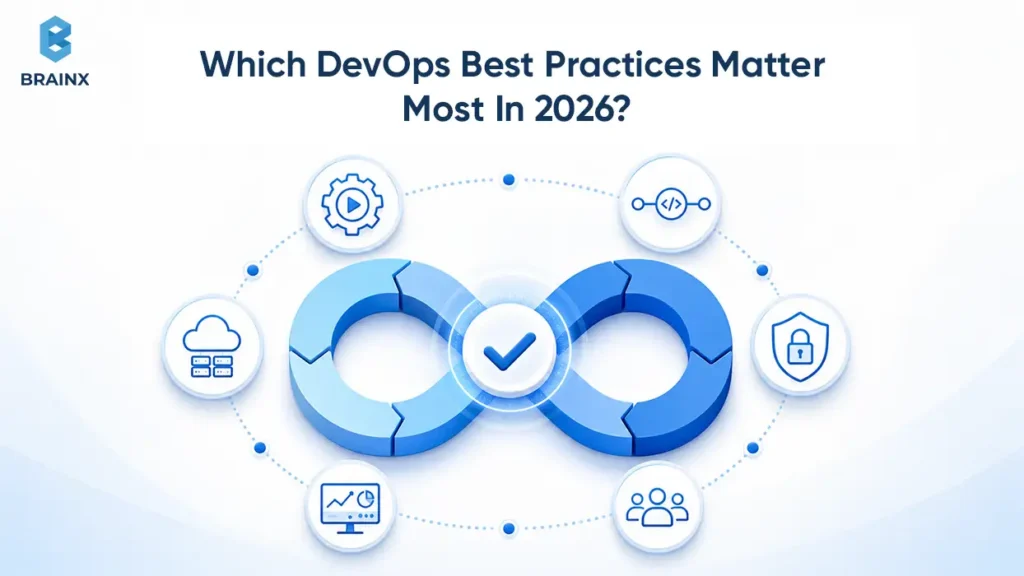
The highest-value DevOps practices in 2026 improve delivery speed without weakening security, reliability, governance, or cost control. CI/CD and Infrastructure as Code remain foundational, but mature teams also standardize security controls, provide self-service delivery paths, and connect production feedback directly to engineering decisions.
Continuous Integration and Small-Batch Development
Continuous integration works when developers merge small changes into the main branch frequently and receive automated feedback within minutes. Each commit should trigger a repeatable build and a focused set of reliable tests.
Small batches reduce merge conflicts, make reviews easier, and limit the number of possible causes when something breaks. Short-lived branches, branch protection, feature flags, and automated tests make frequent integration practical without allowing unreviewed changes into production.
Teams should treat a broken build as a priority. When failures remain unresolved, other developers continue building on an unstable foundation, increasing rework and slowing the entire delivery system. DORA associates daily integration, fast tests, and small changes with better software delivery performance and system stability.
Continuous Delivery and Controlled Deployment
Continuous delivery keeps software in a deployable state so teams can release a tested change safely whenever the business is ready. Continuous deployment goes further by automatically releasing every change that passes the required pipeline checks.
The distinction matters. A regulated product, mobile application, or high-risk enterprise system may benefit from continuous delivery without automatically deploying every passing change. The team can retain a business, compliance, or risk-based approval while keeping the technical release process automated and repeatable.
Where continuous deployment is appropriate, teams need strong automated testing, production verification, observability, and rollback controls. Higher-risk changes can use canary releases, blue/green deployments, progressive exposure, or feature flags instead of an immediate full rollout. DORA recommends beginning with continuous delivery even when continuous deployment is not the intended operating model.
Infrastructure as Code and Configuration Management
Infrastructure as Code manages cloud and on-premises resources through versioned configuration rather than undocumented manual changes. Infrastructure updates should move through pull requests, plan reviews, policy checks, controlled execution, and post-change verification.
Configuration management complements IaC by keeping operating systems, applications, packages, and environment settings aligned with an approved state. Together, these practices reduce configuration drift and make environments easier to recreate, review, and recover.
The objective is not simply to store infrastructure files in Git. Teams need reusable modules, protected state, least-privilege execution, documented exceptions, and a process for reconciling emergency changes back into code. HashiCorp’s standard Terraform workflow follows the same core pattern: define the change, review the execution plan, and apply it through a consistent process.
Automate Governance With DevSecOps and Policy as Code
Security and governance should run as part of the delivery workflow rather than appear as a manual gate immediately before release. Fast checks can identify exposed secrets, vulnerable dependencies, unsafe infrastructure settings, excessive permissions, or unapproved artifacts while the change is still easy to correct.
Policy as code turns repeatable organizational requirements into versioned automated checks. For example, a pipeline may block public storage, wildcard administrator permissions, unencrypted resources, missing ownership tags, or unsigned release artifacts.
Not every decision should be automated. Engineering, security, and compliance specialists should still review architectural intent, justified exceptions, and changes with significant business risk. Automation should handle repeatable rules so human reviewers can focus on decisions that require context. NIST recommends integrating software supply chain controls, including provenance and SBOM-related measures, directly into DevSecOps CI/CD pipelines.
Platform Engineering and Paved Roads
Platform engineering helps teams apply DevOps practices consistently by providing reusable, self-service delivery capabilities. A paved road may include a repository template, standard CI/CD workflow, approved infrastructure modules, identity controls, observability defaults, and deployment safeguards.
The platform should make the preferred path easier than creating an unofficial alternative. Developers should be able to create environments, deploy routine changes, and access operational information without submitting a ticket for every action.
Paved roads should remain adaptable. Product teams may have different architecture, compliance, availability, or data requirements. Platform teams should therefore treat developers as internal customers, measure adoption, collect feedback, and improve the platform as a product rather than enforcing a rigid toolchain.
Observability, SLOs, and Continuous Feedback
Monitoring identifies known conditions, while observability helps teams investigate unfamiliar behavior and understand why a system is failing. Applications should emit correlated logs, metrics, and traces so teams can connect customer impact with a specific service, deployment, or infrastructure change.
Production telemetry should feed back into delivery decisions. A deployment may pass every pre-release test but still increase latency, errors, resource use, or customer abandonment. Deployment markers, automated health checks, and progressive rollout signals help teams detect those problems before the change reaches every user.
Service-level indicators and objectives turn telemetry into reliability targets that reflect user experience. Alerts should focus on meaningful customer impact and error-budget consumption rather than every technical fluctuation. This creates a continuous feedback loop between development, deployment, operations, and product priorities.
How Do You Implement Practices of DevOps Without Disrupting Delivery?
The safest approach is to improve the delivery system in stages. Standardize the path before adding advanced controls. Add controls before expanding self-service. Measure each change before scaling it across the organization.
A Practical DevOps Maturity Model
| Maturity level | Typical condition | Priority practices | Evidence that the level is complete |
|---|---|---|---|
| Level 0: Fragmented | Manual deployments, snowflake environments, long-lived branches, and tribal knowledge | Put services and configuration under version control; establish ownership; create one traceable deployment path | Production changes are attributable, every service has an owner, and one documented release path works |
| Level 1: Standardized | Build automation exists, but repositories, pipelines, and environments vary by team | Standard repository rules, CI on every merge, test baseline, immutable artifacts, and environment conventions | Teams use a common pipeline skeleton and promote the same artifact through environments |
| Level 2: Controlled | Delivery is repeatable, but security, infrastructure governance, and operational readiness are uneven | Security scans, IaC review, policy checks, deployment verification, runbooks, and release dashboards | High-risk changes have automated evidence, production releases are verified, and rollback paths are tested |
| Level 3: Optimized | Teams ship through self-service paths and manage reliability as a product concern | Golden paths, platform APIs, SLOs, error budgets, drift detection, cost telemetry, and improvement loops | Teams can create, deploy, observe, and recover services without routine manual gatekeeping |
This model is a planning aid, not a certification framework. A large organization may have services at several levels. Measure maturity per application or value stream rather than assigning one score to the entire company.
What Should Teams Standardize First?
Start with repositories and CI, then deployment and environments, then expand observability and platform automation. That sequence creates dependable events for later controls and metrics.
- Repository rules: ownership, pull request expectations, branch protection, secret handling, and versioning.
- CI skeleton: build, quick tests, quality checks, security scans, artifact creation, and visible status.
- Deployment contract: environment promotion, configuration handling, verification, and rollback.
- Infrastructure path: code-based changes, plan review, policy checks, controlled apply, and drift monitoring.
- Operational baseline: logs, metrics, traces, service ownership, alert routing, and one first SLO.
- Platform capabilities: reusable templates, self-service workflows, golden paths, and feedback channels.
Starting with a full internal platform before these foundations are stable often codifies inconsistency instead of removing it.
A Focused 30/60/90-Day Rollout Plan
| Period | Main objective | Recommended actions | Expected outcome |
|---|---|---|---|
| Days 1–30 | Establish a baseline and one reference path | Measure current delivery; identify the largest constraint; standardize repository rules; create one reference CI pipeline; document service ownership | One service has a traceable, repeatable build and clear ownership |
| Days 31–60 | Add release safety and infrastructure controls | Improve automated tests; add secrets and dependency scanning; define promotion and rollback rules; move one infrastructure workflow behind pull requests; create one runbook and SLO | The reference service can deploy with automated evidence and recover through a documented path |
| Days 61–90 | Expand carefully and establish improvement loops | Move two or three more services to the path; add progressive delivery for higher-risk changes; instrument a critical user journey; review metrics; remove one low-value manual approval | The approach is reusable, measured, and ready for wider adoption without a big-bang migration |
What Does A Dependable CI/CD Pipeline Look Like?
A dependable CI/CD pipeline is fast enough to preserve flow, strict enough to protect production, and predictable enough that teams trust it. It creates an authoritative artifact, proves that the change meets defined checks, deploys through a controlled mechanism, and verifies the production result.
DORA's continuous integration guidance recommends that each commit trigger a build and automated tests that return feedback within minutes. It also identifies continuous integration as a priority for organizations beginning a continuous delivery journey.
A practical pipeline should include:
- Source control trigger and change metadata
- Reproducible build
- Unit tests and static quality checks
- Secrets, dependency, and code security scans
- Integration or contract tests where needed
- Versioned, immutable artifact creation
- SBOM and provenance generation for relevant systems
- Deployment to the target environment
- Smoke tests and health verification
- Progressive exposure or rollback controls
- Deployment marker in observability tools
- Post-deployment verification against customer-facing signals
A good CI/CD pipeline is fast, boring, and hard to misuse. “Boring” means routine releases do not depend on heroics. “Hard to misuse” means unsafe shortcuts are less convenient than the approved path.
Shift-Left Testing Without Creating a Slow Pipeline
Shift-left testing works when fast checks run early and expensive checks run selectively. Unit tests, linting, type checks, and focused security scans should provide quick feedback. Contract, integration, end-to-end, performance, and resilience tests should run according to risk and change scope.
A useful testing strategy has three properties:
- Trust: A failed test indicates a real problem, not chronic flakiness.
- Speed: Developers receive useful feedback while the change is still fresh.
- Coverage by risk: Critical business paths receive deeper validation than low-impact changes.
Do not treat the number of tests as the goal. Measure escaped defects, flaky test rate, test duration, and the percentage of failures that help teams catch issues before deployment.
Rolling, Canary, Blue/Green, and Feature-Flag Releases
No deployment strategy is universally best. Choose based on blast radius, architecture, state handling, observability, and recovery requirements.
| Strategy | Best suited to | Main advantage | Important limitation |
|---|---|---|---|
| Rolling deployment | Routine stateless service updates | Replaces instances gradually while maintaining availability; commonly supported by platforms such as Kubernetes | Mixed versions may run temporarily, so compatibility matters |
| Canary deployment | Higher-risk changes with measurable production signals | Limits initial exposure and supports evidence-based expansion | Requires reliable segmentation, telemetry, and automated rollback criteria |
| Blue/green deployment | Clean environment cutovers and rapid traffic reversal | Keeps the previous environment available during validation and cutover | Stateful systems and database changes can complicate synchronization and rollback |
| Feature flags | Separating code deployment from customer release | Enables narrow exposure, experiments, and emergency disabling | Old flags create configuration debt unless ownership and removal dates are enforced |
OpenFeature provides a vendor-neutral specification for feature flagging. Standards can reduce application coupling to a particular flag provider, but they do not replace flag governance. Every temporary flag should have an owner, purpose, exposure rule, and deletion condition.
If a team cannot remove flags safely, it does not have a release control system. It has configuration debt.
How Should Teams Use Infrastructure as Code Without Drift Or Outages?
Infrastructure as Code is safest when infrastructure changes follow the same discipline as application code. That means version control, review, automated validation, controlled execution, and continuous comparison between declared and actual state.
The common failure is partial adoption. A team manages most resources through code but still makes urgent production changes through cloud consoles. The next automated apply may overwrite that manual change or produce an unexpected conflict. At that point, the repository is no longer a reliable description of production.
A strong infrastructure pull request should answer:
- What business or operational change is being made?
- Which services, environments, identities, and network paths are affected?
- Has the proposed plan been generated and reviewed?
- Did policy and security checks pass?
- Are ownership, environment, and cost-allocation tags present?
- Is least privilege preserved?
- How will the result be verified?
- What is the rollback or forward-fix path?
- Was existing drift assessed before the change?
Manual break-glass changes may still be necessary during incidents. They should be time-bound, recorded, reviewed, and reconciled back into code immediately after the emergency.
When GitOps Helps
GitOps is useful when systems have a declarative desired state and an automated reconciler can compare that state with reality. The OpenGitOps principles emphasize declarative configuration, versioned and immutable desired state, automatic pulling, and continuous reconciliation.
This model works particularly well for Kubernetes workloads, application configuration, and platform components. It is less straightforward for one-time data migrations, imperative cloud operations, or legacy infrastructure that is not yet codified. GitOps should not be used to disguise incomplete Infrastructure as Code coverage.
Use Policy-as-Code for Repeatable Guardrails
Policy-as-code translates governance rules into checks that run consistently. The Open Policy Agent is one option for applying policies across CI/CD, Kubernetes, APIs, and infrastructure workflows.
Useful policies include:
- no public storage unless explicitly approved
- no wildcard administrative permissions
- mandatory ownership and cost tags
- approved regions and resource types
- encrypted storage and transport
- signed images or verified provenance
- required health checks and resource limits
Automation should enforce clear rules. Human reviewers should focus on intent, architecture, exceptions, and business context.
Security in Modern DevOps: DevSecOps Best Practices
The best DevSecOps model is a minimum viable set of security controls embedded in normal delivery. Security should produce fast, repeatable evidence rather than appear as a separate gate just before release.
The OWASP CI/CD Security Cheat Sheet highlights the value and risk concentrated in build and deployment systems. Pipelines often hold broad access to source code, artifacts, cloud environments, and credentials. Compromise can therefore affect the entire software supply chain.
A prioritized DevSecOps baseline includes:
- secrets scanning in repositories and pipelines
- dependency and container image scanning
- least-privilege CI identities
- short-lived credentials or workload identity where possible
- separation between development, staging, and production
- branch protection and mandatory review
- Infrastructure as Code policy checks
- SBOM generation for relevant release artifacts
- artifact signing and provenance
- traceability from commit to deployed version
- defined remediation expectations based on severity and exploitability
The NIST Secure Software Development Framework provides a broad framework for integrating secure development practices. SLSA focuses more specifically on software supply chain integrity and provenance.
Secrets Management and Least Privilege
Long-lived credentials should not be stored in repositories, pipeline configuration, build logs, or developer scripts. Use a managed secret store, narrowly scoped service identities, credential rotation, and short-lived access where supported.
Least privilege should apply to the pipeline itself. A build job that only reads dependencies should not have permission to deploy production infrastructure. A staging deployment identity should not control production. Separate responsibilities by job, environment, and service.
SBOMs, Signing, and Provenance
An SBOM records the components included in an artifact. Signing and provenance help teams verify where the artifact came from and whether the expected build process produced it.
A practical entry point is to:
- Generate an SBOM during the build.
- Run dependency and policy checks.
- Sign the approved artifact.
- Store provenance with the release record.
- Verify the artifact before deployment.
These controls are most useful when the team already has dependable continuous integration. Supply chain tooling cannot compensate for an unreproducible build or uncontrolled release path.
How Do Observability, Incident Response, And SLOs Improve Reliability?
Reliability improves when teams can measure customer impact, diagnose unfamiliar failures, and respond through known procedures. Monitoring detects known conditions. Observability helps teams investigate what they did not anticipate.
The OpenTelemetry observability primer describes observability as the ability to understand a system's internal state from its outputs. Logs, metrics, and traces are central signals, but they become useful only when they share consistent context.
A lean production baseline should include:
- structured logs with request and correlation identifiers
- request rate, error rate, and duration metrics
- distributed traces for critical user journeys
- deployment markers and application version metadata
- infrastructure saturation measures such as CPU, memory, queue depth, and disk
- service ownership and alert routing
- dashboards organized around customer-impacting workflows
Set SLOs That Reflect User Experience
A service-level objective defines the acceptable level of service provided within a time period. It should be based on what users care about, not the things easiest to measure.
Examples for a public API could include:
- Availability: 99.9% of eligible requests succeed over 30 days.
- Latency: 95% of eligible requests complete within 300 milliseconds over seven days.
- Background-job freshness: 99% of jobs complete within 10 minutes over 30 days.
Google Cloud's SLO monitoring guidance explains how service-level indicators, objectives, compliance periods, and error budgets work together. Generally, a 100% target is not helpful as it leaves no error budget and may lead to over investing in running the business.
An error budget turns reliability into a decision mechanism. When the budget is healthy, teams can continue normal change activity. When it is being consumed too quickly, they can reduce exposure, pause high-risk releases, or prioritize reliability work.
Build Incident Response That Does Not Depend on Heroes
A practical incident runbook should include:
- Alert source and trigger condition
- Service owner and escalation path
- Definition of customer impact
- Immediate containment actions
- Rollback, failover, or feature-disable options
- Links to dashboards, logs, and queries
- Internal and customer communication templates
- Recovery verification steps
- Post-incident review owner and due date
If every severe incident begins with “Who knows this system best?”, the organization does not have a dependable incident response process. It has dependency risk.
Postmortems should focus on system improvement. Avoid reducing an incident to a person's final action. Ask which conditions allowed the action to create customer impact, why detection or containment took time, and what change will reduce recurrence.
Real-World Lesson: Configuration Changes Are Production Changes
Cloudflare's official November 18, 2025 outage postmortem shows why configuration pipelines need the same controls as application releases. A change in database permissions and query behavior produced duplicate rows in a generated feature file. The oversized file then spread across the network and caused the systems that consumed it to fail.
The lesson is broader than one incident. Generated configuration should be schema-checked, size-limited, tested against realistic inputs, rolled out progressively where possible, and protected by a fast kill switch. A configuration artifact can have the same blast radius as executable code.
How Should Teams Measure DevOps Success?
Measure DevOps as a chain from practices to engineering outcomes to business outcomes. Deployment activity alone does not show whether delivery is improving. Teams need balanced measures of throughput, instability, reliability, security, developer friction, and cost.
DORA's software delivery metrics guide, updated in January 2026, defines five current measures:
- Change lead time: How long a change takes to move from commit to production.
- Deployment frequency: How often the application or service is deployed successfully.
- Failed deployment recovery time: How long it takes to recover from a failed deployment.
- Change fail rate: The percentage of deployments that cause a failure requiring remediation.
- Deployment rework rate: The proportion of deployments that involve unplanned work to fix a production issue.
Change lead time, deployment frequency, and failed deployment recovery time measure throughput. Change fail rate and deployment rework rate measure instability. DORA recommends applying these metrics to a specific application or service, establishing its baseline, and tracking improvement over time rather than comparing systems with different risk profiles or delivery contexts.
Dave Farley summarizes the false speed-versus-quality debate as a choice between “better software faster and worse software slower.” The point is not to maximize deployment frequency at any cost. It is to improve the delivery system so speed and stability rise together.
Connect Engineering Metrics to Business Signals
| Practice area | Engineering measures | Business signal |
|---|---|---|
| Small-batch CI/CD | Lead time, deployment frequency, rollback rate, pipeline duration | Faster feature delivery and lower launch risk |
| Automated testing | Flaky test rate, build success rate, escaped defects | Less rework and fewer customer-visible defects |
| Infrastructure governance | Drift events, infrastructure change failure rate, policy failures | Lower outage risk and stronger auditability |
| DevSecOps | Critical vulnerability age, signed artifact coverage, credential exposure events | Reduced security exposure and stronger customer confidence |
| Reliability engineering | SLO attainment, error-budget burn, failed deployment recovery time, incident recurrence | Better service performance and fewer customer-impacting interruptions |
| Cost-aware operations | Cost per service or transaction, idle spend, anomaly frequency | Better margins and more predictable cloud investment |
Use Leading Indicators to Steer Improvement
DORA metrics show the outcome of the delivery system. Leading indicators reveal problems earlier. Useful measures include:
- pipeline duration by stage
- pull request wait time and review size
- flaky test rate
- percentage of changes using the standard deployment path
- rollback readiness and verification time
- unplanned operational toil
- alert noise and repeated incident causes
- infrastructure drift age
- security finding age by severity
Do not turn these measures into individual performance targets. Teams may game a deployment-frequency goal by splitting work unnaturally or avoid reporting failures to protect a change-fail-rate target. Use metrics for learning, constraint identification, and system improvement.
What Emerging Trends Are Shaping Modern DevOps in 2026?
Modern DevOps is expanding beyond pipeline automation and cloud infrastructure. Teams are applying AI across the software lifecycle, adapting internal platforms for AI and hybrid workloads, integrating cloud-cost data into engineering decisions, and adopting open standards that make delivery systems more portable and governable.
These trends do not replace CI/CD, Infrastructure as Code, observability, or DevSecOps. They build on those foundations and expose weaknesses when delivery processes, ownership, or controls are immature.
AI-Augmented DevOps and Agentic Operations
AI-augmented DevOps is expanding beyond coding assistance into AIOps and agentic operations across testing, delivery, incident response, security remediation, and infrastructure management. Agentic workflows can analyze context, use approved tools, complete multiple steps, and recommend actions within defined boundaries.
Potential applications include:
- Generating and maintaining tests
- Summarizing deployment risks
- Investigating failed builds and releases
- Correlating logs, metrics, traces, and recent changes
- Recommending runbook actions during incidents
- Identifying infrastructure and cost anomalies
- Automating repetitive repository and pipeline tasks
This trend increases the need for control rather than reducing it. AI agents should receive only the permissions required for their tasks, operate in isolated environments where practical, and maintain an auditable record of their actions. Production changes, security exceptions, destructive operations, and other consequential decisions should continue to require appropriate human approval.
The 2025 DORA report on AI-assisted software development describes AI as an amplifier of an organization’s existing strengths and weaknesses. Teams with strong delivery systems can gain more value, while organizations with weak testing, feedback, or governance may amplify instability instead.
Platform Engineering for Hybrid and AI Workloads
Internal developer platforms are evolving from application-delivery portals into broader engineering environments. Alongside repository templates, CI/CD workflows, infrastructure modules, and observability defaults, platforms increasingly need to support data pipelines, model deployment, GPU access, AI agents, and hybrid infrastructure.
A modern platform may provide:
- Self-service application and AI environments
- Approved cloud and Kubernetes deployment patterns
- Reusable infrastructure and security controls
- GPU and accelerator provisioning
- Model, data, and application delivery workflows
- Cost, ownership, and operational metadata
- Standard monitoring and incident-management integrations
The platform should remove repetitive configuration without hiding every technical decision. Product teams still need flexibility for different workloads, availability targets, security requirements, and regulatory obligations.
According to the CNCF State of Cloud Native Development Q1 2026 report, 88% of backend developers now work with at least one form of infrastructure standardization. The report also highlights the growing influence of platform engineering, hybrid cloud, and cloud-native infrastructure for AI workloads.
For teams deploying machine learning systems, the same platform layer increasingly supports MLOps practices such as reproducible training pipelines, model versioning, evaluation gates, controlled deployment, and production monitoring. This helps organizations manage applications, data, and models through a more consistent delivery environment.
FinOps Moving Into Engineering Workflows
FinOps is shifting from retrospective cloud-cost reporting toward continuous technology-value management. Engineering and platform teams increasingly need cost information while designing systems, reviewing infrastructure changes, and selecting deployment options, not only after the monthly bill arrives.
This may include:
- Estimated cost changes in Infrastructure as Code reviews
- Budget and usage limits for development environments
- Cost anomalies linked to recent deployments
- Cloud spending allocated by service, team, or product
- Unit-cost metrics tied to customers or transactions
- GPU and AI-model usage connected to business value
- Architecture reviews that consider cost, reliability, and performance together
The goal is not to make developers responsible for every financial decision. It is to give engineering teams timely visibility into the financial consequences of technical choices.
The 2026 State of FinOps report found that 78% of FinOps practices now report through CTO or CIO organizations. This reflects the movement of cost accountability closer to architecture, engineering, platform management, and technology selection.
Open Standards and Continuous Compliance
Modern delivery environments often combine multiple vendors for source control, CI/CD, cloud infrastructure, observability, feature management, security, and deployment. Open standards help teams maintain consistent operating practices when tools or providers change.
Examples include:
- OpenTelemetry for vendor-neutral collection and export of traces, metrics, and logs
- OpenFeature for a vendor-agnostic feature-flagging API
- OpenGitOps for a vendor-neutral, principle-led definition of GitOps
- Open Policy Agent for policy decisions across CI/CD pipelines, Kubernetes, APIs, and application infrastructure
These standards reduce the amount of vendor-specific instrumentation and workflow logic embedded in applications. They can also make it easier to change providers, combine tools, and apply governance consistently across delivery environments.
Continuous compliance builds on the same principle. Instead of collecting evidence only before an audit or production release, teams can generate it throughout the delivery lifecycle. Pipelines can retain policy results, infrastructure plans, test evidence, artifact provenance, deployment approvals, access records, and change histories.
Automation should enforce repeatable requirements and surface exceptions. Human reviewers should remain responsible for interpreting unusual cases, approving justified deviations, and evaluating risks that cannot be reduced to a fixed rule. For example, Open Policy Agent’s CI/CD guidance shows how policy-as-code controls can validate repository rules, deployment configurations, and Infrastructure as Code before changes proceed.
What DevOps Mistakes Should Teams Avoid?
The majority of DevOps programs are less effective because they focus primarily on optimizing the toolchain, with no attention paid to how handoffs, incentives, or ownership should be changed.
DevOps as a Separate Team
A platform or enablement team can provide shared capabilities, but product teams must still own release quality, service reliability, and operational feedback. When “the DevOps team” becomes the only group allowed to deploy, the organization recreates the development-to-operations handoff under a new name.
Ticket-Driven Operations
A self-service portal that produces a ticket is not self-service. Standard environment creation, secrets updates, deployments and infrastructure changes should be automated through APIs, templates or approved automation. Human intervention should only take place in exceptional cases and when decisions are likely to be high risk.
CI That Returns Feedback Too Late
A pipeline can be automated without providing continuous integration. When quick feedback takes 40 minutes, developers batch changes, delay merges, and work around checks. Separate fast commit-stage validation from longer test suites, run work in parallel, and investigate flaky or redundant tests.
A Platform Built Before Understanding Users
An internal platform can fail like an external product. Building it without developer research often creates abstractions that do not match real workflows. Start with one or two high-friction journeys, provide a useful paved road, measure adoption, and improve from feedback.
Ignoring Architectural Constraints
The practices remain consistent, but implementation differs by architecture:
- Microservices need shared pipeline standards, service-level ownership, contract testing, independent rollout controls, and cross-service telemetry.
- Monoliths often need selective test execution, safe database migrations, build optimization, and feature flags to reduce release coupling.
- Monorepos need clear ownership, dependency-aware build graphs, and tests that run only where changes create risk.
- Regulated systems need stronger evidence, separation of duties, traceability, and controlled exceptions. Automation usually improves that evidence.
- Multi-cloud environments need consistent identity, tagging, policy, monitoring vocabulary, and cost allocation. Do not adopt more than one cloud without clear resilience, regulatory, or product reason.
How Do You Get Started With DevOps Practices?
Start with a current-state assessment tied to a business problem. Do not begin with a broad list of tools. Identify where delivery waits, where releases fail, which systems are difficult to recover, and which controls create repeated audit or security issues.
Assess four dimensions:
| Dimension | Questions to ask |
|---|---|
| People | Who owns release quality, reliability, security, and cost? Does on-call ownership match service ownership? |
| Process | How does a normal change reach production? Where does it wait? Which approvals reduce risk, and which only record it? |
| Platform | Are repositories, pipelines, environments, infrastructure, and telemetry reusable and consistent? |
| Product | Which customer journeys matter most? What reliability and performance levels are acceptable? |
A minimum viable baseline for many teams is:
- one repository template
- one CI pipeline skeleton
- one approved deployment pattern per service type
- one secrets and identity strategy
- one Infrastructure as Code review path
- one SLO for a customer-facing service
- one incident runbook
- one dashboard connecting deployments with errors and latency
A DevOps Best Practices Checklist
Use this checklist to identify gaps in your current software delivery system. It is not necessary to complete every item before improving delivery. Start with the unchecked items that create the greatest delays, release failures, security exposure, or operational risk.
Team Ownership and Collaboration
- Every application or service has a clearly identified owner.
- Development teams share responsibility for release quality and production reliability.
- On-call and escalation responsibilities match service ownership.
- Development, operations, security, quality assurance, and product teams have clear communication channels.
- Runbooks and operational knowledge are documented rather than held by a small number of individuals.
- Teams review incidents and delivery problems without assigning personal blame.
Version Control and Continuous Integration
- Application code, infrastructure definitions, configuration, and pipeline files are stored in version control.
- Developers integrate small changes frequently instead of maintaining long-lived branches.
- Pull requests follow defined review and ownership requirements.
- Branch protection prevents unauthorized or unverified changes from reaching the main branch.
- Every commit triggers a repeatable build and a focused set of automated tests.
- CI feedback arrives quickly enough for developers to act while the change is still fresh.
- Broken builds and flaky tests are treated as delivery problems rather than accepted as normal.
Automated Testing and Release Safety
- The testing strategy reflects the risk and scope of each change.
- Unit, integration, contract, security, and end-to-end tests run at appropriate pipeline stages.
- Build artifacts are immutable, versioned, and traceable to their source commits.
- The same approved artifact moves through testing, staging, and production.
- Every production deployment includes health checks and post-deployment verification.
- Teams have documented rollback, forward-fix, or feature-disable procedures.
- Higher-risk releases use canary deployment, blue/green deployment, progressive exposure, or feature flags where appropriate.
- Temporary feature flags have owners and planned removal dates.
Infrastructure and Configuration Management
- Infrastructure changes are defined and reviewed as code.
- Infrastructure pull requests include execution plans, affected environments, expected impact, and verification steps.
- Reusable modules and approved patterns are used for common infrastructure.
- Infrastructure state and deployment credentials are protected with appropriate access controls.
- Policy checks identify unsafe permissions, public resources, missing tags, encryption gaps, and other prohibited configurations.
- Manual production changes are limited to documented break-glass situations.
- Emergency changes are reconciled back into code after the incident.
- Drift between the declared configuration and the actual environment is detected and investigated.
DevSecOps and Software Supply Chain Security
- Repositories and pipelines scan for exposed secrets.
- Dependencies and container images are checked for relevant vulnerabilities.
- CI/CD identities follow least-privilege principles.
- Development, staging, and production use separate credentials and access boundaries.
- Short-lived credentials or workload identities are used where supported.
- Relevant release artifacts include a Software Bill of Materials.
- Approved artifacts are signed and accompanied by verifiable build provenance.
- Teams can trace a production release back to its source commit, build, tests, approvals, and artifact.
- Security findings have remediation expectations based on severity, exploitability, and business risk.
These controls align with NIST’s outcome-based secure-development practices and OWASP’s focus on CI/CD identity, credential hygiene, dependency risks, artifact integrity, and pipeline visibility.
Observability and Reliability
- Applications produce structured logs, meaningful metrics, and traces for critical user journeys.
- Telemetry includes service ownership, environment, application version, and deployment information.
- Production dashboards focus on customer-impacting workflows rather than infrastructure data alone.
- Deployment markers make it possible to connect production changes with changes in latency, errors, or resource use.
- Customer-facing services have meaningful service-level indicators and objectives.
- Error budgets inform release and reliability decisions.
- Alerts identify actionable customer impact and route to the correct owner.
- Incident runbooks include containment, rollback, communication, and recovery-verification steps.
- Post-incident reviews produce owned and prioritized improvement actions.
Measurement and Continuous Improvement
- Teams measure the current DORA software delivery metrics for individual applications or services.
- Delivery metrics are reviewed alongside reliability, security, developer experience, and cloud-cost signals.
- Teams monitor leading indicators such as pipeline duration, review wait time, flaky tests, infrastructure drift, and operational toil.
- Metrics are used to improve the delivery system rather than evaluate individual developers.
- The largest delivery constraint is identified and addressed before launching multiple transformation initiatives.
- Low-value manual approvals and repeated handoffs are reviewed regularly.
- Platform capabilities are evaluated through adoption, developer feedback, and delivery outcomes.
- Teams review progress regularly and select the next improvement based on evidence.
Unchecked items should be converted into prioritized backlog tasks. Start with one service or value stream, assign an owner to each improvement, define the expected outcome, and measure whether the change improves delivery before expanding it across the organization.
How BrainX Helps Teams Improve DevOps Practices
BrainX helps organizations improve delivery without replacing one dependency chain with another. Its DevOps services include infrastructure assessment, CI/CD, cloud-native delivery, automation, monitoring, security and continuous optimization.
A practical engagement may include:
- Discovery and baseline: delivery mapping, risk identification, architecture review, and initial metrics.
- Implementation: pipeline templates, release standards, Infrastructure as Code workflows, security checks, and deployment verification.
- Enablement: documentation, golden paths, workshops, runbooks, and SLO definition.
- Optimization: reliability reviews, pipeline improvements, platform feedback, cloud cost visibility, and the next prioritized constraints.
BrainX can support new digital products as well as existing systems that need safer delivery. For teams modernizing a larger application estate, its custom web application development services can be combined with DevOps implementation across architecture, quality, deployment, and operations.
The strongest engagement begins with a defined service or value stream, measurable constraints, and clear ownership. It should not promise a universal transformation timeline or force every team into one toolchain. The output should be a delivery system the internal team can understand, operate, and improve.
Fix the delivery system, not only the symptoms
DevOps practices are effective when they become the way teams deliver software always. The goal is not more YAML, more dashboards, or more tools. It is shorter feedback, safer change, clearer ownership, and faster recovery.
Start with one service. Make its path to production traceable, repeatable, secure, observable, and reversible. Measure the result. Then expand the pattern where it provides value.
FAQs about Best Practices of DevOps
What are DevOps practices?
DevOps practices are repeatable engineering and operational behaviors that help teams build, test, release, secure, and run software together. They include continuous integration, automated testing, CI/CD, Infrastructure as Code, observability, incident response, security automation, and continuous improvement.
Which DevOps best practices should a team implement first?
Start with version control standards, service ownership, continuous integration, fast automated tests, immutable artifacts, and one safe deployment path. Add security scanning, Infrastructure as Code controls, deployment verification, and one customer-focused SLO after the foundation works.
How can teams implement DevSecOps without slowing development?
Automate the highest-value controls inside the existing workflow. Secrets scanning, dependency checks, least-privilege identities, Infrastructure as Code policies, SBOM generation, and artifact signing should run predictably and return useful feedback early. Reserve manual security review for high-risk changes and justified exceptions.
What metrics should teams use to measure DevOps success?
Use the five current DORA metrics for delivery throughput and instability: change lead time, deployment frequency, failed deployment recovery time, change fail rate, and deployment rework rate. Add SLO attainment, error-budget burn, flaky tests, pipeline duration, toil, security finding age, and cost signals for a fuller view.
What is the best CI/CD approach for microservices and monoliths?
Both architectures need small changes, fast tests, immutable artifacts, controlled deployment, verification, and rollback. Microservices need stronger service-level ownership, contract testing, and cross-service telemetry. Monoliths often require selective testing, safe database migration patterns, and feature flags to reduce release coupling.
How long does DevOps adoption take?
A focused team can establish a dependable baseline for one service within approximately 90 days. Wider adoption across multiple products, infrastructure domains, and teams usually requires sustained iteration. The timeline depends on architecture, existing automation, compliance needs, ownership, and the number of delivery paths being standardized.